Showing posts with label ACA. Show all posts
Friday, June 12, 2015
Always More to Learn
The learning never stops. A few years ago, when I worked toward earning my ACA Level 3 instructor certification, I claimed to have no interest in progressing to the highest level. The prospect of coaching people in the bigger, more potentially hazardous conditions just didn’t have its appeal. But as I progressed into those environments, it helped to have the occasional guidance from upper-level coaches. As I became more comfortable getting out in rougher spots and moved-on to L4 certification, I naturally started finding myself in those spots with less-experienced paddlers, attempting to pass-on the same kind of coaching that had helped me.
This week I went to an L5 instructor development workshop (IDW) to get pointed in the right direction. We met at AMC’s Knubble Bay cabin, which became our base, and spent the next three days paddling in the area: Five Islands, Reid State Park and the mouth of the Kennebec River. These locations translate to distinctly different environments: rocks & ledges, surf and tidal currents. Each day we had conditions at or beyond the level 5 remit: 3-5-foot seas, 15-25 knots of wind, 3-4-foot surf break and 4-5 knots of current. Beyond that, the water felt cold- still in the high 40s.
But it’s not all about conditions. A big part of L5 has more to do with being able to simultaneously accommodate students at different levels, with different needs. First you need to be able to assess a paddler- see what is working well for them and what isn’t. Then you need to be able to guide them through different activities to help them learn and discover. There’s no set way of doing things. The process will change according to the student and the environment, so the coach needs to be able to put things together on the fly.
Often, in instructor development sessions, we might need to pretend that we’re at a lower level to be students for our peers, but at L5, we just coach each other. It’s tougher, since we’re often looking at skills we’re trying to improve for ourselves, but for that reason it’s also very valuable. And you never get it all. You may focus on improving one aspect of your performance, but then you need to return to some other habit or skill that falls to the wayside.
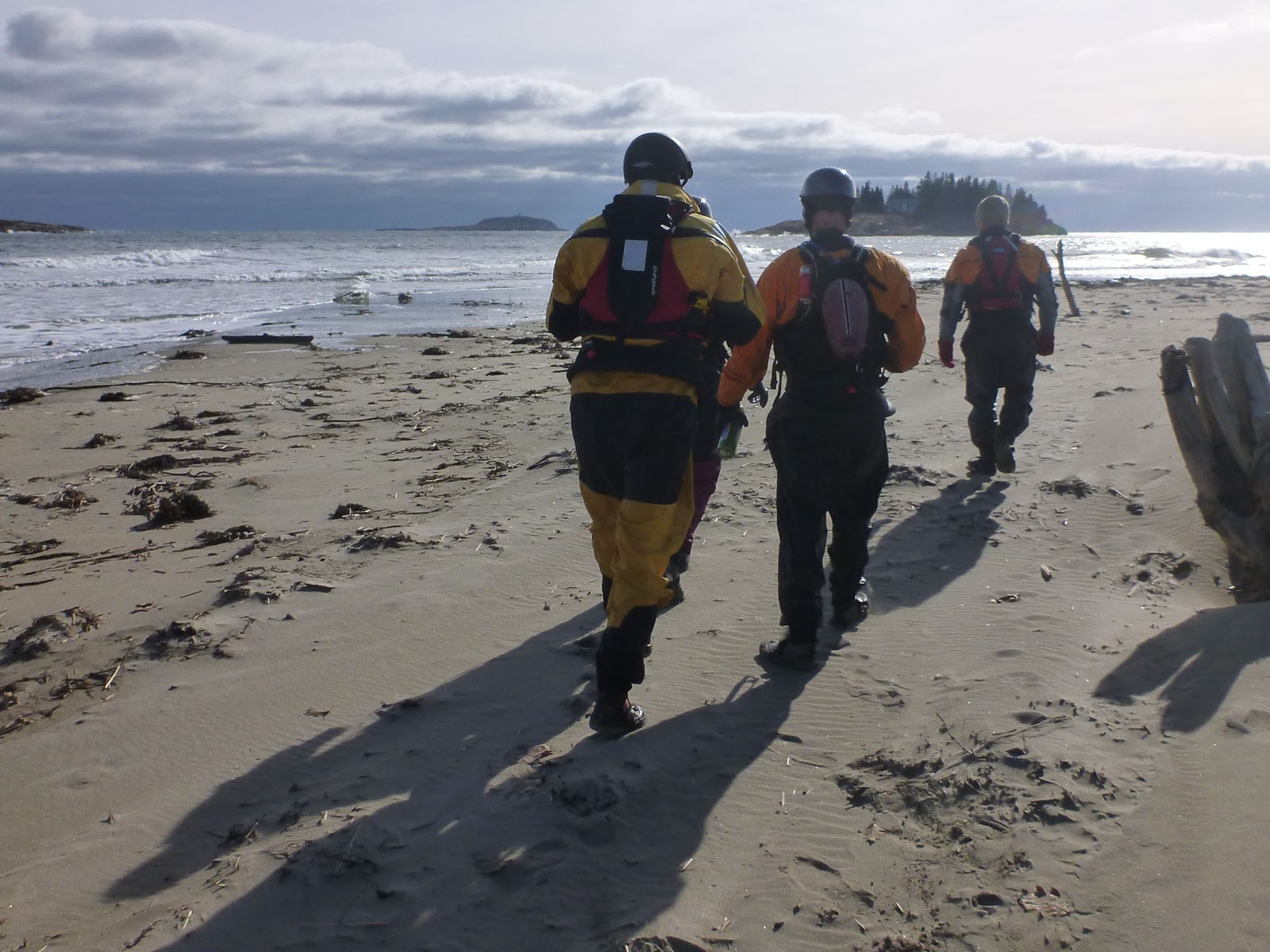
I don’t take action photos at these events anymore, especially when I’m an instructor candidate, so the photos I have are off-water snapshots, but I like the way these photos, over time, have the feel of a family album, bringing together people we run into at these events and paddle with from time to time. I left with an action plan, the crux of which involves spending more time in these L5 environments with students and peers, working on observational skills and translating that to activities.
Despite the bracingly chilly water, it felt great to be paddling in Maine again. I was glad I’d spent plenty of time in the Florida surf this spring, where the water is now about thirty degrees warmer, but aside from awesome paddling, the Maine coast provides us with far more challenging environments than we’ll find most other places, and you need to keep paddling in challenging places if you want to keep your skills sharp.
We’ll be transient for a couple more weeks before we settle-in at Old Quarry for the summer.
Sunday, November 18, 2012
Practice Students
Nate and I were headed south on Route One well before sunrise. A couple of hours later we pulled off at a gas station, puzzling over the map when a car with a familiar kayak on its roof passed by; "There goes Ed." We followed him to the AMC cabin on Knubble Bay, where we met the others- a dozen of us in all. We were there as practice students for several candidates assessing as ACA Level 5 instructors. For the next two days, we would be their guinea pigs.
Sometimes, practice students are referred to as teabags, since getting dipped repeatedly into the ocean is usually part of the drill, but I'm told that various other connotations have brought this term out of favor. Practice students are needed for ACA assessments, and if possible, you want to get real students- not someone just pretending that they've never heard of torso rotation. We've had practice students for Instructor Development Workshops, and I had them for my L3 Instructor assessment. Some were great; others were challenging in the way that any student can bring along their own hurdles. The challenges usually involve ego... not accepting that you might have something to learn from the instructor candidates.
Why be a practice student? The short answer is free instruction. The long answer...
At the AMC cabin, we separated into two groups. Our instructors, Mark and Danny introduced themselves and we got some sense of how the day would go. I'd paddled with both of the other students, Ed and Jenna. Todd Wright would be the assessor that day and would switch with Josh Hall (recipient of the ACA 2012 Excellence in Instruction Award) for Day 2. In a way, I think we all just wanted to get onto the water. Until then, we would be sussing each other out, wondering how skilled the others were, how we would fit in- or if we would be wet, cold and out of our element for the next two days. If I were an L5 candidate, I'd worry that the students are either too skilled and I'd have nothing to teach them, or that they're not proficient enough. Either way, you try to figure out what your students need to learn and how you'll make that happen.
We spent the first day in the mouth of the Kennebec River, practicing in the surf on Popham Beach and in the current out toward the middle. For Level 5 students, the day might involve more coaching than lessons, our instructors observing and getting us to understand how we might paddle better. If you count the assessor, the instructor to student ratio was 1 to 1: not bad.
The next day, we launched in Knubble Bay and used the current around Goose Rocks and Lower Hell Gate. I'd hoped for some rock gardening out at the Thread of Life or Damariscove Island, but conditions looked a bit small. So, while you can't always count on swell and wind, tidal current is fairly dependable, and it's tough to teach L5 skills in L2 conditions. We didn't have a lot of current, but in a way, the mild flow is almost better for coaching.
In addition to working on our personal skills, we watched the candidates to get ideas for our own styles of instruction. Whether it's a warm-up exercise or the subtly different ways we try get concepts across, getting exposure to other teachers is priceless- one of the best ways we can develop our own teaching skills.
And then there's the "just soaking it in" factor. After our first day, we all sat around a long table in the AMC cabin, trading stories, having a laugh or two. I mostly listened, impressed by the camaraderie among paddlers who have been at this for awhile, who, among a revolving cast of characters, show up at these paddling events, whether they're on the East Coast, West Coast, Scotland or Wales, and share their love of the sport. It's not something they're doing to get rich, and it isn't an easy lifestyle, but paddling has obviously pointed the way.
So I soaked it in. I had a good two days. Nate had a good two days. Pleasantly exhausted, we had a lot to talk about during the drive home. We felt fortunate and grateful for a lot of things: that we've had good teachers along the way, that we've found peers to share it with- including our wives who paddle their own boats and make it possible for us to go off on some of these trips.
Labels:
ACA,
instruction,
Kennebec River,
Knubble Bay,
L5,
Lower Hells Gate,
Muscongus to Casco Bay,
Popham Beach
Location:
199 Jewett Rd, Georgetown, ME 04548, USA
Wednesday, May 9, 2012
Guides Guiding Guides
For the last few weeks, much of our paddling was aimed at getting ready for last weekend’s three-day class. You could even say that the last few months of Sunday mornings at the pool at the Ellsworth Y were practice and reinforcement. Most evenings last week Rebecca and I watched our instructional DVDs, pausing every now and then to make sure we understood (and sometimes to wake up). So, in the same way that planning for a trip is part of the fun, so is getting ready for a class. Suddenly it became an emergency to get a new short tow figured-out so we could try it in class.


We met Friday morning at Old Quarry. Nine students, all of us registered Maine Guides were there for the first ever MASKGI-sponsored, ACA L4 Open Water Trip Leader training program. I’ll spare you my diatribe about the exam process for Maine Sea Kayak Guides and how it is entirely possible get your license with little or no on-the-water experience -provided you can talk the talk. It’s great to talk the talk (that’s how you pass the exam) but this program is aimed at getting guides to walk the walk.
It isn’t always easy for experienced guides to be open to learning something new. I’m hardly experienced, but it helps to have some faith in your teachers, to accept that they know their stuff. I’ve had a few classes with Todd Wright and John Carmody, and they are certainly on top of their game. John is one of the few BCU Level 5 Sea Coaches in North America, while Todd holds the highest ACA awards and is fast on his way to being one of the next BCU Level 5 Sea Coaches. This translates to getting spot-on critique and suggestions. If I received just a few such nuggets over the weekend, my efforts would be well-spent.
We chose different locations each day, progressing from a milder excursion to Millet on Friday, to some rocks out around Ram and Hardwood on Saturday. On Sunday we drove over to Bagaduce Falls. It was a good progression. By the time we tried various tows and rescues in the current on Sunday, we’d already practiced in easier conditions, gradually increasing the complicating factors. Of course, we worked constantly on personal boat maneuvering skills.
We’ll have an assessment in the fall- a good goal. In the meantime, we all have points to work-on and improve- both while we’re guiding and on our own. Rebecca and I got out for a mid-day paddle yesterday just as the storm arrived. On one level, it felt good to decompress, to get out and just paddle. But after awhile, we started working on what we’d learned. Once again, I’m tweaking my forward stroke- I don’t expect this will ever end. And when I’d gone into a rocky chasm (trying to avoid that bow rudder until I really needed it) Rebecca came charging-in to contact-tow me out... just for fun.
And in the end, that’s what it amounts to: fun. The first classes I took might not have been as fun- it felt like harder work then, and I learned that I had far to go. I didn’t get it all (still haven’t) in one go- I seem to require layers of instruction that overlap, spaced with plenty of time to try it all out on my own and see how it works. The pay-off is also multi-layered: confidence coupled with a perspective of where my abilities need work. But yesterday I saw a black and white change from just last week: Rebecca maneuvered into that narrow space between the rocks, and I followed her.
Labels:
ACA,
Bagaduce Falls,
Guiding,
instruction,
John Carmody,
MASKGI,
Rocks and Ledges,
Todd Wright
Tuesday, November 8, 2011
Westport, Massachusetts
About half-way between Fall River and New Bedford, Massachusetts, a few miles south of the Interstate and Route 6, the Westport River winds about eight miles inland until it narrows to not much more than the length of a kayak. Beside it is a small, weathered-shingle building, flanked by racks of kayaks. Early on Saturday morning, Nate and I went in and met Todd Wright, who had taught our Instructor Development Workshop in June, and Carl Ladd, the owner, with his wife Samantha, of Osprey Sea Kayak Adventures. We were there, along with Mike, a college student from Vermont, to be assessed as ACA Level 3 Instructors.
Soon, our assessors told us, our six practice students would arrive and the three of us would take turns teaching on the upper Westport River. We would be assessed on our personal skills, group management and teaching ability. The students would be real, with varying levels of experience, lured there for a free lesson. There was no set agenda- the three of us instructor candidates would need to figure things out on the fly, according to what we could observe as our student’s needs and abilities.
I’d like to say I wasn’t a bit nervous. For all the work we’d been putting into this, I should have felt confident, but we were responsible for a lot of material. As we’d driven down from Maine on Friday, Nate and I quizzed each other on everything from weather forecasting and navigation, to teaching theory and the history of the American Canoe Association. We had been doing some teaching at Old Quarry, and sometimes a practice session with friends, but we knew that we still needed more practice. In recent weeks, most of my paddling was aimed at getting ready for this weekend. Maybe you saw me- out among the islands talking to myself, demonstrating the components of strokes to invisible students.

Visible students are way better. Instead of just explaining and demonstrating, for instance, the sculling draw, you can look at what the student is doing and think of several ideas that might make the stroke actually work: loosen your grip, face your work... and think about how that shaft angle works. When the boat suddenly begins moving sideways toward yours, it’s an “Aha” moment and you both feel like you’ve accomplished something.
The tough thing is figuring out how to get students to discover something on their own. And as instructor candidates, we were no different in that respect; we keep learning a bit more about teaching. We’ve seen our students’ eyes go blank when we know we’ve talked too much. And I think we’ve figured-out that the forward stroke is better coached in bits and pieces than taught all at once. We’ve learned that beginner students can be easier to teach than the ones who have been picking-up habits from their friends for years, and that one of the biggest obstacles to learning is believing that there is nothing to learn.

On Sunday we went down to the mouth of the Westport River, where we could introduce current, rocks and surf. It was a logical progression, taking those skills we’d worked on the previous day and applying them to more demanding conditions. At one point, our students climbed up into the grandstand seats- a big hump of rock called The Knubble- to watch us demonstrate our rescues and rolls in the waves and wind. My favorite part came at Horseneck Beach as we- the instructor candidates- waded out into the breaking waves to hand-launch our paddle-less students into the surf, finally letting them graduate to paddles to do it on their own.
At the end of the day, our students were our first assessors, telling us what worked and what didn’t (and their reactions were overwhelmingly positive) and then Todd and Carl gave us individual feedback- what we’re doing well, what we need to work on, and the news that we had passed. This was a great relief. For the six-hour drive home, Nate and I continued the feedback, as well as our ideas for teaching at Old Quarry. In the back of my mind though, I looked forward to getting out for a paddle that wasn't work, in which I could think about none of these things, only the feeling of moving my kayak through the water as well as I could.
Labels:
ACA,
Horseneck Beach,
instruction,
Massachusetts,
Westport River
Subscribe to:
Posts (Atom)