Showing posts with label lighthouses. Show all posts

Wednesday, July 24, 2013

Petit Manan Island

-->


-->
The first time I paddled near Petit Manan Island, my goal was merely to get past it. That was a few years ago on a trip up the coast with Todd. We’d been stuck on an island in bad weather, waiting for a window of good enough conditions so we could paddle around Petit Manan Point. What we knew of the point came from guidebooks with stern warnings of the dangers surrounding the two-mile sandbar stretching out to the islands. The lighthouse--the second tallest in Maine-- stood like a big, dark exclamation point, as if to suggest that whatever lay beneath it needed emphasis. We launched before sunrise and crossed the bar at slack low tide in placid conditions—anticlimactic, but also a relief.


But I’ve always kept the place in mind. Aside from its reputation for rough conditions, Petit Manan Island is known for seabirds, home to one of the few puffin colonies on the Maine Coast. And that lighthouse—hard to explain it, but it just seems to exert a pull; you can see it from miles away (26 miles, to be exact). It makes you want to paddle up close and check it out.


We chose a calm day with a mid-day low tide. Not only did we want some current-assist, but we wanted to minimize the current while we paddled around the island and the bar. Peter and I launched in Pigeon Hill Bay and paddled out along Bois Bubert Island, taking a break on a ledge before pointing toward the lighthouse. Petit Manan Island is off-limits this time of year due to seabird nesting, while adjacent Green Island is always off-limits, so we would be in our boats for a while.

To the west, the bar was visible only by the occasional ridge of white-topped waves above it. A couple of bell buoys marked a channel for sailboats. We aimed for the lighthouse, but felt the pull of current drawing us toward the bar. We’d picked a calm day though, and had little worry about tough conditions. We began seeing less-familiar birds: an oystercatcher with its long orange bill, some others I still haven't identified and the more-familiar laughing gulls.

 
-->

 
-->
I didn’t see any puffins on shore though. “Maybe not this trip,” I thought. But then I noticed Peter ahead of me, watching some small birds in the water. Puffins. I drifted toward them, and soon, one of them swam right beside my kayak, checking me out.

 
-->
This trip was during my annual “waterproof camera is broken” period, which usually happens right in the middle of the summer. Sometimes that means I go without a camera. This time I had Rebecca’s SLR, double-dry-bagged. I snapped-away, taking many photos.

Peter finally asked “Didn’t the tide change a little while ago?” Indeed, it had. We went around the island and found fairly mellow conditions over the bar, which we followed back to Petit Manan Point. The current increased as we went, giving us an easy ride up Pigeon Hill Bay, back to the launch.


Wednesday, May 16, 2012

The Foggiest Place in Maine


 A couple of hours’ drive downeast from Stonington, the Great Wass Island archipelago is a bit far for day trips, but we managed to get there mid-morning on Monday- four of us, and headed west with the current.


We had all day to get around Beals and Great Wass Island- on average, a trip of 14 or 15 nautical miles- and we’d managed to get there for probably the best weather this week would have in store- a little rain, mild winds. Still, fog drifted through, alternately revealing and obscuring our surroundings. In a place known to be the foggiest spot on the Maine coast though, this came as no surprise. 


Barb had paddled here quite a bit. I’d passed through Moosabec Reach once on my way to Lubec, but otherwise, it was all new. What a treat; it’s a very different feeling from paddling a place you know well. Nate often had his card compass out, taking bearings on what islands we could see, and Rebecca, attentive to paddling straight lines on her ranges, kept reminding us that there was a bit more current here than we were accustomed to. This was good practice, since we’d all just had classes.

 
The first task came before we got there: planning. It seemed to be going well, since the current gave us a push down Moosabec Reach and down the west shore of Great Wass. We wanted to round the southern end at around low slack tide, before the wind and current turned against each other, so we ate our snacks on the water and admired the shoreline from a distance. 


But the real fun began as we rounded Pond Point and began following the rocky southern shore. With a 2 to 4-foot swell, it could get interesting.


I would imagine that playing among the rocks and waves is a bit hard for the uninitiated to understand. It might sound a bit like we’re just paddling around and running into rocks. Okay, maybe that’s part of it. As we head into a promising rock garden, we have little idea what will happen. We paddle around and watch the waves come in, see what happens, look for opportunities. Sometimes then, we run into rocks. Sometimes we ride waves over them, and occasionally we get about half-way over before the wave goes away. Nate is pretty good at this.


Often enough, I’m following Nate, saying “you’re gonna get stuck,” or “I think I’ll pass on this one.” His Delphin is getting a few new scratches in the plastic, but with it flat-bottomed stern, it seems to be a perfect boat to balance atop a seaweed-draped boulder and then slide-off with the next wave without getting pitched to the side. Getting stuck makes it all that much more satisfying and impressive when you get it just right.


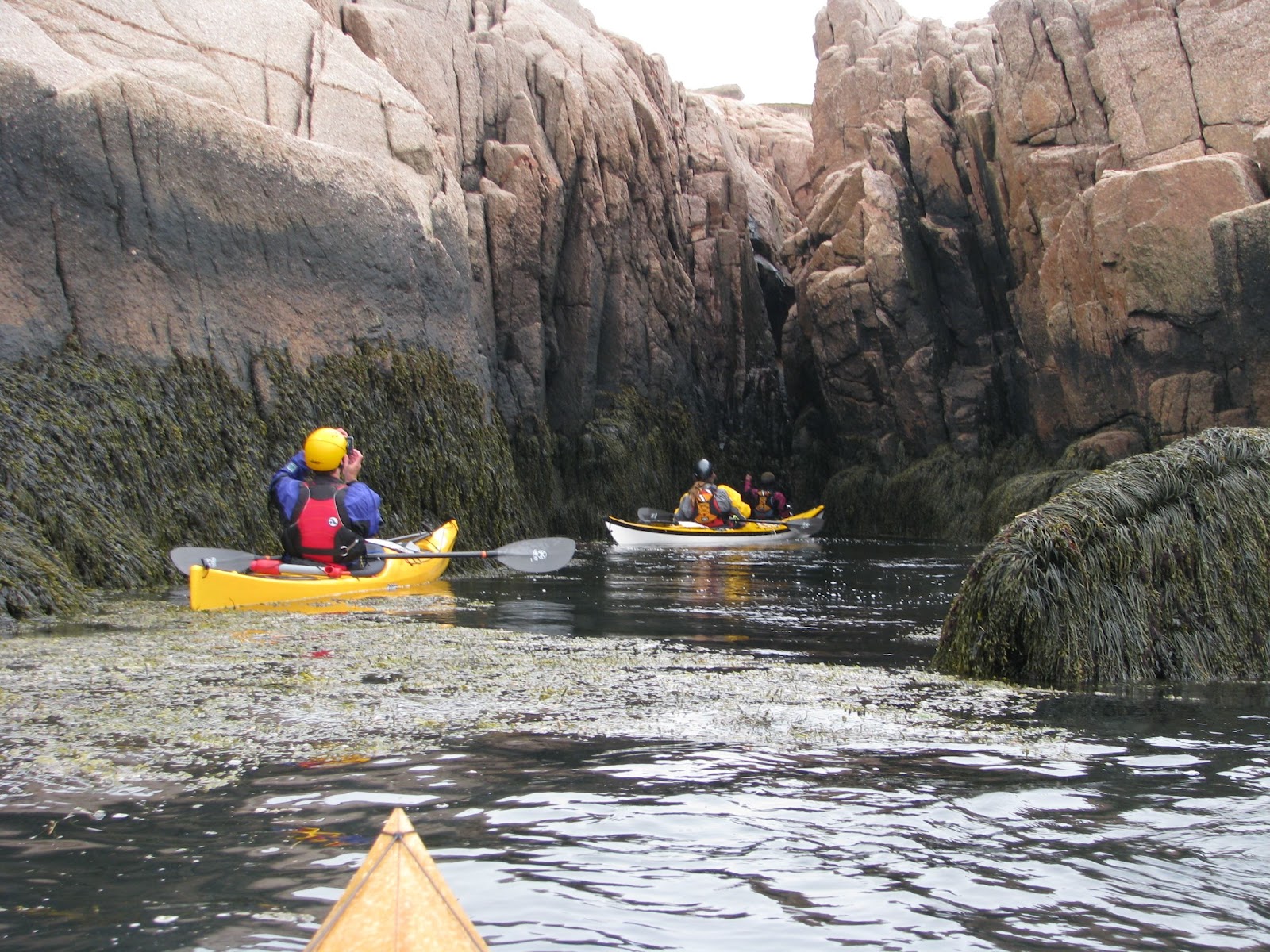
Some of my favorite moments came as we followed slots deep into the rocks. You might ride-in on a wave, and sometimes it’s tough to tell where it will lead. It gets a little quieter, the sound of surf muffled and distant. It’s a good feeling when you see water washing-in from the other side and follow it back out into the waves.


It’s a lot of fun. And best suited for daytrips where everyone understands that we might hit a section of shoreline that we’re going to take really slowly. It took us about an hour and a half to cover the southern end of Great Wass. And yet, that’s why we’re there.  And of course, it's good practice. Practice for what? Uh, doing more of this stuff.


And when you get out of the bigger conditions and find a few smaller waves, and some challenges that aren't likely to result in your getting pasted onto the rocks if you screw-up, well, it's really really fun.


And it makes lunch especially satisfying when you get to try-out the whale bone furnishings.


The day got away from us pretty quickly, but Moose Peak Light on Mistake Island beckoned, along with a few more opportunities for playtime in the rocks. There's been a light there since 1827, the present one since 1887. The best view... from a sea kayak, just offshore.


We all ventured into a narrow chasm near the lighthouse


And Nate took a swim.


If that wasn't enough, the paddle back to the launch took us past scores of seabirds and eagles watching us from granite-edged islands. Curious baby seals followed occasionally. It turned calm and the sun even peeked-out from the clouds.


All a bit overwhelming... and tiring. We returned home late, and the next morning, if the boats weren't still strapped to the car, it might have all been a foggy dream.