Showing posts with label The Everglades. Show all posts

Friday, April 15, 2011

Beaches, Bugs & Books: A Leisurely Paddle in the Northern Everglades


The horseflies were biting, but then again, so were the lizards. It was the first afternoon of a six-day paddle around the northern end of Everglades National Park, and we were doing our best to set the tone for a leisurely, relaxing trip. We sat in our lounge chairs on the coarse sand beside the river, reading our books, but there were these distractions: a few bugs and... every time we looked up from reading, those lizards seemed to have moved closer. Definitely, the lizards were moving-in. And they were staring intently at my foot. Before I could blink, one lizard made its move. It darted and attacked. I felt nothing more than a thump against my foot, but the lizard, having retreated to a safe distance a few feet away, had a mouthful of horsefly. The lizard crunched the horsefly in its jaws and gulped it down. Then it cocked its head and looked at me, as if to say “got any more?”


This would be our last trip in the Everglades before heading home. We wanted to camp in a few places we hadn’t been, and get in some beach time before getting back to our usual life. Our route would take us on a loop starting with a few days on the inside, followed by a meander among the Ten Thousand Islands.


We paddled up the Lopez River, spent the first night there, and followed the familiar markers through inland bays for much of the second day’s paddle. We spent our second night at the Sweetwater Chickee. We’d been in Florida for nearly two months, and that afternoon experienced rain for the third time. As long as the thunder and lightning stay in the distance, a chickee is a nice place to be for a storm. You’ve got a roof over your head and a good vantage point to watch the dramatic clouds sweep past.


We headed down the Chatham River and then camped on beaches in the Ten Thousand Islands: New Turkey Key, Pavilion Key and Tiger Key. We were pretty relaxed about it, favoring quality time on the islands over mileage. The days were getting hotter- in the high eighties, and each afternoon a line of dramatic clouds swept in from the mainland, threatening thunderstorms, but never shedding more than a few drops of rain. We spent a lot of time walking around and looking at things: shells, trees, birds, the distant line of the horizon over the Gulf.


There were others camped at Pavilion Key, and we met some. They were there for a rendezvous of the Water Tribe- the group responsible for the Everglades Challenge race from St. Petersburg to Key Largo in sea kayaks and various other small, non-motorized craft. These were just about the first real sea kayaks we'd seen during our entire time in Florida. They even wear life jackets and sprayskirts.


On our last evening at Tiger Key, we sat on the beach, consciously savoring our last sunset over the Gulf. It was hard to leave, and really, we could have stayed longer. It cost very little to be there, but the meter kept ticking on our home in Maine, and we would be returning to a pile of bills and responsibilities. But we told ourselves we were returning to a good place, and we missed the solid granite of our islands. We would need to return home with an increased resolve to make the most of it, to enjoy it as if we were only visitors. Which, any way you look at it, is ultimately the case.


I awoke before sunrise to see the horizon blurred by fog. We haven’t seen much fog in Florida, so it felt like a sneak preview of Maine. The air and the sea were still and quiet. I went out for a photo and the no see-ums descended, my skin burning with their bites. I dove back into the tent and waited for sun and wind to drive the bugs away. It’s worth mentioning that the bugs were always a presence, but usually, as long as we got our cooking done before dusk, we could wait-out the worst swarms inside the tent. Our last morning there was the one exception. We needed to launch in time to avoid paddling against the current, so we packed quickly, skipping our oatmeal, enduring the bugs until we were on the water where a breeze kept them away.


After a few hours of paddling we were back in Everglades City. Two days later we were back in Stonington amid a heavy rainstorm, our tans beginning to fade, the itch of bug bites subsiding, all of it already feeling distant and dreamlike. But the next morning as the sun sparkled on the water between Stonington Harbor and Isle au Haut, those familiar islands- all granite and spruce- looked very solid.

Friday, March 11, 2011

Hangin' With The Spoonbills

Just east of Flamingo is a large, shallow bay. Five miles across, the bay gently curves about two miles into the Snake Bight area before dipping into another bight. It’s a popular spot for birds, maybe because it is only a foot or two deep, leaving the fish and crabs little room to hide. Huge flocks like to congregate on the exposed mud flats, and in the branches of mangroves along its banks.


On our first foray into the bight, we paddled-in at high tide and ran out of water. The tides and the muddy bottom are hard to predict around here. One foot of water on the chart might really be four inches or none at all if the wind is blowing the water away, or if the mud has shifted. We paddled-out quickly, not wanting to end-up slogging through the mud on foot.

For our second excursion into the bight, we followed the straight line of a man-made channel into the bight. It doesn’t look like exciting kayaking, but it’s nice to be able to dig your paddle into water, rather than mud. Every hundred yards or so stood a marker with a bird on top: anhingas, laughing gulls, the occasional osprey that took off, skimming the water surface with its claws. Small fish jumped from the water again and again. In the distance, a fisherman stood on a lone skiff, poled by a man standing atop a platform. Flocks of wading birds massed in the shallows and mud flats.


At the end of the channel, we paddled around a stand of mangroves with bird poop-speckled leaves, and that unmistakeable aroma of birdly domesticity. We saw ibises and egrets and such- the usual suspects for this area. Wonderful to see, of course, but also visible along just about any canal in southern Florida. We beached ourselves in the mud for an in-the-cockpit lunch break.


As we sat quietly, we noticed a flash of pink feathers in the mangroves up ahead, and then another. A moment later, several of the birds flew out around us, winging around in a circle before settling again into the mangrove branches: roseate spoonbills.


A little over a hundred years ago, it had become fashionable for women to wear feathers or entire wings on their heads. (“Excuse me Miss, but you have a dead bird on your head”). Plume hunters in the Everglades and Florida Bay killed as many birds as they could, making obscene profits until, predictably, the birds began to disappear. The roseate spoonbill has the fortune- or misfortune in this case- to have bright pink feathers. By the 1930s, the species was hunted almost to extinction, down to only a few birds in Florida.

We finished our lunch and drifted quietly past a bend where dozens of the birds were perched atop the mangrove foliage. They are strange-looking birds to be sure. They get our attention with those bright pink feathers, but the spoon-shaped bill seems like a remnant from a prehistoric age, or a cruel joke played by nature. I’m sure we look funny to them too, but they didn’t seem to mind us drifting by at a distance.


It’s funny how we feel lucky to see one species of bird more than another. Is it because we don’t see pink birds very often? Or the unusual bill? Or maybe it’s because we nearly lost the chance to see these birds ever again. Either way, the spoonbills held our attention for a long time, until it started getting late and we headed back to Flamingo, pointing our bows into the sunset.


Friday, March 4, 2011

Greetings from the Everglades


From the road, all one sees is a pool of dark, shallow water beneath a canopy of thick foliage. It goes back maybe fifty feet before disappearing around a bend, if not disappearing altogether, but the presence of other parked cars suggests that maybe this trickle of muddy water actually leads somewhere. This is the beginning of the Hell’s Bay Canoe Trail, a marked route through the Everglades leading to the Hell’s Bay Chickee. Rebecca and I were headed out for the next two nights.


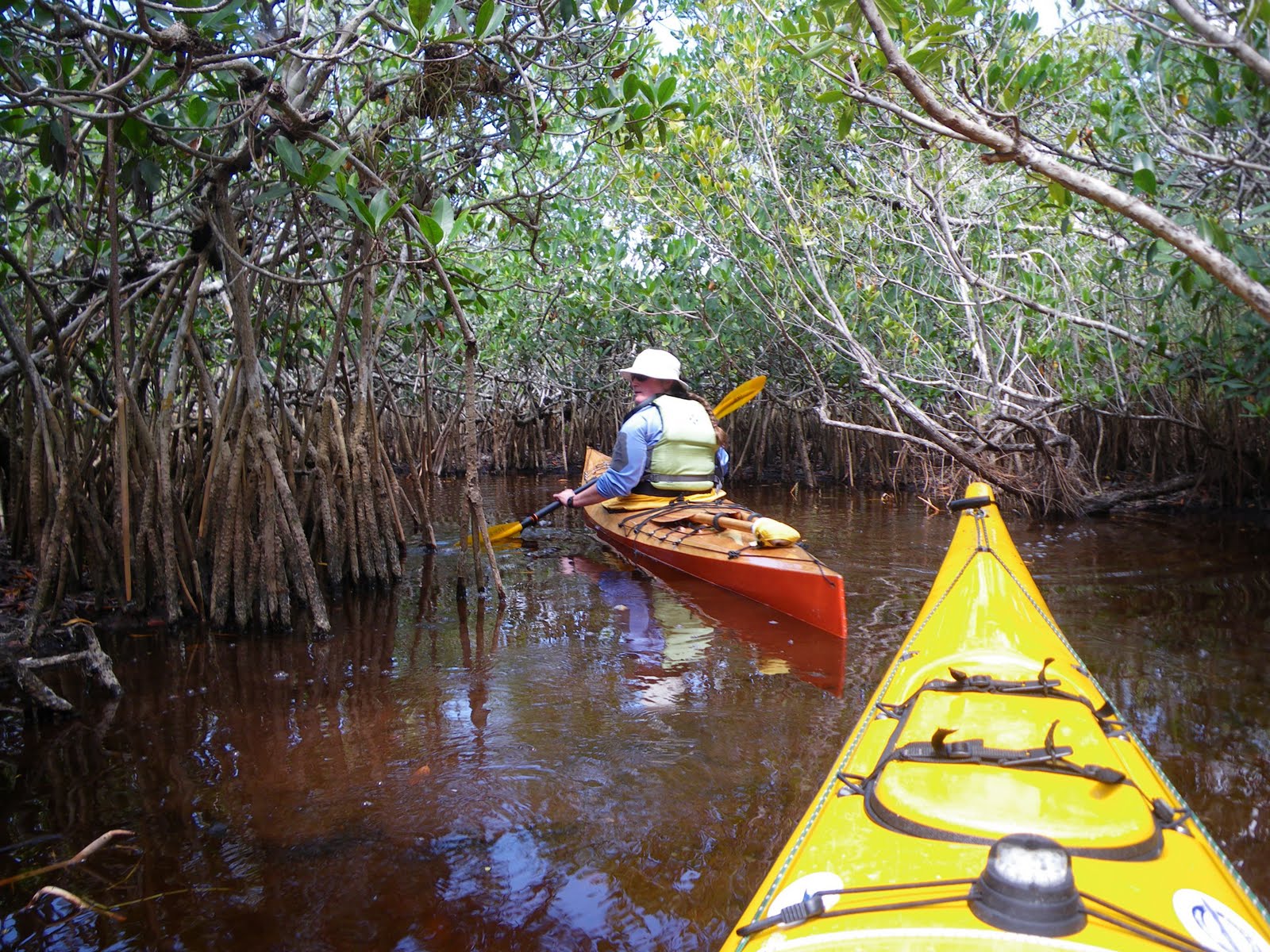
Our paddles churned up the muck, coloring the water to a black bean soup hue. We got around that first bend- a very tight turn- and the liquid path continued, one turn after another. We passed through numerous mangrove tunnels, often six or eight feet wide, with only inches of water beneath our hulls. And then we’d burst into an open area where the grasses and palms hissed in the wind- wind that mostly passed overhead. This is a good spot to paddle on a windy day. We’d had plans for a more ambitious four-night trip around Cape Sable and Whitewater Bay, but the forecast called for strong winds that would have made the paddling a chore at best.


We had been in Everglades National Park for a week. Rebecca is the Artist in Residence, which basically means the park gives her a residence and... yes, she’s the artist in that residence. After about three weeks here last year, we saw so much potential- paddling-wise, and art-wise, that we knew we had to come back and spend even more time. Rebecca’s focus is on painting, drawing and printmaking, but our kayaks get us out to places that relatively few people get to, let alone artists.


The Everglades is an often-misunderstood place. For generations, it was seen as a wet wasteland, useful only if it could be drained. Against all odds, it was drained. It’s a long, convoluted tale of human-centric folly, and at one point it seemed that the Everglades chapter was near its end, with entire species of plants and animals on the verge of extinction. Most of the national parks were established to protect places of grand, obvious beauty, easily seen and appreciated by their visitors. The attraction of the Everglades is subtler than other parks. Everglades National Park was the first of its kind, established to protect a threatened ecosystem, which might not be so tangible from the driver’s seat of an RV. Even from the cockpit of a kayak, it takes some effort to see the big picture.


You could say that the Everglades has a PR problem. And it isn’t because alligators aren’t cute.

After a couple hours of following a twisting watery path, we emerged into a series of small bays, arriving at the Pearl Bay Chickee in late afternoon. A chickee is a platform built on stilts above the water. There’s an outhouse and a roof with just enough room to camp. It’s also a pleasant place to while away what’s left of a sunny afternoon: reading, painting, enjoying the luxury of a hot cup of tea in the wilderness.


We ate dinner as the sun set, finally retreating into the mosquito netting shell of our tent, where we listened to lapping waves and the occasional splash of a fish or a wading bird. In the east, Miami lit the eastern horizon. a pinkish glow that was beautiful in its own way, even if it is a constant reminder of the human sprawl that nearly rendered this place obsolete.


It’s hard to describe our next day’s activities without useing the phrase “hanging-out”. That’s just what you do on a chickee. There’s nowhere to walk, but the twenty or so feet to the outhouse. Sure, we could get into the kayaks and do some exploring, but the view from the platform feels like a privledged one, and an unusual perspective for Rebecca to paint from. We watched birds, and an otter that, of all the little mangrove coves for miles around, chose ours to hunt for its breakfast.


Finally, we packed-up and paddled another couple of hours to get to the Lane Bay Chickee. Here we left the established canoe trail and struck off to navigate for ourselves, finding passages between mahogany and cypress hammocks and mangrove-lined bays. The navigating is a bit imprecise, with the chart only generally representing what we see. Often, an “island” is really a group of mangrove trees that probably weren’t even there when the chart was last updated. Still, it’s all we have to navigate by, so we follow along carefully, and try not to panic when nothing seems to look as it should. Aside from tricky navigating, our mileage would have been that of a short day paddle at home, but that’s okay; it gave us plenty of time on the chickee, which, after all, is why we’re here.

Wednesday, April 21, 2010

The Keys, More Everglades


We had vague plans to meet Peter and Marilyn in the Keys, which remained vague after we left Everglades National Park and tried to catch up on three weeks of email in a parking lot in Homestead. Either way, we were headed to the Keys with no big plans. After spending our first night at John Pennekamp State Park in Key Largo, we were pulling out onto Route One and noticed a car with kayaks approaching from the north: Peter & Marilyn. We pulled into the parking lot at an adult video store (one of the many fine cultural attractions popular in the Keys) and decided to go for a paddle.


We followed a canoe path from the park out into a channel, where we chatted in between the roar of jetskis and powerboats. We found our way back into the canoe trail, which had the feel of a theme park attraction, busy with kids and families in rented sit-upons. Still, it was fun to follow the narrow paths and see where they brought us, practicing our edging to make tight turns. I found myself wishing we had something like this back home.


In the Keys, we spent only a little time paddling, and were seldom out of earshot of Route One. The State Park campsites, where $43 a night buys you a slot between RVs that run their air conditioners constantly, can be reserved eleven months in advance, so we knew that every park was completely booked before we arrived.


Still, we kept getting lucky when we would inquire about cancellations. $43 is a bargain in the Keys, and the most unspoiled places there seem to be in the parks. If you want to car camp and hang out at the beach, it’s not a bad deal. The water is clear, turquoisey blue, and some of the beaches, like the one at Bahia Honda, are covered with fine sand and only a few Portuguese man of war jellyfish. The sharks don’t eat tourists that often, and there’s more scantily-clad beach babes on almost any stretch of beach than I have ever seen in Maine. Of course, like Maine, Florida is a popular haven for elderly beach babes. Spring break was happening somewhere, but we never did see any of those girls gone wild.


We had been spoiled by the Everglades, and it didn’t take long for us to decide we’d seen enough of the Keys for now. There’s nothing like a visit to the galleries of Key West to reinforce our opinion that the gallery scene is far better in Stonington, Maine. We headed back to the Everglades, where the $16 a night campground with cold showers had begun to feel like home. And people didn’t stare at my bug bite-covered legs.


We took some day trips, hiking and paddling and going to every ranger talk we could. Since it takes some real effort to get out and see the wild areas of the Everglades, many park visitors show up at the Anhinga Trail, the one-stop shopping solution to seeing the Everglades. It’s like a zoo. The alligators stroll onto the wheelchair-accesible paths, and people get their worried-looking kids to pose in front of them, seeming to forget that gators can run as fast as a horse. But the alligators just hang-out, smiling for the camera. After awhile, visitors seem almost bored by it, like something seen on TV.


Before we left, though, we had one last excursion: a couple of nights out at Cape Sable beneath the full moon. For the last month we’d hardly been anywhere for two nights in a row, and we’d loved this beach so much we wanted to go back and just hang-out for a day. Time to finish those Travis McGee novels and vegetate a bit, and go for long, long walks on the beach. Time to break our ‘no shell collecting’ vow, and one last chance to work on that tan before we would fade to our usual pale selves.


Despite a group of “troubled youths” that chose to camp amazingly near us on such a long beach, we put in our beach time as occasional teary youths strolled past with counselors who talked non-stop, using the word “respect” rythmically. Okay, this was surreal, but we just smiled. Thanks to scenes like this, we could confidently skip our visit to the Dali museum. The weird thing was that I kept noticing they were making these kids do exactly what we did as a fantasy vacation. Hey look, now they’re writing in their journals while someone plays flute, now it’s time for a forced march on the beach. Oh my god, not paddling into the wind again!


It made me wish I’d been so lucky as these troubled youths. Then it occured to me that I had been. In high school, I took part in an outdoor education program that got me out canoeing, backpacking and rock climbing, all while practicing lightweight, low-impact camping. It’s hard to imagine what I would have done without it. So, while it would have been nice to be alone, I imagined that for at least one of those kids, this might have been as formative an experience as “Project Exploration” had been for me. If it weren’t for that experience, this blog might be called “Jetski Stonington”.


We had some time after they left, and despite a growing east wind that we’d have to paddle into, we stayed on the beach as long as we could. A large crocodile patrolled the shore, perhaps searching for a place to nest. The growing waves slapped the beach rythmically. We finished our novels, caught-up with the journals and sketchbooks, and finally just stared out at the horizon. We knew the next day would find us on I-95, headed north, that in another week we’d be cleaning the sand out of our gear back home. If bug bites and sunburn helped me hang onto this feeling, well then, bring it on.

Friday, April 16, 2010

The Everglades


In March, Rebecca and I strapped the kayaks onto the car and drove down to Florida. The kayak excursions deserve a bit more space than I want to give them in the blog, so I’ll just hit upon some highlights. Similarly, last fall I blogged a synopsis of my trip with Todd from Stonington to West Quoddy Head, but a detailed account will appear in Ocean Paddler Magazine. I’ll let you know when it comes out.


The heart of our trip was a fourteen-day, 170-mile excursion through the Everglades. To do this, we drove for four days, arriving in Flamingo, in Everglades National Park, where we stayed in the campground for a couple of nights while we prepared. It’s amazing how many people want to talk to Rebecca about her kayak (and how few want to talk to me about mine). The usual conversation: “yes, she built it, from a kit, a Pygmy Coho, mahogany plywood, seventeen and a half feet, they say it takes eighty hours but...” Well, we meet a lot of friendly people that way, at gas stations and rest stops, all the way to the campground.

Our route: week #1 in red, week #2 in yellow

For the first week we paddled along the Gulf coast, up to the northern end of the park at Everglades City. This area was what attracted me to paddling in the Everglades: the long undeveloped stretches of beach on the Gulf of Mexico. I was certainly more comfortable with the open ocean than with the thought of what lay “inside”: the maze-like paths through the mangroves teeming with creatures capable of eating people.

Ever feel like this?

Well, that was my impression, and the pythons had been in the news a lot lately. It seemed only a matter of time before a twenty-something-foot python swallowed a seventeen-foot kayak, complete with kayaker and gear. They were, after all, eating eight-foot alligators. We could have also worried about the sharks in the Gulf, or maybe those nasty South American drug dealers with chainsaws we’d seen in “Scarface”. But why worry? We’d survived nearly two-thousand miles of I-95 and the horrors of the multitasking SUV drivers.


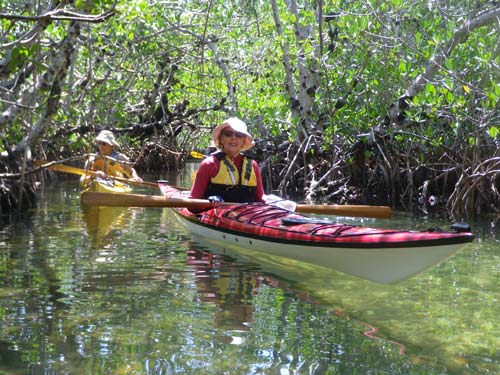
We camped at the beaches along Cape Sable, then dipped into the Little Shark River for our first taste of the mangroves. It was a good taste- just enough to ease some of our uneasiness and get a feel for navigating among the many confusing channels of the delta. I hadn’t given much thought to the mangrove trees, viewing them more as a weedy obstruction- something difficult to paddle or walk through. But these were forests of tall, majestic trees that had adapted to grow where others couldn’t, and paddling among them was to float upon a watery forest floor with arching support roots echoing the shapes of the canopy overhead.


We encountered few other people. Our first three campsites coincided with those of Joel Beckwith, a kayak guide for Florida Bay Outfitters, and two German women. Joel spends his summers in our stomping grounds, guiding on Mt. Desert, so we had a lot to talk about, like his 500-mile Sea of Cortez expedition which you can check-out on YouTube.


After six nights on the “outside”, we paddled in to Everglades City, where we replenished our water supply and obtained our wilderness permit for the return trip to Flamingo. Now we were committed to “inside” paddling and all it entailed: long breaks to photograph wildlife, the occasional powerboats zipping by on the Wilderness Waterway, and easier conditions than on the ocean.


As much as we wanted solitude, the few people we met made for a more interesting time: a pair of canoeists at Lopez River, a group on a motorboat-assisted guided trip at Darwin’s Place, a father and son at Harney River Chickee. The group took us along on a pre-dawn excursion in the powerboat to watch thousands of birds make their morning commute from Cannon Bay out toward the Gulf. The father and son recounted various paddling trips, making it seem there would never be enough time to do all the paddling there is to do.


We returned briefly to the “outside” to camp again at Highland Beach, which was a favorite spot on the way up. Our first visit had been solitary and quiet, punctuated by long walks on the beach. This time, a group of powerboats had anchored off the shore, and at night, their bright lanterns and bonfire were hard to miss.


The “Nightmare” route is a passage from the Broad River to the Harney River through a tangle of small creeks that run dry at low tide. Before, I thought “no way”. I didn’t relish the idea of mosquitoes and spiderwebs and whatever else might be hanging off those low-hanging branches. But my attitude had changed. It’s funny how something shifts from being scary and intimidating to being more fun than you could have imagined. A small alligator (we’d seen a lot of them by then) greeted us at the entrance, and we spent the next several hours making tight turns, ducking beneath branches and trying to keep track of our location on the chart.


Our last three nights were spent at chickees, small roofed platforms with just enough room to pitch a tent. They make for clean camping- none of the sand and dirt we’d been living in, but made it a challenge to stretch one’s legs. Aside from a lunch break on a small shell mound, we didn’t walk on actual land again until we pulled up at the boat ramp in Flamingo.


We took our time for those last few miles in the Buttonwood Canal. It all seems so immediate while you’re there, but you never know if or when you’ll be there again. Suddenly, that shower you’ve looked forward to for two weeks doesn’t seem so important, and even those ice cream bars at the marina can wait. Before you know it, you're back home with thousands of photos to go through, struggling to explain what it was like in brief conversations, and scheming ways to get back out there.