Showing posts with label painting. Show all posts

Sunday, May 27, 2012

Springtime on Isle au Haut


I paddled beside Rebecca as the western sky took-on a rosy, decidedly evening feel. “Well,” I said. If we don’t want to get into camp late, we could always stop somewhere else. Steves Island, maybe. We’d get a nice sunset on Harbor. Or Kimball- we’d be most of the way there.”

“That could be okay,” she said, but didn’t break stride. Isle au Haut rose as a backdrop, still mostly obscured by other islands, and we kept paddling as if to get those islands out of the way.

“Of course,” I added, “we’d have the current against us in the morning.”

“And fog. It’s supposed to turn foggy and rainy. I’d rather get there.”


This last minute, tardy departure felt too usual for us. We were always running late, getting things done at the last minute. We were lucky to have even launched on Monday. The tasks were never finished, and the longer we stuck around, the more the phone rang and the emails came: it seemed irresponsible to be leaving at all. That afternoon, I’d walked into the back of the darkened gallery just as a man on the sidewalk tried the locked door and saw me. To be polite, I opened the door to tell him we’d be closed for a few days, but he didn’t care about that. “Is there a restaurant around here,” he asked, “that serves lobster?” A joke? No- a frequently-asked question. He looked over my shoulder and followed it up with another: “Are you one of the artists?” We launched by quarter to five.


The wind picked-up against us and developed a mild chop. We still had the current with us. At Steves we kept right on going. At Harbor, we paused. The idea was enticing, but we wanted to get there tonight. We wanted to wake up in the morning and have all day. Three all days actually- and another half day on Friday, when we would need to return to Stonington and open the gallery. After which, the gallery would be open every day for the next four and a half months- with at least one of us there every day. It was good we were taking a break.


The current had turned against us by the time we entered the Isle au Haut Thorofare, tilting the buoys toward us. Along shore we found an eddy and passed town: no one was about- just a well-preserved car  from the 1960s rumbling slowly past. The lighthouse beckoned. We arrived at Duck Harbor just in time to get settled-in before dark. 


Duck Harbor Campground has only five sites, all Adirondack-style lean-tos- posh camping on the southern end of Isle au Haut, Acadia National Park’s remote section. Until June 15th when the tour boats start running there, the only likely way to get there is under your own steam. You could take the mailboat into town and backpack or bicycle the rest of the way, or get there in your own boat. I’d made reservations back in early April, which not only held our site, but ensured that we would take the time off for the trip. Two other couples camped quietly nearby.


We spent the next three days walking around on the trails and the rocky shoreline, staring at rocks, mesmerized by waves. Fog and rain came and went and came back again. It was springtime and the plants were just getting started, bright leafy green everywhere, birdsongs a constant backdrop.


The trails were often squishy and damp, but they led to amazing places. We took our time. Rebecca painted. Sometimes I opened a book, or if Rebecca became busy with a painting, I took off bushwacking up to rocky promontories, trying to fill in the gaps of shoreline that the trails left-out.


We both did a lot of staring at waves and rocks. What went through our minds while we stared? Rebecca, I’m assuming, was often going through that process of creating art. How do I paint that? What makes it interesting? Will anyone else see how cool this looks to me? I often found myself following an imaginary kayak in through rocky gaps, tracing its course as it negotiated a turn, got stuck on a rock, and inevitably- pounded by one of the bigger waves that always seemed to follow. Good practice. Maybe better if I’d followed it up with actual paddling... but maybe just as well that I didn’t. 


The days passed. On Friday morning we headed back in the fog. We were in less of a hurry to get back to Stonington. The fog lifted enough here and there to make it more atmospheric than hazardous- a gentle way to return and plunge into our summer.


Friday, August 12, 2011

Are We There Yet?

A few snapshots:


“How far is the island with the swimming quarry?”

I’ve heard this many times already, probably from just about everyone in the group- ten teen-agers and their two college-age counselors. It’s hot, yes, but these kids have an inordinate desire to go swimming. It even seems to outweigh their patience with learning the finer points of a good forward stroke... the very thing that will propel them to the island with the swimming quarry. It’s starting to sound like the “are we there yet?” chorus we plagued my parents with from the back of the station wagon. And like my Dad after hundreds of miles of hot interstate, I’m getting a little snippy.

“What swimming quarry? You believed me? I made that up.”


We’re on the second of three days together. Days- not nights; I leave the group (organized by Apogee Adventures) on an island to camp, returning in the morning to take them paddling. This is my second trip with Apogee and, despite their preoccupation with swimming holes, I’ve had fun paddling with them. Their real focus though, is on community service, which translates to cleaning-up islands. By the end of both trips, we will have picked-up over four nautical miles of shoreline on six islands. That’s a lot of Chlorox bottles. Later, MITA volunteers in skiffs would pick-up our many stashed garbage bags.

For me, the island clean-ups are a good excuse to walk some shoreline- something I don’t do nearly enough. For the kids, it’s an opportunity to discover rocks to jump from into the ocean, which they do again and again. But it’s not the fabled island with the swimming quarry. When we finally get to Green Island, the dip in fresh water feels like a reward; the kids have all earned it.

Meanwhile, Rebecca has an island to paint. She’s been commissioned to do a painting from someone’s family island- a place they’ve spent summers for years. So we’ve been paddling out to this island to see it at different tides and different times of the day. It would have been a nice assignment on any island, but it doesn’t take Rebecca long to see why the place feels so special to the family: the erratic boulders, spruce-topped cliffs and intimate coves. We feel fortunate to be invited to spend time there since we’d paddled past many times, but never landed. One day we stop there for lunch, admiring a new perspective of the archipelago. Rebecca stays to work on drawings while I paddle-on to Old Quarry to guide a trip.


A couple of hours later, I take the group past the island and pause to wait for lobster boats to pass in the channel ahead. A woman waves to us from the island. “My wife,” I tell the group, but they think I'm joking. When I further explain why she's there- that, at that moment anyway, her job is to hang out on an island and draw, while mine is to paddle around with them, it sounds even more implausible.

These are some of the things I get from guiding: a walk on a shore I’m usually too busy to walk on, and a look at our surroundings through the eyes of a visitor. And that island with the swimming quarry? It’s only about a mile from where we’ve lived for eight years, but I never took a swim there until a group of teenagers dragged me along.


Friday, March 4, 2011

Greetings from the Everglades


From the road, all one sees is a pool of dark, shallow water beneath a canopy of thick foliage. It goes back maybe fifty feet before disappearing around a bend, if not disappearing altogether, but the presence of other parked cars suggests that maybe this trickle of muddy water actually leads somewhere. This is the beginning of the Hell’s Bay Canoe Trail, a marked route through the Everglades leading to the Hell’s Bay Chickee. Rebecca and I were headed out for the next two nights.


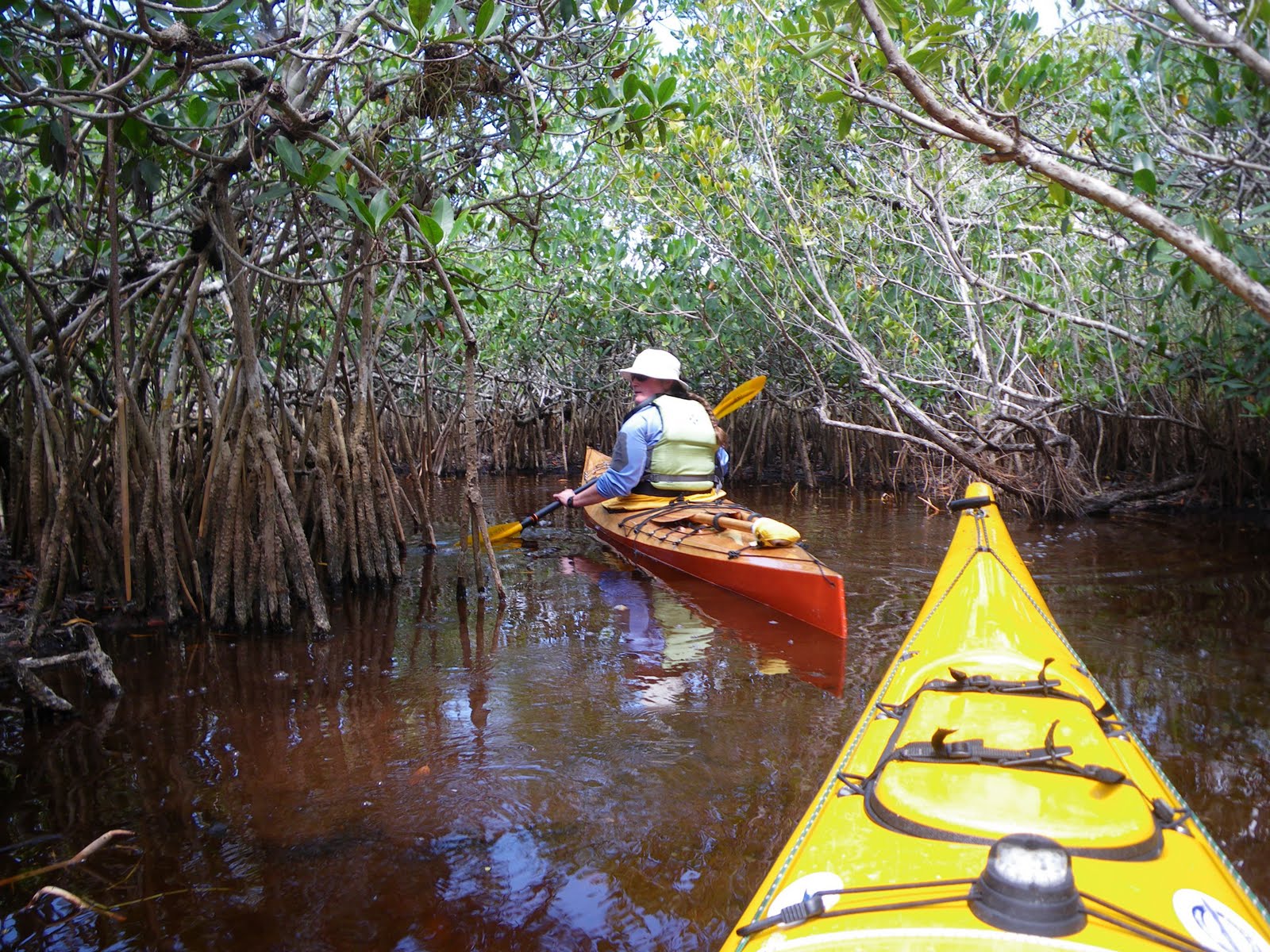
Our paddles churned up the muck, coloring the water to a black bean soup hue. We got around that first bend- a very tight turn- and the liquid path continued, one turn after another. We passed through numerous mangrove tunnels, often six or eight feet wide, with only inches of water beneath our hulls. And then we’d burst into an open area where the grasses and palms hissed in the wind- wind that mostly passed overhead. This is a good spot to paddle on a windy day. We’d had plans for a more ambitious four-night trip around Cape Sable and Whitewater Bay, but the forecast called for strong winds that would have made the paddling a chore at best.


We had been in Everglades National Park for a week. Rebecca is the Artist in Residence, which basically means the park gives her a residence and... yes, she’s the artist in that residence. After about three weeks here last year, we saw so much potential- paddling-wise, and art-wise, that we knew we had to come back and spend even more time. Rebecca’s focus is on painting, drawing and printmaking, but our kayaks get us out to places that relatively few people get to, let alone artists.


The Everglades is an often-misunderstood place. For generations, it was seen as a wet wasteland, useful only if it could be drained. Against all odds, it was drained. It’s a long, convoluted tale of human-centric folly, and at one point it seemed that the Everglades chapter was near its end, with entire species of plants and animals on the verge of extinction. Most of the national parks were established to protect places of grand, obvious beauty, easily seen and appreciated by their visitors. The attraction of the Everglades is subtler than other parks. Everglades National Park was the first of its kind, established to protect a threatened ecosystem, which might not be so tangible from the driver’s seat of an RV. Even from the cockpit of a kayak, it takes some effort to see the big picture.


You could say that the Everglades has a PR problem. And it isn’t because alligators aren’t cute.

After a couple hours of following a twisting watery path, we emerged into a series of small bays, arriving at the Pearl Bay Chickee in late afternoon. A chickee is a platform built on stilts above the water. There’s an outhouse and a roof with just enough room to camp. It’s also a pleasant place to while away what’s left of a sunny afternoon: reading, painting, enjoying the luxury of a hot cup of tea in the wilderness.


We ate dinner as the sun set, finally retreating into the mosquito netting shell of our tent, where we listened to lapping waves and the occasional splash of a fish or a wading bird. In the east, Miami lit the eastern horizon. a pinkish glow that was beautiful in its own way, even if it is a constant reminder of the human sprawl that nearly rendered this place obsolete.


It’s hard to describe our next day’s activities without useing the phrase “hanging-out”. That’s just what you do on a chickee. There’s nowhere to walk, but the twenty or so feet to the outhouse. Sure, we could get into the kayaks and do some exploring, but the view from the platform feels like a privledged one, and an unusual perspective for Rebecca to paint from. We watched birds, and an otter that, of all the little mangrove coves for miles around, chose ours to hunt for its breakfast.


Finally, we packed-up and paddled another couple of hours to get to the Lane Bay Chickee. Here we left the established canoe trail and struck off to navigate for ourselves, finding passages between mahogany and cypress hammocks and mangrove-lined bays. The navigating is a bit imprecise, with the chart only generally representing what we see. Often, an “island” is really a group of mangrove trees that probably weren’t even there when the chart was last updated. Still, it’s all we have to navigate by, so we follow along carefully, and try not to panic when nothing seems to look as it should. Aside from tricky navigating, our mileage would have been that of a short day paddle at home, but that’s okay; it gave us plenty of time on the chickee, which, after all, is why we’re here.