Showing posts with label Porcupine Islands. Show all posts

Monday, October 6, 2014

Tour de' Northern Frenchman Bay


We met Saturday morning at the College of the Atlantic pier: five student leaders-in-training, ready for a weekend trip around Frenchman Bay. The weather forecast wasn't promising: strong winds, 100 percent chance of rain, fog, the potential for big seas, but there was never any discussion of cancelling the trip. The students' stoke level was high. They'd been working hard all week on academics, but had spent Wednesday out with Nate, getting  a good look at the watery part of their neighborhood.


Nate and I have led several COA trips in the past, but this year Nate has made it one of Pinniped's goals to establish a training program for student leaders, so that students at the college will be better able to safely get into sea kayaking, led by their peers. After all, the college has an amazing location on the site of the former Turrets estate, overlooking Bar Island. The students are a great group, all alumni of a college in Victoria, BC, where they've had opportunities to get out paddling and hiking and hone their camping skills.


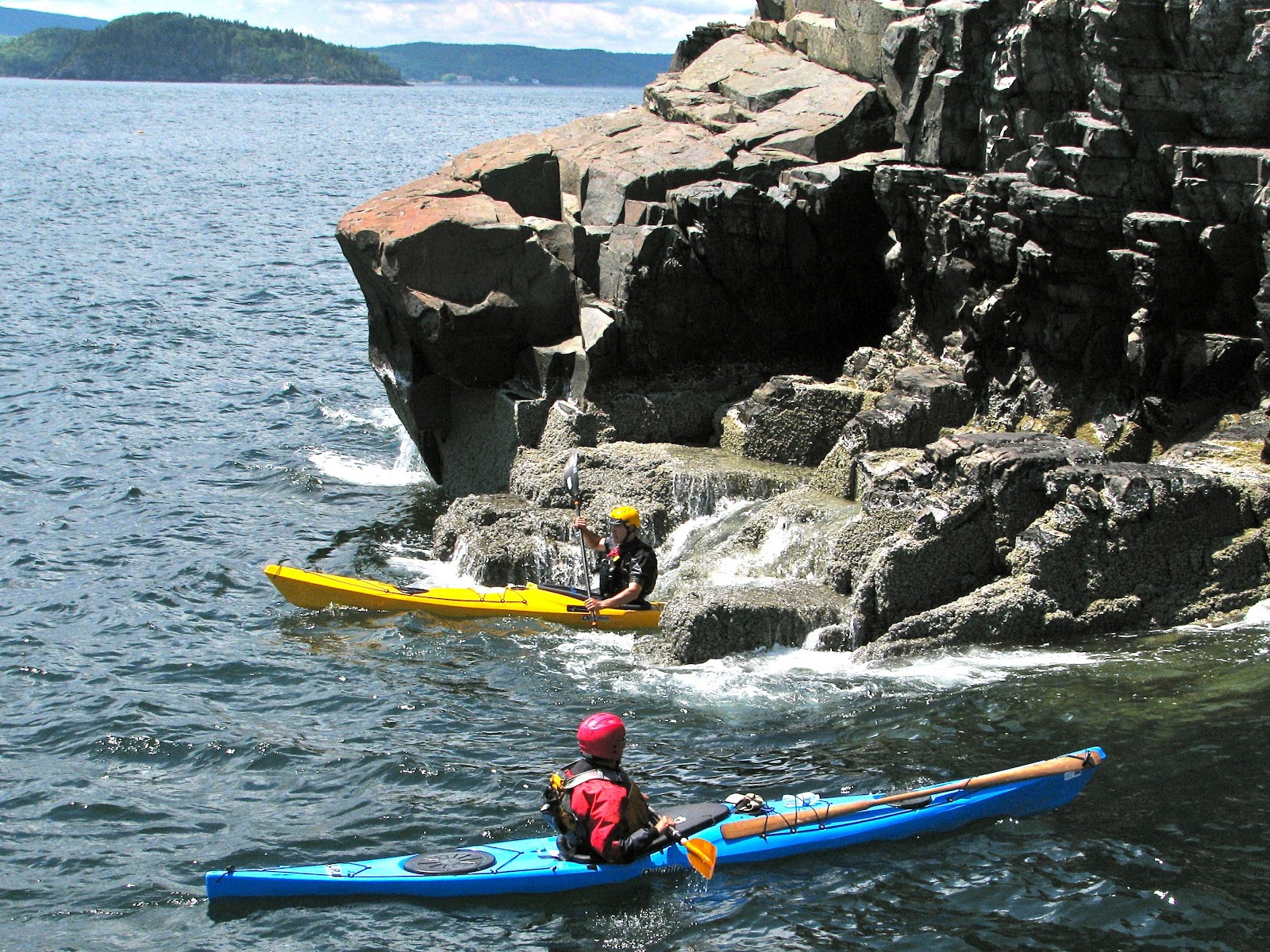
We headed into the fog and followed the Porcupine Islands. Along the way, we took turns leading the group and navigating, getting a sense of what it feels like to lead and be led, and the different ways to go about it. But we found ample opportunity to play along the way.


We ate lunch at Rum Cay and headed around Long Porcupine. 


The seas were fairly small- a good day to learn one's way around the rocks and ledges. But of course, one of the number one lessons to be learned is that no matter how small the seas appear, there's always a bigger wave out there, and you need to keep an eye out for it.


I'm always trying to see things through students' eyes, to try to understand how this looks to them- if I'm pushing them too hard or not enough. One of the best forms of feedback is a great big smile.


We could have kept playing, but we wanted to get to our campsite on Stave Island while the getting was good. The wind began to increase, and we were expecting steadier rain.


As with most clients, I tried to leave as much of the route-planning as possible to the students, floating an idea here and there and seeing what seemed to catch their interest. When we were looking over the chart on the beach, I mentioned the possibility of going around Crabtree Neck the next day. The marine forecast for the greater area called for 3 to 5-foot seas and 25-knot gusts, and the thought of more sheltered waters was appealing. The Crabtree Neck route would take us up Sullivan Harbor, past the Reversing Falls and into Taunton Bay, where we could wind through Carrying Place Creek to the Skillings River, back out to Frenchman Bay.


That caught their interest. The only problem though, was that it was far- close to 20 nautical miles, and we'd need to start early to catch the tides right. They surprised me and all quickly agreed that we would get an early start and go for it.


The students set-up our dining fly in an old cellar hole, where we ate lentil curry, comfortably sheltered as the wind bent the trees overhead. I have to admit that I like guiding people who cook for me- and we ate well. After dinner, instead of ghost stories around a campfire, we listened to kayaking tales of woe from "Sea Kayaker Magazine's Deep Trouble." Later, in my tent, I listened to the wind whip the fabric and the waves washing onto shore. 


We were all up in the dark, eating oatmeal as the rain pattered on the tarp, and launched at a decent hour. We followed the islands that circle the northern stretch of Frenchman Bay: Stave, Calf, Preble, and onward past the shore of Sorrento to the mouth of Sullivan Harbor.


Not a bad way to start the day at all, but it took a little longer than we'd hoped, so as we made our way up Sullivan Harbor, we began paddling against the current.


Our desire to catch the tides kept us in our boats longer than usual, and just short of Sullivan Falls it had already been awhile since breakfast. I had to ask myself if I was maybe pushing them too hard- if my desire to get around Crabtree Neck was overshadowing the needs of the group. But Sullivan Falls was just around the corner- a good place for a break since everyone wanted to see the falls and have a snack. Plus there was water and a bathroom. It was a big day at the falls. Only an hour after slack, the waves were big and meaty with sharp fangs- not something we wanted to get into right then. After a break, with energy levels revived, we carried past the biggest waves and made our way along the edge, below the Route One bridge and into Taunton Bay. Somewhere in there the rain and dark clouds went away and the day turned sunny. We found the entrance to Carrying Place and headed downstream.


It was good that we hadn't dilly-dallied; the creek was draining and in a few spots we bumped along over a rock or two, finally emerging in a stretch of mudflats around a ledge where we ate lunch.


By the time we made it back to Frenchman Bay the day had turned brilliant, fairly warm- still a bit of wind, but we tucked into the shore along MDI as we made our way back to Bar Harbor.

Monday, April 14, 2014

Ironbound Island & The Porcupines

Once again, on Saturday morning we find ourselves, at a reasonably early hour, down at the end of Bridge Street where a sign warns motorists "Flood Area: Do Not Park On The Tidal Bar" before crumbling asphalt gives way to beach gravel and, since we'd arrived at high tide-- the ocean. We'd been coming to pool sessions in Bar Harbor for much of the winter, and it had been good to practice skills in warm water, but on some of the nicer days we got out for a paddle in the morning, and now, with four or five hours before our pool session, we head out into the Porcupine Islands.


(Above: the view from atop Cadillac Mountain: Sheep, Burnt, Long & Bald Porcupine Islands)
The Porcupines-- so-named (I imagine) for their spruce-spined over-the shoulder humps rising from the ocean on the islands' high, cliffy southern ends, extend east from Bar Harbor, steep stepping-stones leading across half of Frenchman Bay before a gap to Ironbound Island. Often when we paddle out into the Porcupines, we do so with a vague float plan, dependent on the seas and our ability to get close to the rocks and and chasms below the cliffs. The first two islands, Bar and Sheep Porcupine make up the northern perimeter of Bar Harbor, and tend to get a bit less impact from open ocean swells as the further-out islands. It's a good shoreline to follow and warm-up- see how well you're maneuvering before venturing into the surf zone along Burnt Porcupine, where swells on a calm day can end in dramatic explosions of whitewater upon the rocks.


By the time we get to Burnt Porcupine, I've lost enough gelcoat to reinforce the conservative approach Rebecca and I tend to take in the colder months. This generally means we stay behind breaking waves instead of in front of them. On a day with 1-2-foot seas, most wave sets have a couple of larger swells. When they trip over a submerged ledge they can rise into steep and formidable waves. Most of Burnt Porcupine's southern shore is fairly vertical, pocked with narrow chasms and steep rock faces and broken-away boulders and ledges. It doesn't take much of a sea to turn the shoreline into frothing clapotis, waves colliding with reflecting waves, pounding and thundering, the air hazy with salt. That big attraction over on Ocean Drive- Thunder Hole? There are a lot of thunder holes out there, and as sea kayakers we have the privilege of getting to know them well.


As we paddle, some places are still linked in my mind to lessons learned, sometimes in classes, sometimes not. Now that I'm an instructor, I have to give credit to one of my first teachers- Mark Schoon- for giving me a long leash and testing my skills in fairly big conditions. We backed into "The Keyhole," a big, rocky slot, and watched the swells roll in and funnel toward the chasm: as much an exercise in keeping calm and trusting yourself as anything. Today we pause at the Keyhole's entrance and watch a series of swells washing through the opening, breaking as the chasm narrows- not so bad. But then a pair of much larger swells wash in, and the narrow strip of water erupts into chaos- not a place I'd want to be.

Or the "Swellevator," a rocky corner where you can ride the swells up and down. And somewhere along these cliffs I performed my first really desperate low brace as a wave pushed me against the wall. And the gap beside Rum Key produces some excellent surfing waves, and occasionally a very tall steep one like the wave that endo-ed me onto a ledge (did more harm to the boat than me). And of course not so long ago that spot off Sheep Porcupine (did more harm to me than the boat). Both of those waves had my name on them, and I think there's always a personally-monogrammed wave out there somewhere.


We continue to Ironbound Island, and at the southern tip, pause to admire the booming surf as it rises over a ledge, plunges into the undercut bluffs and explodes, a deep bass that resonates as much in one's chest as in the surrounding air. Sitting close enough to such a release of energy, it might feel like we've absorbed some of that spent potential. It can be an intimidating place to hang-out, but we seem to be somehow energized by the waves and the salt in the air. When I was still fairly new to paddling, I was in a class with Mark Schoon when we paused off of this point. The seas were smaller that day, but I was unaccustomed to spending my time in such spots, so it felt plenty intimidating to me. Mark asked what my go-to self rescue was, and I answered, a bit too sure of myself, "cowboy."

"Okay," Mark said. "Let's see it."

Of course he was going to say that. Let's just say my opinion of my go-to rescue was much higher than it should have been, a lesson I learned very well.


But today, with forty-degree water, our goal is to stay in the boats, and we do, all along the eastern shore of Ironbound Island, which is just stunning. It seems I've paddled Ironbound's shore more in the late afternoon or evening, and I've come to think of it as a dark, somewhat forboding stretch of cliffy shoreline, but in the morning sunlight the cliffs are sunny and gorgeous, no less awe-inspiring, but maybe more John Singer Sargent or Childe Hassam (both who spent time on the island) than Winslow Homer. Our lunch on a cobble beach, soaking-in the sunshine was more akin to those impressionists as well, a feeling we carried with us all the way home.


Here's a story about the artists who once frequented Ironbound Island.

Sunday, March 30, 2014

The Porcupines


As usual, March weather didn't often inspire us to get out paddling. We did manage to get to the pool in Bar Harbor most Saturdays, and gradually improved our skills, which has been satisfying. Every Saturday we watched to see if we'd have good weather for a pre-pool paddle, but it was usually more conducive to a hike... perhaps even a hike through a department store (these off-island trips serve as our shopping expeditions as well). Yesterday looked good though, with temps well into the 40s and predicted winds that hardly materialized. We met Dick at the Bar in Bar Harbor, and set-out for the Porcupines.


I like to start a trip into the Porcupines by paddling along the shore of Bar Island, where mellower seas make it easy to acclimatize and start exploring coastal rocks with little concern for big waves or their consequences. We were there around high tide, which enabled us to paddle through and around rock stacks with a little tidal movement to keep things lively.


Rebecca was trying out the Delphin for the first time on the ocean-- it handles much differently from her Coho.


Sheep Porcupine Island presented us with similar conditions, but ahead at Burnt Porcupine Island we could see the swells were a bit larger. We scaled back our ambitions a bit, content to paddle a little further from shore.


After lunch on The Hop, we continued around Long Porcupine. By then, we focused more on getting back to the launch so we could get to the pool- questionable logic, since pool time is meant to give us better, safer time on the ocean, and I hated to hurry on such a day. But we enjoy the pool experience as well. It really was a gorgeous, warm day. Rebecca and Dick even opted to paddle without gloves, reminded every once in awhile when they dipped their fingers, how cold the water was (35-36 degrees on the nearest weather buoys).


The water temps didn't stop other paddlers from getting out though. As we loaded our boats and dealt with our piles of wet gear, a couple arrived and quickly launched in their kayaks wearing jeans, flannel shirts and no sprayskirts. As I've written my introductory chapters to the guidebook, I've sometimes felt like I'm hitting the safety note a bit too hard and too repetitious (how many times can you mention cold water?). But every once in awhile I'm reminded that there are plenty of people out there who need reminding. This is a dangerous time of the year, when warmer air lures people out who may not be prepared for the chilly water.

The good news though, is that the pool sessions have been hopping- over 10 boats in the pool yesterday, and not just those of us refining our backwards double-monty nailgun rolls with only half a paddle (one of my favorite rolls). There have also been several newer paddlers learning rescues, rolls and other fun stuff. Pool sessions will probably continue for a month or two, so if you want to brush-up or learn skills from an instructor, there's still time. Contact the MDI YMCA or Pinniped Kayak for more info.

On their blog, The Maine Island Trail Association included a short video of our October trip to Steves Island with Nate's family- the trip that inspired my article in AMC Outdoors Magazine.

Here's a video from this excursion.


Friday, October 12, 2012

Between a Wave and a Hard Place


Explaining rock gardening is usually a challenge, but explaining it to the medical staff as they’re preparing to sew-up a gash in your face is especially trying. Actually, it’s not so difficult: “we like to paddle among the rocks... sometimes with a wave or two coming through.” When the nurse practitioner gives you that look, it seems a little more explanation is in order. “It’s fun,” you offer, “really.” Easy to explain. The tough part is making it sound like you’re not a freakin’ idiot.


This post should have been simply labeled “The Porcupines.” It would have detailed an outing in Frenchman Bay: me, Nate and Rebecca on a day forecast to be a bit breezy and rough, but turned-out to be fairly calm with that magical amount of swell coming-in from the south. Three gargantuan cruise ships sat at anchor with a constant stream of water taxis whisking passengers back and forth. A perfect day to play among the rocks. That’s what we did. A good time was had by all, etcetera, etcetera.


(click on these photos to see them big)

On the southeast corner of Sheep Porcupine, Rebecca and I watched Nate ride into a rocky cleft and disappear through a passage in the back. Looked interesting. A minute later he emerged, pointing seaward. I tried it out, coasting in on the back of a wave and caught the fading force of the next wave as I made a sharp left turn through the rocks at the end. I found myself in a shallow pool, sheltered from the brunt of the action: plenty of room to turn around and get pointed back out.


By this time, Nate had landed and climbed atop a nearby rock. He had his camera out and I paddled back out through the slot.


I enjoyed it so much the first time, I turned around and watched the waves, waiting for my next opportunity. It’s entirely possible that having a ready photographer made another run even more attractive. I wanted to ride-in just on the back of the wave, to avoid getting surfed full-force into the rocks. So I rode-in, but... maybe my timing was off. The wave got away from me and it coasted ahead into the slot as my momentum halted and the water sucked-away beneath me and I went down, down, slipping between what were now exposed rocks.


Usually when the water gets sucked-out beneath you like that, it’s a sign that the next wave is building, probably a good bit bigger than the last one. But there’s not much you can do about it. Did I brace for impact? Maybe. I think I still expected to be pushed forward- or at least, hit from behind.


Instead, the wave hit me from the side. All I experienced was a big impact and then I was underwater, upside down. When the turmoil subsided, I felt calm. I thought to myself “that wasn’t so bad, I got through it.” I set-up for a roll and realized that half my paddle was gone. And yes, something about my face felt different. I rearranged the remaining paddle half and tried to roll with it, but another wave came-in and dragged me through some rocks. There wasn’t even room to roll. I popped-out and found myself in that vulnerable spot, sandwiched between the boat and the rocks, with more waves coming-in. I pulled my feet-up, not wanting to get stuck there, and managed to float/crawl into the slot at the end. Then Nate was there, making sure I was okay, tracking down the halves of both my paddles (the spare had come-off the back deck as well). It seemed like a good time for a break.


We dug-out the first aid kit. Nate and Rebecca tended to me. I held a pad to my face for awhile, until most of the bleeding had stopped. Nate poured me a cup of hot tea. It’s funny how those small gestures- a cup of hot tea, a bite of chocolate- can be so comforting. We went over what happened, tried to figure it out. Nate thought I’d miscalculated the wave angle all along, which is probably the case, since he saw the whole thing. I had a gash on my upper cheek and a smaller cut just beneath my eye. Turns out out I was lucky.  
 

We continued on to Burnt Porcupine and played around a bit more. The swell had increased. We figured this out when Nate came close to getting clobbered in The Keyhole. We proceeded with a bit more caution than before.
 

Nate had to get back. I gazed at Long Porcupine, wanting a bit more, but we talked it over- and Nate called his wife Casey, a physician, and we received some expert medical advice- get it looked at sooner rather than later. If stitches were necessary, it would need to happen soon. We paddled back to Bar Harbor in light rain. After we’d carried the boats up from the beach, Nate and I walked to where we’d parked. This part felt a bit surreal. The waterfront sidewalks were crowded: cruise ship passengers, tour busses- just people everywhere. In our drysuits, we get plenty of funny looks, but with the oversized bandage beneath my eye, we may as well have been dressed-up as pirates. Actually, that would probably be pretty normal in Bar Harbor. 


At the hospital in Ellsworth, Casey took a few minutes between appointments and took a look at my wound. She thought stitches were probably a good idea. Unfortunately, an Emergency Room visit started at $400, and, since we are uninsured, that gave me pause. We ended-up at a walk-in clinic called Primary Health, where they did a great job stitching me up.

A pricey miscalculation: a broken paddle, a lacerated face and some bruised fingers. Still, not a bad day of paddling. It was fun. Really.

Thanks to Rebecca and Nate for photos. Special thanks to Dr. Casey Hanson at Maine Coast Memorial Hospital for suggesting further treatment. And I'm especially grateful to the upbeat and entertaining staff at Primary Health for fixing me up: Lisa Grant, Ellen Pileski and Vicki Alley.

Thursday, July 5, 2012

Ironbound and the Porcupines


July third, Bar Harbor. We unload our boats and Nate drives around for awhile to find a parking space while Peter and I get into our drysuits, readying the kayaks. Amid a tour group in tandems and a group of wetsuited stand-up paddleboard students, we launch a little after high tide and soon follow the shores of Bar and Sheep Porcupine Islands. It’s a perfect day: warm with poofy clouds rising in the distance. I’m accustomed to being denied such perfect conditions, and it feels strange, like I’m playing hooky. July third and I'm not working; Rebecca is in the gallery. Nate and I had work-related plans that got us here, but now we have a whole day off in Frenchman Bay. I feel grateful with every stroke I take.


Nate and I have been concerned that the bulk of our fair weather paddling is becoming work, rather than play. Today will be dedicated solely to play. And it turns out to be even more play than we might have guessed. There's just enough swell coming-in to create plenty of opportunities among the rocks, but not so much as to be particularly intimidating. We meander along the shore, letting the surf buoy us over ledges, riding into wave-amplifying slots, and generally looking for trouble.


The Keyhole, a large slot on Burnt Porcupine, is relatively calm. We're able to ride in on a small wave and land on the smooth cobbles at the end.

We all have memories of each feature in much bigger conditions. In my mind's eye I have superimposed images of huge surf that kept us from even getting near the rocks. This is just about perfect, and we have it all to ourselves. Clusters of tandems in tour groups amble past, far-off shore, but we see no other individual paddlers. As usual, a few tour boats pass by, passengers crowded at the rails, and as always, I feel pretty lucky to be the guy in the little boat getting the close-up view of the shoreline.


As we move further out, the swell gradually increases. It’s a nice progression. We warm-up with easier challenges and slowly up the ante. I occasionally need to explain rock gardening to someone; it’s easy for me to forget how bafflingly odd it may sound to people who think sea kayaking is all about getting to a destination. It usually starts-out on flat water as a way to challenge your boat handling skills: see if you can squeeze through those rocks and make that quick turn at the end. Then add a little swell. Then let the swell create opportunities that weren’t there in flat water. Your maneuvers become timed with the in and out motion of the sea sliding in between and over the rocks... and you begin sliding in between and over the rocks.


But that’s just the physical challenge of the paddle. There is still a destination involved. We were there within moments of launching, and we’re there the rest of the day. Cliffs rise above us, stretching along the shoreline, and below them are playgrounds of hidden coves, rocky chasms and pillars of dark rock (Ellsworth schist?). I keep having these moments- it’s hard to explain, but these instant revelations that go something like this: wow, oh man, awesome, wow. I know... deep.


This goes on all day. On to Long Porcupine Key and then Ironbound Island where we paddle into dark sea caves below the tall cliffs and finally, grudgingly, we make the call to head back.


It’s tough to stay away from the rocks as we paddle back to Bar Harbor. It feels so strange then, to pull-up at the town landing, an amphitheater-like beach, and emerge dripping wet from the sea, hauling our boats up onto the green grass of a park. The town is bustling, buzzing, and it feels strange and good to peel-off our wet gear amid all of these clean, curious bystanders who point their cameras our way like we’re rare sea creatures emerging from the deep.