Showing posts with label Old Quarry Ocean Adventures. Show all posts

Wednesday, July 8, 2015

Paddlers in Residence


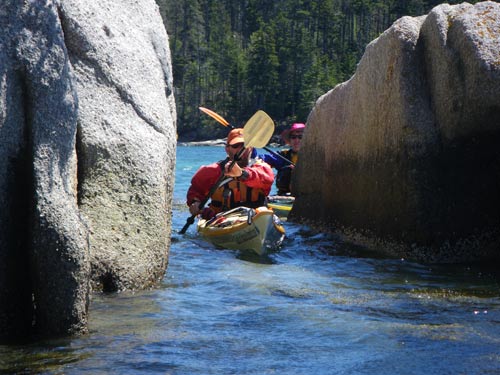
 It felt good to paddling away from Webb Cove, to be able to focus on a good, efficient stroke and not look back- to have no concerns for anyone else. With no real destination in mind, I pointed the bow somewhere around Grog Island; I had almost three hours.


We had been at Old Quarry Ocean Adventures for a week, living in the apartment above the office. The days started early, when we could hear guests trickle-into the office downstairs and chat with whoever was working - usually Bill. And though we’d like to spend our days guiding and teaching kayaking, we’ve also been learning the ropes in the office and on the waterfront, getting a feel for all the various jobs here that need to be done. If we walk downstairs, we get pulled-into whatever is going-on. Very little has been routine.


But in-between tasks we manage to get out on the water on our own time- sometimes poling a canoe or on a standup paddleboard. One day I paddled out to Wreck Island and did some volunteer brush clearing with the MITA crew. Another day I taught a Fundamentals class in Bar Harbor for Pinniped.


With no particular destination in mind, my route took shape as I paddled: past Grog and over to Millet. There wasn’t much wind and the sun shone brightly- the sort of brilliant stillness that descends over the archipelago on summer Sunday mornings when no one is hauling or setting traps. The only lobster boats I saw were carrying a few passengers on post-fourth of July excursions.


I stopped at Shivers Island and had a look around. After only a few years as a MITA island, the impact of visitors is obvious. Originally there had barely been room for one tent beside the boulder overlooking rock ledge sloping down to the water. Gradually, as campers came, presumably in bigger tents and in greater numbers than the recommended two people, a niche was carved from the forest, with limbs cut from the trees to make room. At one point, right after the island’s MITA designation, I pulled apart a fire ring that a camper had built directly on the ledge, scarring the rocks black. Perhaps, aside from the fire, the impact is acceptable- people can enjoy the island by walking around the interior- a choice, like the choice to keep the meadow on Wreck Island open instead of overgrown. Not my place to judge, but it can be a little distressing to see a place go from untouched to heavily-trod.


Everyone seems to think that their impact is less significant than that of others. I recently spoke to a youth group leader who wanted to camp on Steves Island with fourteen teenage boys, and he assumed that the MITA rules were for people with greater impact than themselves. I reminded him that their presence would likely be tough on anyone else who might be camped on Steves- a very popular island, and that there were several islands more appropriate for a group.


But that’s how it is in the summer here, and I’m getting a much closer look at the comings and goings of visitors. Over the weekend the campground was overflowing with campers, plenty of whom had nice kayaks and left in large flotillas. Despite my being on the water so often, I still get a little twinge of envy when I’m not, so it was good that Sunday morning I headed-out on my own. I also needed to get-in a little all-out forward stroke time: no “guide’s stroke” where you’re hardly paddling so that people can keep up with you.


I went out around Saddleback and Phoebe, took a little break on Enchanted and back around Devil: a quick, meditative jaunt around some favorite places, steering clear of other boaters so I could stay in my own mental space for awhile.


Sunday, June 28, 2015

Webb Cove in the Rain

Here we are again, finally, in Stonington. It’s a grey, rainy day, temperature in the mid-fifties, wind picking-up: a day much like some we had in Georgia in January. It’s not an inviting day to get out paddling, but my eyes keep wandering out over Webb Cove and I know how invigorating it would feel: the chilly water and wind, the waves bashing against granite. My mind wants to go, but my body says otherwise.


We arrived here at Old Quarry last night and moved the contents of our car into the apartment above the office. We’ve been making coffee and figuring out where stuff goes, looking outside thinking “should we paddle?” But I’m feeling worn-out, my limbs heavy and sore, a blister on my big toe still subsiding. It’s from the last week of play, and perhaps the last month of travel catching-up. We’ve been on a lake in New Hampshire, a family place where I haven’t spent much warm-weather time over the last dozen years. I was glad to be at the lake, and though it’s a nice place to paddle a kayak (and we did most days) I felt more inclined to hike in the mountains or try my newly-learned canoe-poling skills.


Actually, I spent more time there gardening, trimming brush on the point where, 25 years ago this August, Rebecca and I were married. I spent hours with loppers and shears, sometimes while standing in the water, trimming the undergrowth that was crowding-out the twisting mountain laurel with its snowy bunches of flowers. I’d tell myself I’d just cut away a few branches, and my focus would narrow into a meditative state: clip, clip clip, and onto the next. Hours would pass and I’d look out at the lake and the mountains and think “gee, I should go paddling.” Then I’d start trimming again. I guess, deep down, I’ve got some need to take care of a piece of ground. We felt it in Georgia, where I mowed the first lawn we’d had in 17 years, but resisted most urges to get into long-term landscaping. Rebecca and I have moved around a lot, but the point is the one piece of ground that we keep returning to.


But on Thursday I went hiking. I chose the Skookumchuck Trail trail because it ascends the 3000-plus feet to Mt Lafayette’s summit in 4.7 miles, rather than the more popular, but steeper trails that make the climb in a shorter distance. I wasn’t on top of my walking routine, and I’d hardly even walked up any hills since last fall. I imagined an easier walk, but in the first ten minutes of my hike, I knew that the summit, should I get there, would be hard-won. So I tried to slow down, pausing by the brook to take pictures of flowers. There was no one else on the trail.


I have hiked up Mt Lafayette many times since I was ten or eleven years old. The sixth-highest of New Hampshire’s White Mountains, Lafayette is the high point of the Franconia Ridge, a spectacular stretch of alpine tundra that drops steeply away to valleys on either side. Aside from the more gradual grade, the Skookumchuck Trail offers a less populated walk; only one other car was parked at the trailhead. After about three hours of quiet, solitary walking, I encountered the other hiker- a man a bit older than me who’d paused at timberline. We chatted for awhile and then I continued onto the ridge.


Lafayette’s summit was crowded. I ate my lunch, watching hikers arrive and pose for photos. I obliged a French-speaking couple who wanted pictures of themselves, but didn’t ask for the favor in return, thinking I didn’t need another shot of me on a mountaintop. Then I thought better of it and felt strangely self-indulgent and vain when I snapped a couple of selfies. After all, who knows when I might get there again?


The part I’m leaving out- and my excuse for including this story in the blog, is the pain. Going up that hill was hard work, and several painful spots had developed well before I reached the top. For the trip down, I used my trekking poles to reduce the impact on my knees, but a hot spot on my big toe officially turned to a blister that I felt with every step. It felt great to jump in the lake when I returned, but I knew I’d be feeling the hike for several days.


Add poling a canoe to the list, and it helps me, as I sit here looking out at the rain on Webb Cove, to inventory the various aches and pains. And it also helps me appreciate the efficiency of sea kayaking, perhaps explaining why it is a popular sport for so many of us who are realizing, bit by bit, that we’re not getting any younger.

Saturday, June 20, 2015

Easing Into Maine


Sunday morning, Old Quarry Ocean Adventures, Stonington. We unload our boats and get our gear together, and the people start to arrive. We’re here for the third annual Wreck and Round Islands cleanup trip. When we lived full-time in Stonington, I was the steward for these Island Heritage Trust islands, and since I also worked at Old Quarry, it seemed like an obvious connection- provide a free guided trip to get a bunch of volunteers out to clean up the islands. After we left, we were pleased to learn that Island Heritage Trust planned to continue the tradition - Anne Douglas had agreed to lead the trip in our absence. But we were even happier when we realized we would be able to join the trip personally.


It takes awhile, as people trickle-in, to get us all ready and on the water, but eventually we’re all pointed toward Indian Point- a very familiar route. The day is warm and calm, and since it’s a Sunday, largely free of lobster boats. In the group we have three tandems and nine singles, three of whom are guides. Our group includes a couple of pre-school girls who ride with their parents in tandems, as well as a few people trying sea kayaking for the first time. We head across the Thorofare to Russ Island and I glimpse Stonington- my first view of it since that frigid morning in January when we left.


The path to Wreck Island is very familiar, and on this calm day, an easy, hour and a half trip. We land and have lunch before splitting into smaller groups to clean-up stretches of shoreline. I paddle over to pick-up the shores of Round Island with two friends. A couple of hours later, we’ve assembled large caches of garbage above the beaches- mostly fishing-related. A skipper from the Maine Island Trail Association arrives in one of their distinctive red Lund skiffs to haul the garbage back for us. Marissa, the organizer from Island Heritage Trust, passes around a tin of home-made cookies and we get ready for the trip back.


It’s one of those rare days when it seems we have wind and current behind us the whole way. We hardly need the break on Little Camp Island, but I figure it’s worth it for anyone who hasn’t experienced the sweeping views from the top.


As much as the trip’s purpose is to clean-up a couple of islands, it may be more important to get a few people out there enjoying them who might not otherwise have the chance. And even though we guide and teach to make a living, a trip like this seems to embody the real reasons we do it.

Sunday, May 12, 2013

Guide's Class


At Old Quarry, the culmination of our 6-day class for aspiring sea kayak guides is a camping trip out to the islands. This year Nate and I taught the class and we were fortunate enough to have along a willing pair of practice clients, who we treated as we would treat any customer.  The fact that they were a pair of journalists on assignment for Maine Magazine added yet another angle, putting our students on the spot, yes, but what better way to learn than to guide actual clients?


For the previous four days of the class, which occurred over two weekends, we had spent time in the classroom and on the water, covering much of what one might need to know to be a sea kayak guide: everything from group management to rescues and weather. In addition to teaching practical skills, we were also preparing our students for the Maine Guide licensing exam.


Our clients, Sandy and Frank, arrived on Saturday morning just as we finished in the classroom. We equipped them with drysuits and dry bags and we all gathered down at the launch to pack. One important part of guiding, for the exam and in real life, is the pre-trip briefing. This is akin to the spiel that a flight attendant delivers before take-off, imparting a few important details, like what to do if you capsize or get separated from the group. We had our students deliver the pre-trip and we headed-out.

 
When we guide, the trip belongs to the clients and we try to provide them with the experience they want, as long as we can do it safely. So when we’re guiding student guides, we want them to learn how to best communicate with the clients; how to keep them safe without diminishing their sense of freedom and discovery. It is a learned skill that evolves with practice. So, at the very start of the trip when we embarked in the opposite direction I expected, Nate and I conferred: just go with it, we decided, see how it works out. But when we started into the channel with a lobster boat headed our way, we cut-in and suggested we wait for the boat to pass.


We ate lunch on Hells Half Acre and continued. With occasional pauses for quick lessons, we made our way out past Millet, and on to our destination on Saddleback. I watched our guests, wondering if this felt like fun, as any guided trip should, or if it just felt like a lot of work. I guessed it fell somewhere between the two, but the bonus for our guests was that they were learning much more than they otherwise would- skills that most paddlers don’t learn until they decide to guide other paddlers.


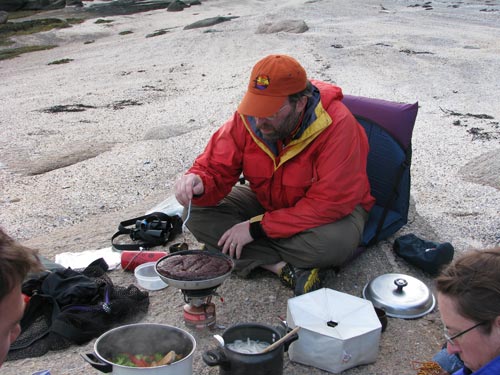
We arrived on the island and set-up camp, choosing a rocky outcrop above the water for our dinner area. One conflict I have with guiding overnight trips is balancing my personal, minimal approach with what others expect. My dinner is usually made by boiling water. I make an insulated mug of tea that will last me all evening, then I heat some ready-made packets. Last week I had pad thai one evening and an Indian lentil dish over rice the next. I’ve always been quite satisfied with this. Dinner takes about 20 minutes, 30 tops. There is almost no clean-up. This allows me to spend my time paddling or exploring... or perhaps just sitting out on the rocks with a book, enjoying the sunset.


With a group it is always a more cumbersome process, partially because it isn’t very cost-effective to do otherwise. Also, we want to impress. And our dinner that night was impressive: a stir-fry and rice combo with choice of tofu or chicken. Certainly tastier than my instant dinner packets. While dinner cooked, we sat on the rocks, ate Goldfish and chatted. Sandy asked a lot of questions, while Frank shot numerous photos with at least two cameras; now they were working.


I woke up early and took a walk. I watched the sun rise and did my stretches. I’m not always an early riser, but I prefer to be up before others on a group trip. That span of time for myself seems to make it easier the rest of the day to accept that it is no longer my time. I returned to camp and found Nate making coffee. We sat for a long time, talking about what we thought was going well and what wasn’t, what we needed to focus on for the last day of the class. In six days, we couldn’t possibly cover everything. We would need to let the students go and trust that they would layer this instruction with more practice, study and experience. Some would be taking the guide’s exam within a month or two, and while their success or failure reflected upon us, we cared far more that they were confident and able leaders... all of which began with their own personal skills.


The others gradually awoke and drifted toward the smell of coffee. Nate made French toast. We launched mid-morning and made our way back, stopping at one more island for lunch. I was impressed with our guests. Sandy, concerned that she might not keep up with the group, had focused on learning a good forward stroke, and it showed. And when we paused before crossing the Deer Isle Thorofare-- our last such crossing of the trip, Frank spoke-up, suggesting that it might be a good place to take a range to ensure we didn’t drift sideways with the current. Everyone laughed; after all, this was the guide’s role, but he was right. Accordingly, our guide for the crossing lined-up Humpkins Ledge with Indian Point and away we went.


Sunday, February 17, 2013

Saturday in the Archipelago (In February)


At Old Quarry, the road to the ramp lay covered in snow from last weekend’s blizzard. We got into our drysuits in the heated office and pulled our boats like toboggans through the woods. We then carried them down the slippery granite steps beside the ramp at low tide. Heavy clouds hung over the archipelago, but with the air temperature above freezing and not much wind, it looked like a good day. Nate and I gave a minimal pre-trip briefing and we headed out.


This guided trip was the result of Island Heritage Trust creating an event for the Maine Great Outdoors Weekend.  I wasn’t sure I wanted to guide the trip. I have no desire to encourage others to paddle in the winter. The risks are far greater than the rest of the year, and it’s probably better for paddlers to incrementally increase their risks as they increase their skills. Going on a guided trip allows paddlers to abruptly leave their comfort zone -- maybe not a good thing. But it allows them to take those risks with guidance, perhaps building skills and confidence to eventually do it on their own. 


So it seemed important to get paddlers with some experience. Four of us were licensed guides who had recently practiced rescues in the pool together, while another had taken Nate’s Paddler Development Week course in September. We’d hoped for a few more clients, but it was really no surprise that most people don’t want to go for a paddle in the winter, and it's maybe just as well.


Since this was an Island Heritage Trust trip, we thought we might visit some IHT islands, starting with Millet. We didn't have much of a plan, but we anticipated stronger afternoon north winds, along with some rain or snow. The wind picked-up as we ate our lunch in the lee of some rocks on Millet, and we decided to head west into the archipelago, hopscotching behind a few islands. We found a pleasant minor swell along Spruce and McGlathery, and played a little in the rocks.

 
It was a quiet day: no lobster boats, rafts of ducks squawking like horns of distant traffic... and us, just meandering along. We passed more IHT islands: Round and Wreck, but we kept moving. I think everyone figured-out that you get cold when you stop.  But by the time we made it to Little Camp Island, it was time for another break: hot tea, chocolate, PB&J- it all helps keep you going. Plus, it's not far to the top of the small island: a bargain view, just as it began to snow.


By then, we were on our way home, and the snow felt like a bonus; you go paddling in the winter, you ought to get some snow- right? And it makes us feel rugged to squint our eyes and paddle into the teeth of the storm.


Tuesday, May 4, 2010

Guide Training


We met upstairs in the new classroom building at Old Quarry Ocean Adventures. There were seven of us: Rich MacDonald, our instructor, and six students. The goal, over six days of instruction, was to prepare us for the exam to become registered Maine sea kayak guides. Every spring, outfitters up and down the coast need to fill positions for kayak guides, and candidates of varying levels of experience take these crash courses to get ready.

The "husky" tow

It’s mostly classroom work, covering a lot of material, but the heart of it is safety, and in partcular, how to safely take groups of inexperienced paddlers out on the ocean. The exam consists of written and oral components. For the oral exam, three examiners from Maine Fish & Wildlife ask the applicant to demonstrate, among other things, proficiency with navigating and chart reading, wildlife identification, and the ability to communicate calmly and logically under pressure.


The crux of the exam seems to be the “lost person scenario” in which the candidate is given a hypothetical crisis. The candidate verbally goes through every step of the process, from taking care of the group and calling the Coast Guard to conducting the search. There aren’t always black and white right answers, but there are a lot of ways to fail. A calm, confident demeanor is key, as well as verbally accounting for every step of the process, including the logic behind every decision. Plenty of candidates fail this part of the exam on the first attempt... which might be a good thing.


Our class got out on the water as well, starting with some rescue practice on the pond, and some towing practice on Webb Cove. Then we paddled out to Hell’s Half Acre and spent the night.


While we paddled and camped, we worked on guide skills. Camping and camp-cooking skills take some effort to be good at it, and everyone comes to it with their way of doing things, which gave us all a chance to learn something new from the others. In particular, I think we were all impressed with the chocolate cake Rich made in his Outback Oven. Take care of your clients’ stomachs and their hearts are bound to follow.


Rich is an ornithologist, which has brought him to some unusual places, including gigs, with his wife Natalie, as naturalists on cruise ship excursions arranged by Garrison Keillor. In 2002, he and Natalie embarked on The Gulf of Maine Expedition, paddling around the Gulf of Maine, from Cape Cod to Nova Scotia. This year, Rich and Natalie are opening The Natural History Center, a shop and guiding service in Bar Harbor.


So I’m now much better at recognizing the difference between an eider and a guillemot. We also took a walk around the island, looking into tidepools, turning over rocks, learning about the creatures and plants that we often don’t notice.


So why do I want to guide? I keep learning that the sea kayak is more than just a vehicle to take you out on the ocean from place to place. It can be a practice and a pursuit that gives one direction in a bigger sense. I’ve never known what direction it might be taking me, but I’ve learned to say yes to the opportunities that come up, trusting that it somehow makes for a richer experience.

Wednesday, August 19, 2009

More Puffins


Once again, Todd and I loaded our kayaks aboard the Nigh Duck, taking Old Quarry Ocean Adventures’ puffin watch out to Seal Island, with Captain Bill Baker. We had a perfect day this time: eighty-degrees, not much wind, a little hazy, but no real fog. Sixteen passengers boarded the boat, and as we motored through the archipelago, Todd and I fielded one question after another, updating our postion on the chart, identifying the islands, and, as we entered deeper water, pointing out the porpoises and birds.


Looking down at the chart, passengers inevitably asked “so where are we going?”
I pointed to a place well off the chart, beyond Isle au Haut. Finally I got out a bigger chart and watched their eyes widen when they saw how far we were going.

As on our last trip to Seal Island, Todd and I were playing it by ear, waiting to see what the conditions were like before committing to a plan. As we passed the end of Isle au Haut, the low bump of Seal Island appearing on the horizon, we had a pretty good idea that this was our day: the conditions wouldn’t get much better than this. We began to see puffins about half way across and large pods of porpi. (If that wasn’t plural for “porpoise” before, it is now). By the time we disembarked, Todd and I had decided we would make the crossing back to Brimstone Island, returning along the east side of Vinalhaven.


Seal Island was far quieter than two weeks before. Where the rocky shore had previously teemed with puffins, razorbills and terns, we now saw groups of gulls and cormorants. The puffins floated on the water surface, taking to the air when we approached, circling us again and again. Soon they will leave the island, living on the open ocean until they return next spring.


With far smaller seas than on our last visit, we paddled close to shore, exploring the fissures and cliff faces along the exposed southern side. We met up with the Nigh Duck and confirmed with Captain Bill that he could leave us there. Waving goodbye to our fellow passengers we were on our own (and soon to be snapshots in various vacation albums).


Finally, we pointed our bows to 10 degrees and began paddling. Eight miles away, Brimstone Island lay obscured in a haze. A mild swell occasionally lifted our sterns, but the paddling remained easy. Occasionally, a gannet or puffin circled around as if curious about these strange little craft so far from shore. After an hour, we rolled to cool off and took a break, dangling our legs out of the cockpits to stretch out. We did the same after two hours, and each time a large grey seal surfaced nearby and stared at us for what seemed a long, thoughtful moment.


Finally, the quiet gave way to the crash of waves on Little Brimstone Island, where large rafts of ducks swarmed the water surface, emitting a sound not unlike the hum of a large, restless audience. We had arrived.


After two and a half hours, it felt like waking up. Now there was shoreline. Now there were rocks. We paddled among them, finding the slots and passages, the mild swell lifting and dropping us. Finally, we found a small beach on the south side of Brimstone, and took a break beneath the steep, rocky hillside.


From Brimstone, it took us less than three hours to get back to Stonington. We rode a strong current along the east shore of Vinalhaven, covering nearly six miles in the first hour. After Stoddart Island, we pointed toward Mark Island light and the water tower in Stonington, making a five-mile crossing via the Brown Cow to Mark Island, where we took one last break, savoring that “exhausted, but you know you’ve made it” feeling.


Well, that’s one way to paddle 25 miles on a Sunday in August and never encounter another kayak. Thanks to Old Quarry for getting us out there.