Showing posts with label Downeast. Show all posts

Monday, October 25, 2021

Baileys Mistake to Lubec


We floated in our kayaks below the bluffs of Jims Head. Beyond the harbor entrance, a jagged horizon of rough water undulated offshore. We hoped that it marked the edge of a massive eddy that would diminish as we made our way along Boot Head and the tidal current slackened, affording us the least-bumpy passage around the head. 


It was a brilliant, clear day, and Jims Head rose steeply from the sea upon tall fins of dark, flaky rock. There were six of us. Most had been on a Downeast multi-day trip I’d guided at the end of August, and we were continuing from the spot where we’d had to cut the trip short. There’d been some bad weather coming, and we’d made a hard choice, but we’d made plans to return the next time we all had a day – in October, and here we were. 


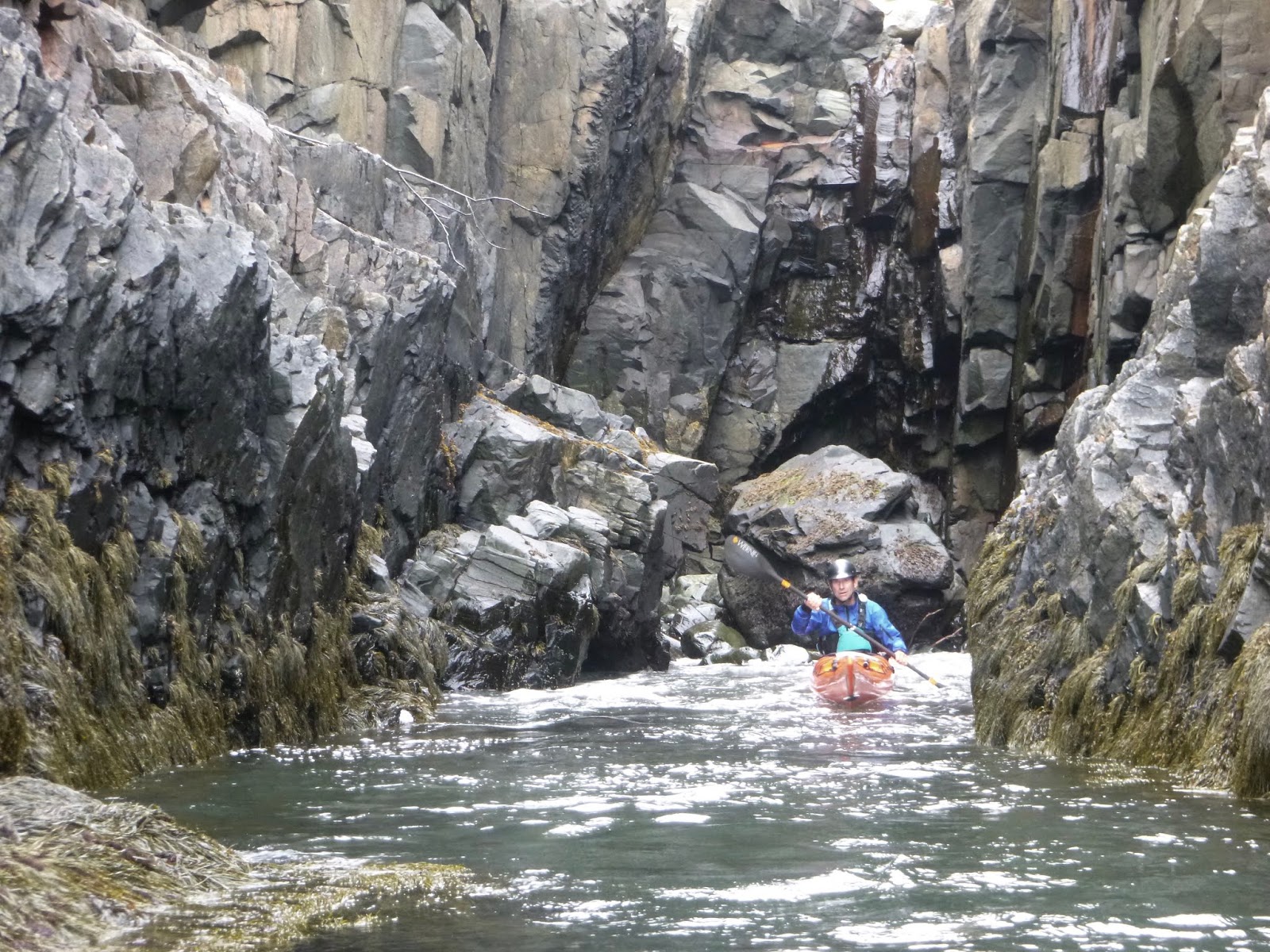
We followed the shore out toward Boot Head, and though the conditions were docile, they were perfect for some mellow play along this shore. We looked for small challenges – slots to back into, rocks to get buoyed over by waves. The challenges grew progressively as we made our way along the shore. Finally, we took turns paddling into the tallest, darkest chasm on Boot Head. You back in so you’ll see the waves coming your way, and it makes it easier to paddle out quickly if the need arises. You go one at a time, alone, and as you venture backward, alternating your over-the-shoulder view of your destination with that of the bright entrance beyond your bow, your companions become distant silhouettes, occasionally eclipsed by a wave rising between you, You’re dwarfed by the soaring walls. You look up and see the crack of light above, the blue sky outlined by spruce. The walls are damp, mossy, echoing each time a wave thunks into the rocks behind you.


We were paddling the eastern end of the Bold Coast. We’d launched in Baileys Mistake and hoped to finish somewhere north of West Quoddy Head. We’d left a car in town in Lubec, so we could shuttle back to the launch. This easternmost section of the Maine coast is a stretch of steep, craggy shoreline dropping abruptly into the Grand Manan Channel. Known as The Bold Coast, the twenty-or-so-mile section between Cross Island and West Quoddy Head has only a few small islands to buffer coastal boaters from the open Atlantic, and just a handful of small coves or harbors. In addition, the tidal current accelerates between this shore and Canada’s Grand Manan Island as it flows in and out of the Bay of Fundy, known for having one of the highest tide ranges in the world. 


For some paddlers, the Bold Coast is a challenge standing in the way of larger goals, as it was the first time I paddled it with my friend Todd. We were paddling from Stonington to Lubec and at that time there was little info available about the area. Guidebooks suggested avoiding it. We learned what we could, including the popular theory that you could just catch the flooding current and make it from Cross Island to West Quoddy in about three hours. It didn’t work that way for us, and I now understand how little I knew about tidal currents back then. And even though I think I now understand the currents better,  I still expect surprises. Maybe that’s part of what keeps pulling me back there. 


In the years since, I’ve paddled the area various ways, but have found it most rewarding to take shorter trips that allow for ample shoreside exploration, especially if the conditions are calm enough to get in really close. Yes, you could go far enough offshore to catch that big current, but it’s likely to feel like simple “Point A to Point B” paddling – highway miles, and I wouldn’t go out of my way to do that. I’ve also paddled a hybrid route – staying near shore as far as Boot Head and going offshore for the last 6 miles to the lighthouse in an hour – or vice-versa.


On the last Saturday of my guiding season, we met again at Baileys Mistake, joined by Todd (see trip #1 above) who’d been guiding with us over the summer. The day couldn’t have been much nicer. There was a bit of an east wind, and it did happen to be during an auspiciously big tide range (max flood in Grand Manan Channel approaching 4 knots) but it felt almost warm enough to skip the dry suit (but not quite). After paddling into the chasm on Boot Head, we stopped for lunch at Boot Cove, where a few hikers eyed our kayaks curiously (the Boot Head Preserve is owned by Maine Coast Heritage Trust and has nice hiking paths leading out to the cliffs, now somewhat ubiquitous on Instagram).


After lunch we continued, but as a couple of us headed along shore, continuing to find features to weave among, the others took the more direct route a little offshore, chatting with each other. Perhaps they’d had enough of all these details, or perhaps they had much to chat about – who knows? But though their route was more direct, and I was dilly-dallying among the rocks, I got a little ahead of them. I took this as a sign that the eddy was starting to increase – win-win: you get to dilly-dally along shore, and get moved along with a little help from the tidal current. Far offshore, the tall navigation buoys leaned heavily toward the southwest – current that would have been against us. So as we went around each new corner, I headed in toward shore. Though these rocks along this stretch are not tall and imposing like those at Boot Head, there’s plenty here to explore. There’s a few houses here and there, and you pass the shore of one more preserve – Hamilton Cove Preserve – before you reach Carrying Place Cove, where the shore again turns steeper along West Quoddy Head.


We got our obligatory group selfies in front of the lighthouse and then hugged the shore (more tall rocky passages to weave among) and then curved in westward to avoid the current against us in Lubec Channel. This was another test of faith in theories about tidal currents. Some wanted to head straight across and stayed far to the east of the group, paddling against more current than those veering westward. You could paddle a little farther with less current against you or paddle on a treadmill that looked more direct. Or at least that’s how it looked from my perspective, and by this point as a guide, I felt inclined to let people figure it out for themselves if they didn’t want to follow me or test my theories about it. 


The current beneath the bridge was largely diminished by the time we passed beneath. We made our way around the breakwater to the take-out. 


Thursday, September 12, 2019

Mellow Days Along he Bold Coast


We’d been working without much break since June. The guiding business had done well, and in addition we’d kept-on with some of the home improvement work, hedging our bets in case the kayaking work didn’t come-in. But it did come-in, so we worked every day, trying to keep up with it, the rest of the summer stretching ahead like marathons yet to be run. Finally, on Labor Day, we tied the Delphins atop the car and drove Downeast. We felt a weight lifted, just to be driving, a few days-off ahead.


We took a few kayak excursions off the Bold Coast, paddling it just the way we like: no need to get anywhere, just tooling along the steep rocks, exploring, looking for waves to buoy us over ledges or through chasms. 


Despite windy forecasts, the conditions were perfect for near-shore wave and rock play: small swell gently rolling-in, nothing too big. We did this each day, taking-on short stretches of the shore, retracing our routes as the tide changed, revealing a different set of features. It was the first time we’d paddled together in a while, the first time in a while either of us had paddled without a guest. 


On that first excursion I caught a wave between some rocks – one of those moments when you’re not sure if it will play-out like you hope, but a pillow of refracting wave bounced me along into a watery pile-up that left me in a calm pool when the wave went back out. I felt myself smiling, We’d felt worn-down enough on the drive up, that it almost came as a surprise, this smile. 


The new guiding business had evolved over the summer. I began with the idea we would simply be guides for hire, and try to avoid investing in too much overhead like boats and gear. But I suspected that this approach might take a while to catch-on, so I started offering scheduled day trips through Air BnB Experiences. This has gone well. I’ve offered regular trips in the Brooklin Islands and Stonington as well as the Cranberry Islands and a few sunset trips. The private trips and instruction filled-in the rest, including a few multi-day trips. Rebecca was further busied with her studio-gallery in Stonington, and filling-in at the Old Quarry shop. 


All this time we lived in our vintage (old) thirteen-foot travel trailer on a friend’s property in Deer Isle. It was tight, rustic living, but nice, despite this being a banner year for mosquitoes. I built a small deck with a screen room as a vestibule, which gave the mosquitoes a place to congregate and feel welcome before proceeding to the inner sanctum where we slept. Evenings found me rinsing gear and hanging it out, hoping it might be somewhat dry before I needed it again in the morning. We roasted vegetables on the grill as it grew dark and usually fell asleep exhausted. We’d wake with sunrise and think ‘what now?’ In those last weeks of August we looked forward to the four days off we’d planned way back in April. 


Anyway, that’s what we’ve been up to, in case anyone has wondered why this blog has been dormant. I feel less inclined anymore to write about trips with guests, and that’s pretty much all the paddling I’ve done for a while. I’ve had very little down-time these last few months. But I’d like to have a few more days like the ones we spent along the Bold Coast. We were in a rented cabin, and when we weren’t on the water, we stared-out at Grand Manan Channel, puzzling over the mysteries of this stretch of coast, watching the water surface for indicators about current direction. The seas were generally calm. It was foggy about as much as it was clear. 


In our kayaks, we just followed the shore, looking for passages among the rocks, riding occasional waves, gradually emptying our heads of clutter. 


Driving back to Stonington, where we would be cat-sitting for the next few weeks, we felt pleasantly drained, not quite ready to leave the quiet behind, but I also looked forward to returning to my work, which over the next week would include several full days and an overnight off of Stonington.


Notes
Looking for more particulars about paddling off the Bold Coast? Buy my book, AMC’s Best Sea Kayaking in New England. The Maine Island Trail Association’s annual guidebook also now includes some good info on paddling this volatile area. If it’s not obvious from my observations here, I think a great way to explore this area is to take smaller day trips, rather than the end-to-end approach that some paddlers follow when they want to ‘do’ this spectacular stretch of shoreline.

My article Dallying Downeast came out in July’s Small Boats Magazine. The article covers the same trip that inspired a forthcoming book… hopefully out soon. 

Want to book a trip with me or Rebecca?  Check-out our website or our listings on Air BnB Experiences.


Friday, July 27, 2018

Greetings From Tumbledown Dick Head!


I’ve wanted to use that title for some time now. Tumbledown Dick Head is a steep section of shoreline on Pleasant Bay, in Addison Maine that until a few days ago I’d only experienced as that – a feature on the chart that just naturally seemed to invite exploration. Nate and I have been fond of using it during tabletop navigation exercises, and last year, when Rebecca and I camped nearby during our Upwest and Downeast trip, I kept looking forlornly up the bay, wanting to check it out. We finally managed to get there. 

 
We had a day off and drove to the Addison Point launch, where we caught the outgoing tidal current on the Pleasant River that helped us along. The wind from the south made it a bumpy ride, and by the time the river turned to Pleasant Bay, fingers of dense fog began drifting in. We navigated buoy to buoy, a quick ride to Mink Island, a tiny MITA island, where we stopped for lunch and the fog thickened. We found ourselves, as we often do, off in our own little world for a bit.


We were already feeling good just to be away from work, off the island (Deer Isle) for a day, to be off doing our own thing for a change. I hadn’t driven to many new places to launch for a while, and it all felt familiar and good… stopping to pick up a submarine sandwich to take along for lunch, chatting with a local guy who’d just returned to the launch after tending his recreational lobster traps, watching the current heading out to sea, knowing we’d planned well and we’d get a considerable push from it. And then finally, landing in a place we hadn’t been before, checking out the campsite, taking it all in.

Since this is the Maine Island Trail’s 30th year, they’re doing a challenge called “MITA 30 in 30” that encourages people to visit at least thirty MITA islands this summer by offering a cap for those who manage 30 islands. I’ve been posting photos on Instagram as I’ve visited the islands, which has been a fun challenge and an easy way to document it.


If the fog had been less dense, we would have continued to Sheep Island, which we enjoyed so much last summer that we stayed there twice, and even spent a zero day hanging out there. But the fog was about as dense as it gets, so instead we paddled through the Birch Islands and followed a bearing over to the Addison shore, where we visited Marsh Harbor Island, another MITA island, and then followed the shore north to Tumbledown Dick Head.


As far as I can tell, the odd name of the place probably comes either from Richard Cromwell, a 17th century English head of state whose ineffectiveness earned him a short time in power and the nickname, or from a pub named after him. Either way, it made me want to go to this place, which is worth visiting – a steep cliff rising from the bay – but perhaps less singular than its name.

Of course, by this time, low tide had come and gone, and we had a nice push from the current to help us the 6 or 7 nautical miles back to the launch.

Notes
You can see my Instagram photos here. I've more or less stopped using Facebook except to post this blog - for several reasons, but I enjoy the photo sharing more than the sharing of just about everything else that you find on Facebook. I know - you probably followed the link here from Facebook... probably the only reason I still use it at all.

Thursday, September 14, 2017

The Bold Coast: Boot Head


I had a lesson to teach on Cobscook Bay, so Rebecca and I used the opportunity to get away for a couple of days and get in a little paddling and hiking of our own. We’ve been at Old Quarry in Stonington, doing a bit of everything, and it felt good to be going down the road, off in our own world again.

Meeting the locals at Cobscook Bay
We camped at Cobscook Bay State Park, and after my lesson on Monday we went in to Eastport to poke around in a way that we really couldn’t when we were camping out of our kayaks. The town seemed quiet, recovering from the weekend festivities – a Pirate festival, and there wasn’t much going on. We strolled the empty sidewalks, peering in windows: antique shops, galleries, a marijuana dispensary, a pet store… We looked at the statues and the waterfront and pondered the menu at a restaurant before deciding to return to the campground to make dinner. 


But Tuesday we had all day to explore and the weather was fairly calm and warm- almost hard to believe how nice it felt. Like summer. We launched at Baileys Mistake, at a launch mostly used for the 8 or 10 lobster boats that moor nearby. There’s not much parking there along the roadside- barely enough for the fishermen’s trucks and trailers, so at this point it’s not really a dependable launch for kayakers, but I heard it was being acquired by a land trust. Hopefully this is true and they will develop the parking enough to accommodate both fishermen and recreational boaters. The launch adds considerable possibilities to Bold Coast paddling – easier access to (or a bailout from) the stretch between Moose Cove and Quoddy Head (Route #2 in my guidebook) which includes Boot and Eastern Heads, cliffy sections of coast with plenty of nooks to explore if the seas aren’t too big.


We paddled out of the harbor and soon exchanged our caps for helmets so we could get into some tighter spots among the rocks. The mild swell felt perfect for some gentle play, and we made our way along the shore slowly, looking for small challenges. We hadn’t done much paddling like this for awhile. The last time we’d passed here we’d been offshore in a dense fog, a thirty-four mile day that afforded us little time or energy for anything beyond getting to our destination. Today, with no destination, we paddled our barely loaded, nimble Delphins – the opposite of the sort of paddling we’d done most of the summer, and we felt playful, cut loose, remembering how it feels to make a tight turn through a slot or let the surf take you over a ledge, simply because you can.


Currents get to be fairly consequential in this area, but for the first stretch we noticed very little current close to shore- not even eddies. We rounded Boot Head near mid tide though, and with the increased mid-tide current and the concentrated flow off the headland, the conditions were getting livelier. As we took a break on the beach at Boot Head Cove, we watched the surface turn into acres of whitecaps- true to form for the Bold Coast. I’ve heard plenty of sweeping statements about the place, but the most accurate and useful one is that things can change here pretty quickly, and often, dramatically.


The paddling was really no more difficult though. For us it mostly meant that our long-period small swells had been replaced with short-period bouncy chop- not really conducive to much play along the shore. That was okay- we’d had our fun and now it was a short paddle back to the launch. We were still hoping to get-in a hike. 


Last month as we paddled past the Cutler Peninsula – another stretch of awesome cliffy shoreline, we saw some hikers atop the bluffs and wondered how they’d managed to get there. Chatting with some local walkers on another trail, we heard about a trail that goes out to Western Head in Cutler, down near the end of Destiny Bay Road, and we thought we’d give it a try. We weren’t too surprised to find a 247-acre preserve owned by Maine Coast Heritage Trust, preserved since 1988.  It has a small parking area- maybe room for 5 or 6 cars, and maybe it’s good that it’s a well-kept secret, since it is an absolute gem. A 3.5-mile trail follows the Little River out to the head where it loops along the bluff-tops with views out to Grand Manan and southwest toward Cross Island. The trails are well-maintained, and you get some nice glimpses of Cutler Harbor as well.

Notes:
Route #2 in AMC’s BestSea Kayaking in New England covers the area between Carrying Place Cove in Lubec and Moose Cove. The launch in Baileys Mistake is not included, but if it really is being acquired by a land trust and the parking situation improves, it will make it into the next edition. Conditions during today’s paddle were mild, but the guidebook has much sterner warnings as well as strategies for paddling this area. One of the most volatile and remote areas of the New England coast, it is not a place for inexperienced or unprepared paddlers.


Here’s a link to some more info on MCHT’s Western Head Preserve. And here’s a link to the MCHT website, which does have information on their other nearby preserves, but not this one.  


Tuesday, August 22, 2017

Upwest and Downeast: Almost Done


I nearly titled this 'almost home,' but knew that it wouldn't be quite correct. We'll be back to Deer Isle by Thursday or Friday, and it is about as close to home as we have, other than this feeling we carry with us as we paddle up and down the coast, a sense of being where you should be. We get our mail in Stonington still. We have friends there, and a rented storage space where our stuff is stored and where Rebecca keeps her studio, but no house or apartment or place to live (we've mostly house-sat the last couple of years). We rent a few spots in a kayak storage space by the town boat ramp,  and until summer kicked-in, were regulars at pickleball, twice a week at the Community Center. 

This was our fifteenth summer living in Maine, but it's the first in which I've tasted the sense of joy and freedom that I hoped I'd find when we came here. Much of that comes down to economics. We haven't worked since June. And yet we've spent very little money on this trip. Probably less than we usually do on food,  two nights at a commercial campground... a tank of gas at the beginning of the summer. And of course the usual overhead: health insurance, phone bill... a tank of gas in a car that's been parked all summer.  The storage and studio... subscriptions to unwatched Amazon and Netflix.

We haven't lived in a way that most people would find comfortable. It's been weeks since the last real shower, and pooping into a plastic bag has become surprisingly normal. We've eaten well, including a shared pint of ice-cream in most ports. We're a bit damp much of the time, with a layer of salt that seems to permeate the skin. I do look forward to a long soak in a tub of hot water. Obviously this existence- even as a temporary foray- isn't for everybody. Which is good. We've had little competition for campsites and have encountered amazingly few kayakers, especially those who seemed to be going somewhere or camping.

It's premature to recap the trip, but knowing that we're almost done brings-on a wistful sense of melancholy. All those summers we worked so much, and they went by so fast. Well, this one went by fast as well. Many people tell us this is the trip of a lifetime, and they're right, but all we can think is that we want lots of trips like this in our lifetime, or even that we want our life to be more like this.

Right now I'm sitting on a comfortable slab of rock on the south end of Stave Island, in Frenchman Bay. Rebecca is nearby, painting. I don't know what she's painting- the fog has come in pretty thick, obscuring most everything out there, but a little while ago you could see it rising over the Porcupine Islands with Cadillac Mountain in the background. There's a storm forecast for tonight and we decided yesterday that this might be a more comfortable spot than the ones ahead. I think we also just liked the idea of one more time-out on an island, without rushing back to Deer Isle.

Since my last post, we left Dickenson's Reach, up at the sheltered head of Little Kennebec Bay in Machiasport, and made our way down to Jonesport, where we once again bought a few supplies and refilled water at the Moosabec Variety (you can still rent VHS tapes there too). We continued on to Sheep Island off of Cape Split and spent 2 nights there to wait-out predicted rough seas (don't  think they got too rough, but we were glad to stay there). We identified the nearby home of modernist watercolorist John Marin (the weird-sounding seabird that turned-out to be an alarm system helps give it away) but never got over to see, up-close the bluffs of Tumble-Down Dick Head. It's good to save things for future trips.

On Sunday morning we paddled into Milbridge for groceries and headed out to Bois Bubert Island. From there, yesterday morning, we went around Petit Manan Point, on to Corea and then around Schoodic Point during the eclipse. Quite a crowd there;  it felt as if we were sauntering along the outskirts of a party, where everyone was waiting for the band to start, but had kind of forgotten what they were doing there and hey, the light is kind of funny now, isn't it? And we'll give the eclipse credit for the big eddy that took us all the way here, against the dominant current.

Just after lunch today, we spied two skiffs coming our way, and they turned out to be MITA boats, carrying the Maine Island Trail Association's Trail Committee. We're not on a MITA island, but they were checking things out, and we had a sort-of impromptu meeting right there, discussing such things as the need or feasibility for sites along the Bold Coast. They took our trash away and left us with some extra water. And provided us with more human contact than we've had in awhile, which was welcome.

Over the next couple of days, we'll meander back to Deer Isle- only two or three days and nights, and maybe a stop at Old Quarry for a shower before we pack our gear into the car an head over to a family lake home in New Hampshire, where we have a week to recover a bit while hanging-out with some of the constant people in our life. Then we're sort of transient again. Maybe a little teaching and guiding in September... a dentist's appointment... and maybe some time up in Newfoundland with Rebecca's parents. For now though, this fog has come-in thick and cool. Time for some food.


Thursday, August 17, 2017

Deer Isle to Eastport


The second part of the trip has gone quite differently from our first month paddling. If you're just tuning-in now, we've been paddling the coast of Maine since July first, a trip that began in Deer Isle with a meandering route and pace that took us to Portland and back to Deer Isle- some 330 miles in 34 days, with a few zero days for weather. Part of our aim was for Rebecca to do some painting on the islands along the way, and I of course would at least write an occasional blog to keep up with things. 

We were guests for three nights in Greenlaw Cove at the house where we house-sat last winter- time that included some resupplying and other tasks, as well as some socializing... which was great but a little weird. I felt very preoccupied, anxious to be back on the water. Unfortunately, Spider-Man, which had been scheduled to play at the Stonington Opera House, was cancelled. 

We got underway again on Sunday, August 6th, paddling over to Naskeag Point where Steve Stone from the website Off Center Harbor did a video interview with us. It probably won't be out until after the trip is done. We said some brilliant things as well as some goofy things, but I understand they can edit it to make it go in either direction. Camped that night on Little Hog Island. 

Since I'm still in the middle of this trip, and I have adventures yet ahead of me this evening, I'll be super-brief, but overall, this stretch of the journey has been a bit more rushed than the upwest (southern) portion. Leaving on the sixth, we had less than three weeks to get up the coast and back to Deer Isle before other commitments loomed. This stretch of coast has a few longer stretches between campsites, and a few areas that we'd rather paddle in not-too-huge days. Also, resupply opportunities are a bit scarcer Downeast, so it just makes sense sometimes to paddle some longer days. We've had far less time to hang-out and do any painting or writing. I'm still only half-way through the novel I started reading a month and a half ago. Internet and cell service is sketchier. We've had some early starts and late finishes and more or less pass-out after dinner. In short, it's the way life should be. 

Hopefully after I return I'll get some maps on here, but for now, this will have to do. From Little Hog Island we went across Blue Hill Bay, rounded the southwest end of Mount Desert Island and camped on a small MITA island near the Cranberry Islands. From there, we followed the southeast corner of MDI (Otter Cliffs, Thunder Hole, etc) and crossed Frenchman Bay, around Schoodic Point and on past Corea into Gouldsboro Bay, where we camped on another MITA site, this time on a ledge/island, that kept us about three feet above the full moon high tide.

On out to Petit Manan Island (puffins and a lighthouse!) and in to Bois Bubert for lunch and across to Sheep Island, a Downeast Conservancy island, newish to the trail, to camp. We refilled water bags and bought some convenience store fare the next day in Jonesport before continuing on to Ram Island in Machias Bay, and then to Cross Island before making the 34 nautical-mile hop up to Sumac Island near Eastport.

This doesn't scratch the surface, I know. In Eastport, we unsuccessfully tried to clear customs by phone and opted to stay in the US. A kind woman (kayak guide now watching-out for marine mammals at the pier construction site) leant us her car so we could get groceries. Topped off water at the Port Authority. We spent three nights in Eastport before grabbing our weather window for the return trip down the Bold Coast in total fog. There is much to be said about this experience beyond the mileage (34 nm again). I have kept copious notes. From Cross Island, we came here, to Dickenson's Reach, a remote mainland property on a millpond in the far inland reach of Little Kennebec Bay, in Machiasport. This was the home of simple living philosopher and yurt-guru William Coperthwaite. We're trying to soak-up that simple-living vibe. And sitting-out a Small Craft Advisory. We've got about a week to get back. Yesterday, our 47th day on this trip, the tripometer (don'T all kayaks have them?) passed 500 nautical miles. But that's just a number. It's been fun. Dinner time.

Tuesday, June 20, 2017

Breakfast on Mistake Island


Eleven of us paddled along the narrow ribbon of dark, calm water near the shore of Knight Island, shepherded by a young woman who, mindful of the seals hauled-out on a ledge a quarter-mile distant, was trying to keep us quiet. As we pulled into the cove where a sandbar bridged the gap between Knight and Mistake Islands, I saw what I thought would be the best landing spot, a small crescent of gravel untouched by the southeast wind funneling between the two islands and over the bar. We were looking for a place to cook breakfast. I hoped that our leader, who’d been taking her turn for the last mile or so, would also recognize the calm spot. The air felt cool and damp, and the breeze added a rawness that might easily induce a hypothermic chill. It was our last day on the water together though, and I felt determined to take a back seat and see what unfolded. 


The leader seemed to mull it over and then called to the guy who happened to be in front of the pack. She told him to go ahead and pick a place to land… delegating, but also leaving it to chance. He paddled ahead, and just when I thought he’d land in the windiest spot, paused and headed-in for the calm spot. I doubt that anyone but my co-instructor noticed this tiny victory, but I felt immensely relieved- not just that we would land our kayaks in the lee, but that the group seemed to be learning something, improving. In general, they learned quickly and I often felt impressed when we saw a dramatic increase in abilities or judgment. Recognizing both the existence and the importance of finding a spot out of the wind on a raw, cool day may not sound like a big deal, but the more I teach paddling, the more I realize that I take some of these more subtle skills for granted. And these subtle skills, which are often just the myriad tiny choices we make again and again, all day long, can add-up, not to overdramatize – to life or death.


We were on the third morning of a camping trip in the Jonesport – Great Wass archipelago. We’d been camping on private islands that the company had permission to use, but for our last morning, the group had decided to start the day with hot drinks and save breakfast for a more picturesque spot. This seemed a good idea to me. So much of what we did out there felt like work – training for a job these new guides would soon be doing. I hoped they would experience some of the joy of discovery that many of us feel while paddling, that thrill of finding our way among new shores to find places with an otherworldly feel. It’s that joy, I think, that fuels our desire to take it seriously, to invest in learning and improving.

Moose Peak Lighthouse, our goal for the morning, and what would undoubtedly be the visual highlight of the trip, beckoned, down at the south end of the island, a reward of sorts.


After we get accustomed to our own paddling process, it’s easy to take for granted all the things we learn to do in a particular way. Like whether or not we fling our paddle up on the beach like we’re ridding ourselves of something we’ll no longer need, now that we’re on land. Or whether we drag boats over the rocks and barnacles or if we carry them. Do we take our paddle apart and tuck it inside the cockpit where it won’t float or blow away or get stepped-on? Do we set-up the cook stove at the top of a sandbar where it is subject to the wind we were trying to avoid, or do we find a spot lower down? Do we dress for the water temperature or do we paddle in shorts and a t-shirt? Do we stroll bare-footed on a remote shore that bristles with sharp-edged shells, broken glass, urchin spines and barnacles? Do we put-on a warm hat and an extra layer when we stop for a break on a cool, blustery day?


These things are akin to hearing someone call a chart a map, or suggest that we’ll be paddling at ‘knots per hour’ rather than knots – it hurts our ears, but after pointing it out once, maybe twice, you just figure that people will need to learn on their own. Maybe it’s not that big of a deal. Or maybe they’ll find their own way of doing things that will work just fine. Or maybe they’ll just get lucky and never find themselves in cold water in inadequate gear, unable to get back in their boat or to reach the radio they’ve stowed inside a drybag in a hatch. Which is what happened just about a year ago now when a guide and client died off of Corea. 


After that happened, despite the Maine Association of Sea Kayak Guide’s and Instructors’ press release that essentially stated that the ocean is a dangerous place and bad stuff happens, a lot of noise was made about improving standards. But as the summer wore-on and the temperature went up, everyone got so busy that they seemed to forget about it. Over the winter we practiced most weekends at the Bar Harbor pool, but you don’t see too many other paddlers there, let alone guides, practicing any rescues. Lately, Nate has had a few takers for his Risk Management classes, but they tend to be the usual suspects, the paddlers and guides who already take it pretty seriously and train for the inevitable mishaps- and like me, probably find that kind of stuff fun. The Coast Guard and Marine Patrol have been checking for guide licenses, PFDs, whistles and the ubiquitous orange ‘If Found Contact’ stickers inside of kayaks, but I don’t know if they have much to say about people wearing inadequate gear in sub-50-degree water.


I can’t always tell exactly how chilled people might be, but by the time we wolfed-down our oatmeal, a few people had lost interest in seeing the lighthouse and wanted to get back on the water, I suspect, so they could start moving again and get warmer. But they waited while the others hiked out to the lighthouse, and seemed relieved to get moving again when we returned.


At some point during our ten-day class, I was asked if most guides, after getting their licenses, kept learning and practicing to improve their skills. I would have liked to have given a more positive answer, but I told them that the usual pattern seemed to be that getting their license was usually the beginning of a long, downward slide into complacency, that they begin to assume that since they’ve been lucky so far, they’re doing something right. And I suspected that this pattern helped account for two deaths a year ago. I admitted that this was not an opinion that would win me any friends, especially in the guiding community.

While many paddlers with far more paddling miles behind them, and perhaps less training may lack confidence, that guide’s license seems to instill some with a confidence that can quickly turn dangerous. I was hoping that my candid answer might have a sobering effect, that it might urge my students to treat the license as the beginning of a long path toward learning more and becoming safer. And I hoped, if my students became chilled because they were underdressed and had to wait while the rest of us walked to the lighthouse, that it would be a learning experience. Only time will tell. 


I haven’t found how Mistake Island got it’s name, but one might easily assume that someone made a mistake there once, and odds are, something bad happened as a result. But for us, it was an idyllic spot for breakfast, and perhaps the climax of the trip, before we made our way back out to the take-out.

Notes:
For more information about this area, check-out Route #6: The Great Wass Archipelago in my guidebook, AMC’s Best Sea Kayaking in NewEngland.

We're now in the process of preparing for our summer trip, and we'll be leaving... pretty soon. The 'to do' list is two pages long.


Wednesday, September 14, 2016

A Journey Downeast


We landed on the cobble beach: the usual heightened moments of a landing in small surf, focused more on the task at hand than your surroundings – pulling your own boat high enough onto the rockweed before helping the next person land and do the same, until our kayaks were all just out of reach of the highest waves. Then we had one of those “we’re here, now what?” moments. Other evenings on this trip we’d pulled-in late enough that there wasn’t time before dark to do much besides make camp and get dinner going. Now we stood beside our boats, pulled-off our gear and looked around: a fog that had dogged us the last four days had lifted, and from the look of the clouds and the dry feeling in the air, it seemed we might get a break from it. Clear, late afternoon sunlight lit the grassy hillsides around us, and after the shades of grey we’d been living in, the greens and yellows and the blue sky beyond seemed almost unreal. Aside from that, as we’d approached the island, a quartet of black-faced sheep had moved down the hillside toward the cove as if to welcome us, only to bound away after we made landfall. They stood on a distant knoll, watching us until they finally disappeared, but it still felt as if we’d been welcomed.


We carried our gear up some wooden steps to a tent platform atop a bluff, pausing every now and then to marvel at our surroundings. To the west, 7 miles beyond the rounded hilly profile of the nearest islands, lay Great Wass Island, and beyond that, barely visible, Petit Manan Lighthouse, roughly marking the area where we’d begun our trip. To the east, the startling array of 26 skyscraper-height red and white antennae on Cutler Peninsula and the cliffs on Cross Island marked the gateway to the Bold Coast. We would have been able to see these sights earlier had it not been for the fog, but now, getting the big picture, including the bold vastness of the Atlantic south of us, we felt a bit overwhelmed. E, having set-up her tent on a grassy hummock, smiled  and said “this is my favorite campsite.”


We’d begun on Tuesday in Milbridge. We’d hoped to begin farther west, but a tropical storm had paused somewhere south of Cape Cod, leaving us with residual big seas that would last through the week, as well as the warm, moist air that became relentless fog.


For this trip we had the luxury of getting dropped-off and picked-up wherever we pleased, so we spared ourselves the eight-foot seas and whatever that might look like at  Petit Manan Point, and chose instead to follow the edge of Narraguagus Bay as it went from calm to bumpy on our way out to Bois Bubert Island.


With only me and two participants, we were a small easygoing group that came to consensus about our choices fairly easily. As with most journeys, the learning focus would be more on journeying skills – the choices along the way and navigation – than on maneuvering or even play. The seas were usually a bit big for play, especially with loaded boats, but everyone would get plenty of navigation practice.


Over the next three days we made our way east through the fog. On Wednesday, after some navigation instruction, we crossed the mouths of Narraguagus and Pleasant Bays with amazingly accurate results. Then the fog cleared as we passed south of Cape Split and crossed over to Stevens Island, where we camped for the second night.


On Thursday we woke to more fog and like the previous day, took our time getting launched in hopes that it might lift.


It didn’t.


We felt our way up through Moosabec Reach, past Jonesport and across Chandler Bay to Roque Island, where we hand-railed among the outer islands in pea soup fog and rather big conditions. We couldn’t get close enough to the islands to play among the rocks, and yet we wanted to stay near enough to see them. The shore appeared as a series of white explosions where the surf hit below a vague outline of spruce. I kept anticipating the gap between Great Spruce and Double-Shot Islands, hoping to slip from the chaos into calmer water. I would start nosing northward, only to encounter more thundering surf where I hoped the gap would be. Finally we pointed-in through the gap, only to find a tide race where the swells collided with the outgoing current. And the quality of light had dimmed enough to suggest that it was then officially evening. On Halifax Island, we ate in the dark: the end of a long day.


On Friday morning the fog hung around us, about as thick as it gets.


We consulted the marine forecast and the chart and decided to go easy on ourselves. We took our time getting ready and exploring the island and not long after we finally launched mid-day, the fog cleared. It seemed so simple now, to just choose a destination and point to it. We paddled up to Roque Bluffs and over to the MCHT preserve on Hickey Island for lunch. The tall, grassy hills on Scabby Island then drew us south and on to the campsite for our final night.


From my tent that night I could see the moon over Englishman Bay on one side and the blinking red lights atop the Cutler radio towers on the other. The South Libby Island lighthouse pulsed regularly, and way off to the west came the flash from the Petit Manan light. In the morning, I sat for awhile on the highest hilltop, just absorbing the feeling, knowing that it might be some time before I passed that way again.


The waves calmed down a great deal – enough that we spent Saturday morning doing rescue practice in the cove, and then paddled in to Machiasport, where Rebecca picked us up at the launch.

On the way home, we stopped at Wild Blueberry Land, the giant roadside blueberry in Columbia Falls. Since I usually drive past at odd times, it is usually closed, but this time, prepared for the “all things blueberry” experience, I devoured some ice cream and a muffin, wishing we had time for a round of miniature golf.

This route took me to a few new spots, but much of it is covered in my guidebook, AMC’s Best Sea Kayaking in New England, in Routes 4 through 7.

Trivia:
Launch: Milbridge Marina
Take-out: Pettegrow Beach, Machiasport
Number of other kayakers seen: 0