Showing posts with label instruction. Show all posts

Tuesday, June 20, 2017

Breakfast on Mistake Island


Eleven of us paddled along the narrow ribbon of dark, calm water near the shore of Knight Island, shepherded by a young woman who, mindful of the seals hauled-out on a ledge a quarter-mile distant, was trying to keep us quiet. As we pulled into the cove where a sandbar bridged the gap between Knight and Mistake Islands, I saw what I thought would be the best landing spot, a small crescent of gravel untouched by the southeast wind funneling between the two islands and over the bar. We were looking for a place to cook breakfast. I hoped that our leader, who’d been taking her turn for the last mile or so, would also recognize the calm spot. The air felt cool and damp, and the breeze added a rawness that might easily induce a hypothermic chill. It was our last day on the water together though, and I felt determined to take a back seat and see what unfolded. 


The leader seemed to mull it over and then called to the guy who happened to be in front of the pack. She told him to go ahead and pick a place to land… delegating, but also leaving it to chance. He paddled ahead, and just when I thought he’d land in the windiest spot, paused and headed-in for the calm spot. I doubt that anyone but my co-instructor noticed this tiny victory, but I felt immensely relieved- not just that we would land our kayaks in the lee, but that the group seemed to be learning something, improving. In general, they learned quickly and I often felt impressed when we saw a dramatic increase in abilities or judgment. Recognizing both the existence and the importance of finding a spot out of the wind on a raw, cool day may not sound like a big deal, but the more I teach paddling, the more I realize that I take some of these more subtle skills for granted. And these subtle skills, which are often just the myriad tiny choices we make again and again, all day long, can add-up, not to overdramatize – to life or death.


We were on the third morning of a camping trip in the Jonesport – Great Wass archipelago. We’d been camping on private islands that the company had permission to use, but for our last morning, the group had decided to start the day with hot drinks and save breakfast for a more picturesque spot. This seemed a good idea to me. So much of what we did out there felt like work – training for a job these new guides would soon be doing. I hoped they would experience some of the joy of discovery that many of us feel while paddling, that thrill of finding our way among new shores to find places with an otherworldly feel. It’s that joy, I think, that fuels our desire to take it seriously, to invest in learning and improving.

Moose Peak Lighthouse, our goal for the morning, and what would undoubtedly be the visual highlight of the trip, beckoned, down at the south end of the island, a reward of sorts.


After we get accustomed to our own paddling process, it’s easy to take for granted all the things we learn to do in a particular way. Like whether or not we fling our paddle up on the beach like we’re ridding ourselves of something we’ll no longer need, now that we’re on land. Or whether we drag boats over the rocks and barnacles or if we carry them. Do we take our paddle apart and tuck it inside the cockpit where it won’t float or blow away or get stepped-on? Do we set-up the cook stove at the top of a sandbar where it is subject to the wind we were trying to avoid, or do we find a spot lower down? Do we dress for the water temperature or do we paddle in shorts and a t-shirt? Do we stroll bare-footed on a remote shore that bristles with sharp-edged shells, broken glass, urchin spines and barnacles? Do we put-on a warm hat and an extra layer when we stop for a break on a cool, blustery day?


These things are akin to hearing someone call a chart a map, or suggest that we’ll be paddling at ‘knots per hour’ rather than knots – it hurts our ears, but after pointing it out once, maybe twice, you just figure that people will need to learn on their own. Maybe it’s not that big of a deal. Or maybe they’ll find their own way of doing things that will work just fine. Or maybe they’ll just get lucky and never find themselves in cold water in inadequate gear, unable to get back in their boat or to reach the radio they’ve stowed inside a drybag in a hatch. Which is what happened just about a year ago now when a guide and client died off of Corea. 


After that happened, despite the Maine Association of Sea Kayak Guide’s and Instructors’ press release that essentially stated that the ocean is a dangerous place and bad stuff happens, a lot of noise was made about improving standards. But as the summer wore-on and the temperature went up, everyone got so busy that they seemed to forget about it. Over the winter we practiced most weekends at the Bar Harbor pool, but you don’t see too many other paddlers there, let alone guides, practicing any rescues. Lately, Nate has had a few takers for his Risk Management classes, but they tend to be the usual suspects, the paddlers and guides who already take it pretty seriously and train for the inevitable mishaps- and like me, probably find that kind of stuff fun. The Coast Guard and Marine Patrol have been checking for guide licenses, PFDs, whistles and the ubiquitous orange ‘If Found Contact’ stickers inside of kayaks, but I don’t know if they have much to say about people wearing inadequate gear in sub-50-degree water.


I can’t always tell exactly how chilled people might be, but by the time we wolfed-down our oatmeal, a few people had lost interest in seeing the lighthouse and wanted to get back on the water, I suspect, so they could start moving again and get warmer. But they waited while the others hiked out to the lighthouse, and seemed relieved to get moving again when we returned.


At some point during our ten-day class, I was asked if most guides, after getting their licenses, kept learning and practicing to improve their skills. I would have liked to have given a more positive answer, but I told them that the usual pattern seemed to be that getting their license was usually the beginning of a long, downward slide into complacency, that they begin to assume that since they’ve been lucky so far, they’re doing something right. And I suspected that this pattern helped account for two deaths a year ago. I admitted that this was not an opinion that would win me any friends, especially in the guiding community.

While many paddlers with far more paddling miles behind them, and perhaps less training may lack confidence, that guide’s license seems to instill some with a confidence that can quickly turn dangerous. I was hoping that my candid answer might have a sobering effect, that it might urge my students to treat the license as the beginning of a long path toward learning more and becoming safer. And I hoped, if my students became chilled because they were underdressed and had to wait while the rest of us walked to the lighthouse, that it would be a learning experience. Only time will tell. 


I haven’t found how Mistake Island got it’s name, but one might easily assume that someone made a mistake there once, and odds are, something bad happened as a result. But for us, it was an idyllic spot for breakfast, and perhaps the climax of the trip, before we made our way back out to the take-out.

Notes:
For more information about this area, check-out Route #6: The Great Wass Archipelago in my guidebook, AMC’s Best Sea Kayaking in NewEngland.

We're now in the process of preparing for our summer trip, and we'll be leaving... pretty soon. The 'to do' list is two pages long.


Thursday, June 8, 2017

Whitewater For Sea Paddlers: Class in Vermont


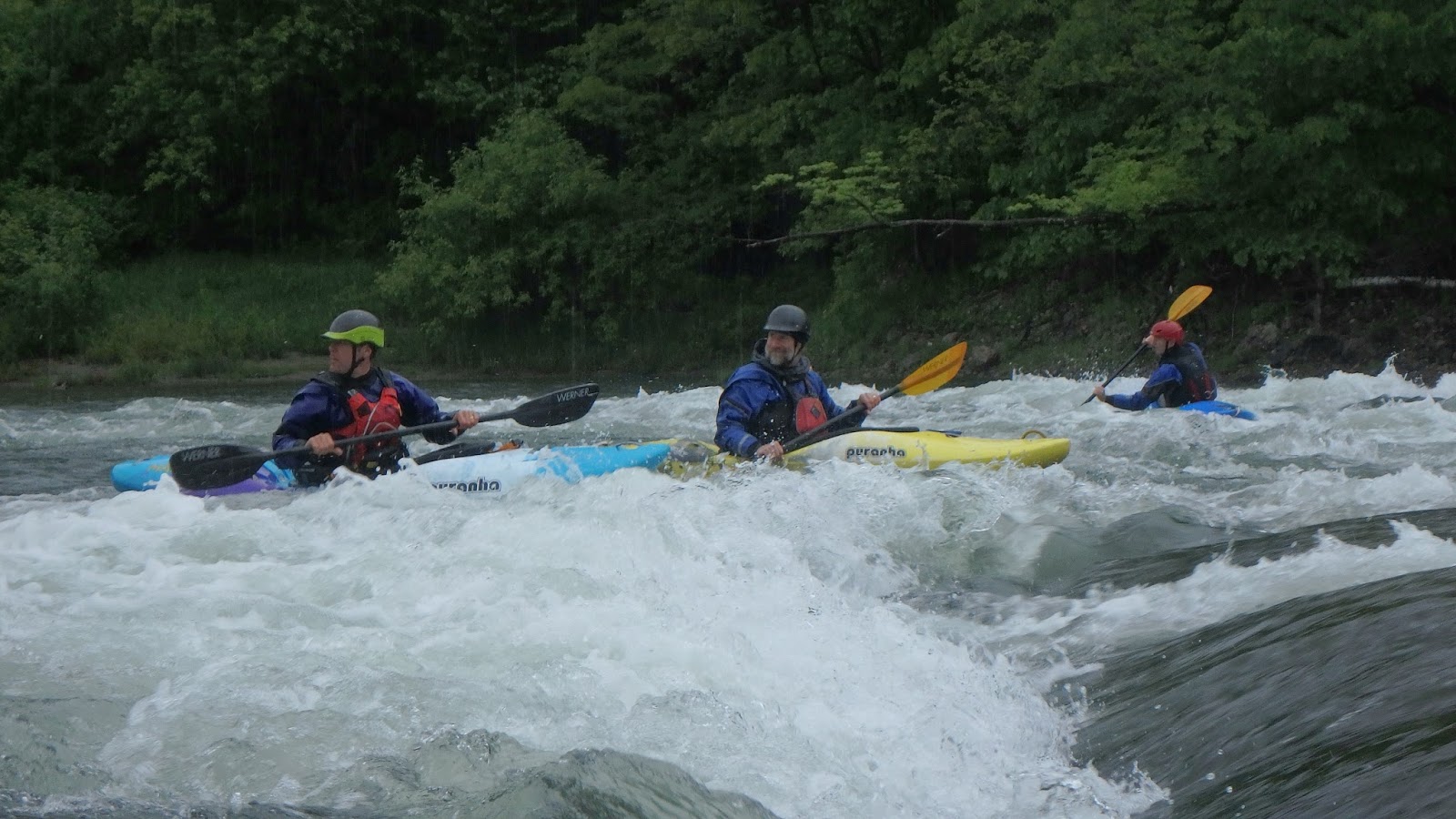
Rebecca and I just spent three days taking a whitewater class in Vermont with Nate Hanson (Pinniped Kayak) and Todd Wright (St.Michaels College Adventure Sports Center) (both of them pictured above). I can still count the number of days I’ve spent whitewater boating on two hands, but I feel like I’m getting the hang of it and enjoying it more each time. 

  
Much of my attraction to taking the class was that I didn’t want to sit through a beginning whitewater class that assumed I would need to learn a lot of skills that I already had. While there may be more emphasis in whitewater on certain skills and strokes, they’re basically the same maneuvers we would do in sea kayaks. With my last blog entry about whitewater for seakayakers, I posted it on some Facebook groups with the question: “do sea kayaking skills transfer to whitewater kayaking?” and a number of people weighed-in with opinions in the Facebook comments. 


Some of those people had experience in both pursuits – which seems like a good basis for an educated opinion. In general, those with experience in both pursuits felt that skills definitely transferred, and those with a whitewater background tended to assume that sea kayakers might need to learn the basic sorts of skills that we teach sea kayakers during their first lesson. I suppose this says more about our notions about either pursuit than anything else, but after the last three days I can claim with more conviction that both forms of paddling are parts of the same thing: different boat, different environment, but most of what you learn in one boat or environment is going to help you in the other as well. I not only learned about whitewater paddling, but that experience will help refine my sea kayaking skills. 


Everyone in the class had been previously coached in sea kayaks by both Nate and Todd, and in addition had all spent some time paddling in tidal currents like Sullivan Falls, so on the first day- Monday on the Lamoille River, we were able to get out and start having fun right away. 


That day was a ‘park and play’ day, where we used the features in a short stretch to get a feel for the boats, play around on features and experiment with some of the maneuvers we would use in tidal currents, like reading the water, ferrying, surfing, attaining against current and getting efficiently into eddies. 


In the afternoon we worked on safety and group management: rescues, swimming with and without boats and tossing a throw rope to a swimmer. 


One big difference between the two boats is that sea kayaks maintain momentum pretty well. You can take a couple of good strong strokes that will propel you well across an eddy zone. But, while whitewater boats can turn on a dime (which will be super easy if you’re accustomed to turning a sea kayak) they have the momentum of a potato. And you’ll need to use strokes, edging and trim to minimize turning. This took some getting used to.


The next two days we did day-long runs on the White River and the Lamoille. It rained hard for much of Tuesday, so when we returned to the Lamoille for a longer run on Wednesday, the volume of flow had more than tripled. It was my first day paddling a whitewater boat in sunshine, and as far as I can tell it functioned pretty much the same as on a cloudy day. 


By then, we were given a longer leash, striking off on our own to find our own lines and features, and I think we were all beginning to have more of a sense of autonomy, like we might be able to get out and do this on our own and have a sense of what we should or shouldn’t get into. 


Aside from the whitewater-specific experience, as an instructor, it felt great to be a beginner in a class. It helped put me into the shoes of the people I teach and guide, reminding me how it feels to be frustrated when I’m not understanding something, as well as the little victories when I rise to a challenge and maybe have an ‘aha’ moment or two.


It’s also worth mentioning that the part about getting to go down a river amidst some gorgeous scenery is pretty awesome as well. Sometimes you get a stretch of flatwater where you float/paddle downstream and take a breather before the next set of rapids, and in those times I marveled at how sea kayaking had brought me to this beautiful place, via a whitewater kayak. And, as with paddling on the ocean, it brings us to some sublime spots to eat lunch.


I think a lot of sea kayakers who might otherwise enjoy and benefit from river paddling find the thought of it scary because it’s a little mysterious, and what we mostly see of it in media are the more sensational moments, which might involve drops from waterfalls or getting pinned inside a grabby hole. As with all paddling, there’s always risk, but you can still have challenges and minimize the risk, and a good way to do that is to start with a class like this one.

Tuesday, May 30, 2017

Two A.M. on Harbor Island


The sound of the waves woke me. Or it may have been the effect the sound of the waves had on my bladder: a gradual awareness that I’d need to climb out of my sleeping bag and pull-on my shoes. I’d pitched the tent on the soft, mossy ground just above the granite ledges, and from where I lay I could just make out the dim outlines of the kayaks twenty feet away, and beyond them, the dark ocean, the looming shapes of islands and the sparkling lights of Stonington three or four miles away.


The waves were a little closer than I’d anticipated. We’d carried the kayaks up the granite incline, far beyond the reach of rockweed and the dark, slippery patches of algae, and put them down, all in a row at what appeared to be a good height for a night with a nearly twelve-foot high tide. 


Earlier, I’d sat with the others out in the fading evening light with my back against a big driftwood tree. Some were drinking wine, remnants of the pasta dinner that one of the cooking groups had provided, and I was having my usual tea (which is akin to setting an alarm clock for 1:30 am, just before high tide). It was one of those quiet interludes in a trip when all the work is done, when we’re no longer teaching or questioning the group about which of their leadership methods is working and which are not, and the conversation bounces around the group, recounting experiences, learning about where the others have been and where we’re going. As the lights in Stonington became more pronounced and the voices of our friends became heavy with the wearying weight of a long day, the seals joined our conversation. They called-out in dog-like groans that sounded like questions. They may have been directed at us: who are you? What are you doing here?


Someone had a penny whistle, and he responded beautifully: clear notes, slow enough to avoid an obvious melody, but intentional enough to sound like a response. It seemed to satisfy the seals. They continued to linger down below, chatting as we had been, but perhaps resigned to accept our presence there. It was time for bed.

Later, when I awoke to the sound of nearby waves, I checked my phone, which I’d plugged into a battery for the night: about a half-hour before high tide. I pulled on a jacket and stuck my feet into the vestibule to get my shoes on, and stepped down the ledge to the row of kayaks. The highest waves were just beginning to lap at the sterns, so I pulled each boat up a few more feet. They were tied-up, of course, but I preferred to avoid seeing the kayaks actually begin to float and getting bonked-around by the waves.

Twenty minutes to high tide. The crescent of the waxing moon, just past new, lay to the west, just below the trees. Stonington’s lights were the brightest feature, while off to the northeast a dim glow in the distant sky marked the location of Mount Desert Island’s towns. Aside from that, a couple of blinking lights on buoys helped give shape to the night. Of course I always bring a few lights with me on trips, but it can be surprising how seldom I use them. I had my headlamp in my pocket, but didn’t find a need to use it even once. When I’d check my phone for the time (or to post a photo on Instagram, which I’ve just begun to experiment with) the light shone blindingly bright, cancelling, for a moment, my ability to see much else around me. But most people seem inclined to use headlamps fairly liberally, and as I stood there watching the tide crest at the sterns of our kayaks, a light came-on in a tent and bobbed down to the boats to check them, followed, a few minutes after I’d returned to my sleeping bag, by another: a good omen, I felt, for our leadership students, since it seemed that their internal clocks, or perhaps their bladders, were also becoming better-attuned to the nuances of tide.


Notes:
This was the culmination of day 3 of Pinniped Kayak’s SeaKayak Leadership course, based at Old Quarry Ocean Adventures. The course is meant both for aspiring guides and those looking to improve their skills at planning and leading sea kayak excursions, whether alone, with friends or family or more organized trips. 


As I’ve pointed out in the group management section of my guidebook, AMC’s Best Sea Kayaking in New England, the need for leadership skills sneaks-up on you, whether you’re planning on guiding or leading or not. Learning these skills intentionally is far preferable to learning them the hard way – by trial and error – which are often the trips we read about in the news. 


We were camped on Harbor Island, at a MITA campsite along the edge of Merchant Row. You can learn more about this area in AMC’s Best Sea Kayaking in New England, Trips #14 and #15. 


Monday, August 15, 2016

Around Swans Island in Four Days


We floated just off Devils Head, a granite bluff on Hog Island, at the edge of Eggemoggin Reach, a dense white wall of fog between us and our destination. R held the radio up to his face and made the call: Sécurité Sécurité Sécurité,: attention boaters in the east end of Eggemoggin Reach. We’re a group of 5 kayaks crossing from Hog Island to White Island, estimated crossing time, twenty minutes, standing by on one-six.


We paused, we listened: nothing. “Okay,” I said. “Let’s go.” Or I might have said “let’s boogie,” which I often seem to say in such situations. So we did. We boogied, but at that moderate pace that enabled us all to stay close together as we made the crossing. We were all following our compasses, but D paddled just ahead of the pack, the chief navigator who made it easier for us to follow the bearing without bumping into each other.


This was the fourth and last day of our around-Swans Island journey, a trip organized through Pinniped Kayak, and though I hadn’t exactly planned for this fog, it was, in a way, a good thing. I wouldn’t have been heartbroken had it lifted, but it enabled us to work on navigation and communication in a way that gave us immediate and obvious feedback… or consequences. 


The four paddlers in the group had come on this trip not just to have a guide, but hopefully to go home with some improved skills as well. They’d all had some previous instruction and experience, and at times I found myself wondering what they most needed me to teach, which were usually subjects provided more by the environment than any agenda. A four-day journey doesn’t lend itself as well to nit-picky strokes and maneuvers development as well as it does to overall journeying skills.


At every juncture I tried to put the route planning and decision making into the hands of the group. We had an overall plan: try to get around Swans Island, camping along the way on three probable islands. On the first day we left Old Quarry and took our first break on Saddleback Island, hoping to get across Jericho Bay to our first campsite on Marshall Island. But the winds blew in the mid teens, gusting into the low twenties – blowing with the flooding mid-tide current, but still likely to create some lively conditions for a 3-plus-mile crossing. Like the fog though, this was an opportunity for decision-making and for paddling in rough water that one might not venture into without the safety net of an instructor.


We could have taken the easier downwind ride northward. I would have been fine with that, but the overall consensus pointed us toward Marshall Island, so off we went, and soon found ourselves amid some considerable ups and downs. I’m sure we each have our own mental picture of what it felt like in those waves. At first, the skills learned in calmer water might be difficult to muster – the edging and efficient sweep strokes to keep from turning too much into the wind, the degree of skeg needed to avoid weathercocking. A couple of schooners blew toward us from Isle au Haut, sailing wing on wing, straight downwind, passing behind our sterns. We tried to stay close together without colliding, keeping a heading toward the northern end of Marshall Island, where, after an hour, we landed.


So we got the bumpy crossing out of the way, and that evening I think everyone felt some sense of relief and accomplishment as we ate our dinner and watched the sunset. Each evening we were treated to a display of shooting stars, as the Perseids meteor shower drew near, lying back and watching the night sky until we could no longer keep our eyes open. 


On Tuesday we wound through the islands south of Swans and made our way to Frenchboro Long Island, where we ate our lunch before heading to our campsite on West Sister Island. On Wednesday we followed the east shore of Swans up to Casco Passage and through the Black/Opechee group of islands before heading across the north end of Jericho Bay, to our campsite for the last night. 


As always, I often felt challenged to get people to focus more on the moment than the destination, which is more difficult when you have some miles to cover to get to your campsite. But that last evening after we’d made camp, I offered to go for an additional paddle around the island we were camping on, and half the group joined me, while the other half, a bit cold and tired, took a well-deserved break.


The distance around the island wasn’t much more than two miles, but we took our time, following each contour of the shore: around rocks, beneath bluffs and boulders, picking our way in empty boats through the mist and fog. Despite the miles we covered in the overall trip, and despite the challenges we’d overcome to get places, these moments were certainly the most peaceful, and perhaps most representative of why I paddle in the first place: the joy in maneuvering a boat well, the quiet connection to a place, those moments where your head empties of all the choices and chit-chat, narrowing-down to the path you’ll paddle among a winding, rocky passage.


As often happens on the last day though, the focus on getting there becomes heightened. We made a couple of foggy crossings and after the fog cleared, took one last break on the Lazyguts before heading back to Old Quarry for lunch.


Swans Island is Trip #13 in my guidebook, AMC’s Best SeaKayaking in New England. This version of the route is suggested as one of the alternatives, launching at Old Quarry Ocean Adventures in Stonington, rather than Naskeag Point, and focusing more on the surrounding islands than on Swans. We camped on Maine Coast Heritage Trust Islands (Marshall, West Sister and Hog). 

I have one more journey on the Pinniped calendar this year: The Downeast Journey, September 6 through 10. There may be space for one more person.


Here's a photo of me, courtesy of Rob Sidlow. Yep, that's a toilet and a tarp lashed to my stern deck.  


Saturday, July 9, 2016

A Good Morning on Webb Cove


Before we set-out, we took a Scorpio down from the rack and W, my morning student sat down in it to adjust the foot pegs. I could see almost right away, from the way he rocked the boat back and forth with his hips, but kept his upper body vertical, that he would do well. He had the basic concept of edging already figured-out… perhaps not the nuances, like which way to edge to point the boat in a particular direction, but we could work on that over the next few hours. This was his first time in a sea kayak, and before he even launched, he had a basic concept down that eludes far more experienced paddlers.


It was a good day for a lesson: strong gusty winds and fog that made the inner reaches of Webb Cove at high tide into a calm, sheltered classroom- with mud-warmed, shallow water significantly warmer than the water just a half-mile out. Not only that, but the fog has a way of slowing one down. W had some difficulties at first – everyone does, but slowing down, contour paddling along the curving granite shoreline, sorted them out. After a few hours of strokes and exercises to try them out, he was maneuvering his boat amazingly well. We finished with a rescue session, and to be honest, I was enjoying it so much myself that I hardly wanted to stop. And W’s enthusiasm was infectious; it helped carry me through the rest of the day.


After the first week of July, I’m feeling a bit beat-up, having taught or guided multiple trips almost every day for awhile now. Unless the sun comes out today, I will probably have the rest of the day off… a valuable chance to do a few home improvements on the travel trailer. I’m tired, but overall things have been good. I had one day that, at the end of it I said that if every day were like that I wouldn’t be doing this work, but then I had several days of decent enough weather (not too much wind) and easy-going people who I enjoyed being with and were able to paddle well enough to manage.


We’ve tried to avoid working in the office this year, opting to clean the bathhouse instead (we all have to do our part around here). And while it might seem to be dirty work (and it sometimes is) I prefer it to the headache of dealing with whatever comes at you in the office. In particular, I really hate renting kayaks. I could write a whole diatribe on it, but I’d rather keep my blood pressure down. At the heart of it is that very few people who want to rent kayaks are even remotely prepared. On some level it’s our job to try to screen them, but most people are indignant if you suggest that they might not fare well in 55-degree water if they can’t get back into their boats. Especially if it looks calm out. They might suspect that we just want to sell them on guided trips… but if the people seem difficult, that is far from the truth. We just don’t want them to have a bad day, and we worry about them until they return. Like the day that started-out calm a couple of weeks ago- the day two people (one a guide, the other a client) died not far from here, an accident that I’m choosing to avoid writing about, because it is still so similar to almost all kayaking mishaps that should have been avoided. I’m just not going there, at least today.


Instead, I’ve decided to tell you about W’s first hours in a kayak, how in four hours he went from no kayaking skills at all to experiencing a certain joy in maneuvering his boat, and the ability to rescue himself or others. He will get so much more out of kayaking and be safer than the larger percentage of paddlers out there. And that makes me happy.


In other news, it looks like the Swans Island Journey may be moved a few days later, perhaps to the next week, probably with one or two more openings for students. And the Downeast Journey has one or two openings as well. My daily schedule here at Old Quarry has been busy, but I've been able to accommodate anyone who wants a lesson. Contact Old Quarry Ocean Adventures at 207/367-8977.

Sunday, June 19, 2016

Leadership Training off of Jonesport


We landed on Man Island, a mostly barren hump of rock rising above the bold southern end of the Great Wass archipelago, and the group meandered to the grassy summit, where we gazed out at the broad line of horizon over the open ocean and the late afternoon sunlight coating our surroundings in the oversaturated sort of glow that makes everything feel just a bit unreal. The feeling might have been enhanced by this being the end of our sixth day together – six very intense days of training conducted both in the classroom, on the ocean and in the pool, during which I rarely stopped heaping the students with information and tips on personal paddling skills, leadership and group management, as well as critiques of their newly-learned abilities. 


Every trip has its high and low points, and on a trip that doubles as leadership training, those highs and lows are probably more pronounced. This one felt like a high point in both the geographic and psychological sense. On our first day of class we’d demonstrated various leadership styles, accepting that there can be a time and a place for each, but lately I’d needed to use the authoritative or “drill sergeant” style more than I liked. I had needed to be very direct at times, and perhaps not so polite, and yet by urging the group on to this place, I was also hoping that it might help them discover what I like about sea kayaking, and have a little fun with it: a tough balance.


During training, we tend to come-up with a lot of hypothetical situations. We give pre-trip briefings and paddle lessons to the rest of the class, pretending that they haven’t already heard it a bunch of times. We pause at anything vaguely resembling a channel crossing and get the group lined-up in a tight formation. We discuss what all the possible things that could go wrong might be, how we might prevent those scenarios, and what we might do should the worst happen. 


The danger in all of this role-playing and make believe is that the students might start to treat sea kayaking as if it is all one big exercise or game, losing sight of the true potential, or simply the fact that we might have a good time out there.


We’d stopped earlier to set-up camp and eat lunch, and before we headed-out for our afternoon paddle, the leader-of-the-moment shared plans for what seemed a rather short and unambitious trip, so I interjected and suggested a few destinations. When we were a short distance from Man Island, which seemed unmistakably awesome, I once again interjected when the leader announced that it was time to head back to camp. I think everyone, including the leader, was pleased. As much as any kayak trip might be more about the journey than the destination, it occasionally helps to find yourself in an amazing place.


I gave the students a break and took over leading along the southern, exposed stretch of the islands, out around the lighthouse, and handed the reins back over in more protected water. Again, I think everyone enjoyed it, and I hoped that it might be inspiring. Of course, over the next couple of days we had plenty of ups and downs, but I hoped that the glimpse of potential might make it more obvious why it’s all worth it, and why we’re out there in the first place.


If you're interested in paddling in this area, it is covered in Route #6: The Great Wass Archipelago in my guidebook, AMC's Best Sea Kayaking in New England. If you're interested in joining me on a guided learning journey that visits this area, I'll be leading a 5-day journey along the Downeast Coast in September through Pinniped Kayak.