Showing posts with label winter paddling. Show all posts

Friday, March 5, 2021

Gooseberry Island


As we paddled along Little McGlathery Island, a mild swell washed over the near-shore rocks, lifting our kayaks gently and then dropping them as the waves rebounded from the granite bluffs.
 Gooseberry Island lay to the south, with Isle au Haut rising behind it. The day had started bright and clear, but now a layer of high, wispy stratus clouds floated over us from the west, the sun a pale disc. Rebecca maneuvered beside me. She said, “Lunch on Gooseberry?” We turned our bows southward. 


Paddling excursions had lately been the result of watching the weather, and days ahead, deciding that a particular day might be good enough for a paddle. And when that day arrived, if the weather forecast was close enough, and if we weren’t too lazy or too stuck in our routines, we dropped everything and went. Sunday was one of those days. With the temperatures approaching 40 degrees, we made some sandwiches, filled the Thermos with hot mocha and went for a paddle. We had a few ideas about places to go, but once we launched we just pointed across the Thorofare and went with no particular goal, until finally we found ourselves on the seaward side of Little McGlathery, angling out toward Gooseberry Island, a half-mile off. 


Even on the last day in February, I had a sense of relief as we rounded the point and saw that there was no one else at the beach where we liked to land, at the head of a narrow cove, overlooked by a dense boulder field. Of course, there was no one there, but the habits from summer remain. We hadn’t come across other paddlers since some time in the fall, and in a way I looked forward to seeing others out there again. There weren’t even many lobster boats out, quiet for such a nice day. 


We landed on the shell sand beach, barely pulling our boats up since the tide was retreating, and we sat on a log to eat our sandwiches. The water looked glassy clear, as it does in winter when there’s less algae, but frigid, probably just above freezing. I don’t think we had much to say. We’d had no shortage of time together lately, and we always found things to talk about. But it was also a relief just to sit and eat our sandwiches and look out toward Isle a Haut, with the clouds thickening before the sun. 


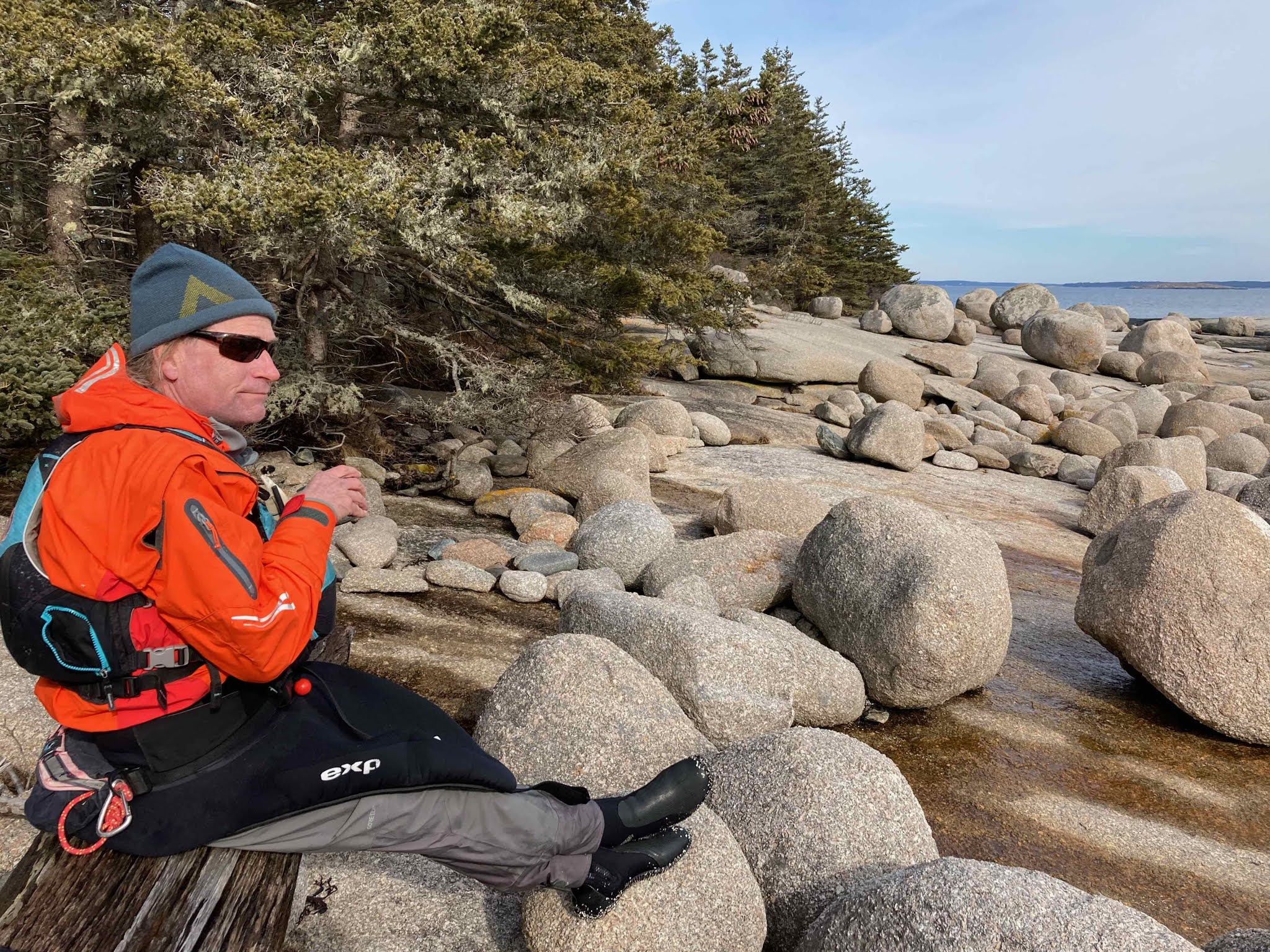
We then walked out among the boulders. I can’t think of any other spots with such a concentration of them, like the glacier just tired of artfully placing them here and there on sloping granite shores and said “ah hell, just drop ‘em all here.” Walking among them feels like strolling through a natural sculpture garden. 


Gooseberry Island is one of the many names that pops into my head when someone asks me about a favorite place out in the archipelago. It’s been a favorite for a long time, even back when it was privately owned and we’d heard that Maine Coast Heritage Trust would acquire it. We like the island’s small size, the boulder field, the way it feels like the last stop at the edge of the archipelago, with Jericho Bay and Isle au Haut for a backyard and the vast Atlantic stretching out beyond. It’s only about 3 ½ miles from the launch, a good distance for a casual paddle, just far enough away from the busier islands near town, and yet angled away from the archipelago, so it feels more remote. 


We started feeling a little chilled and launched again. I made my inevitable joke about skipping the swim at Green Island, and when we returned to the launch we were surprised how late it was; the days were getting longer. 

Friday, February 10, 2017

Between Storms: A Few Winter Paddling Tips


A storm had come through the previous night, battering the windows with sleet, covering the ground with a layer of slushy snow, and another storm – a bigger one – was on its way. But for a few hours anyway, the air temperature would rise above freezing, and this happened to coincide with high tide: a perfect opportunity for a quick paddle. I got into my gear as quickly as I could and headed-out.

It has been awhile since I’ve written much about the measures I take before I feel adequately prepared to paddle on a day with both air and water temperatures in the mid-thirties, but it’s certainly worth mentioning every once in awhile that I don’t take the risks lightly, and I wouldn’t want to encourage anyone else to either. But it seems that some do. Two weeks ago, the Coast Guard rescued a man who had capsized his kayak off of Kittery. Somehow, when we read such accounts it is unsurprising that he wasn’t wearing a lifejacket and that his cold, wet clothing was cut from him before he could be treated for hypothermia and shock. Of course he was lucky just to survive.

It’s the sort of story that makes the news and gets the general public thinking that kayakers aren’t too clever. I won’t make any assumptions beyond the bare facts in the Coast Guard’s report, but any time I hear about a mishap like this I have this vague fear that among the paddler’s gear they’ll find a soggy copy of my guidebook (with the entire Introduction completely unread, of course). I have also been concerned that someone might have read my blog, said ‘that looks like fun’ and gone-off to try it themselves.


Part of the reason I shy away from writing about gear or how to acquire skills is that I feel strongly that this is something best learned first-hand, in person, rather than reading about it or from videos. Sure, I can tell you what gear I use, but I’d hate to give the impression that it’s all you need. And if you take a class or get coached by a knowledgeable instructor, you’ll learn about these things.

I think I worried more about the example I set in the earlier years of this blog, before Facebook became saturated with photographs or videos of paddlers taking what might appear to be baffling risks, often with no context at all to give the viewer some idea whether this were something they should try at home or not, or what the paddler did to be safe – or not. At least I try to put things in context. But I’ve also tended more toward trying to convey the experience, rather than the ‘how-to’ aspect of kayaking. And again, the Introduction to my guidebook covers quite a bit, and I’m not fond of repeating myself. Really, I recommend it.

But at the risk of repeating myself, here are a few points about the paddling I do in the winter in Maine. Really, these are all things to consider no matter the season, but in the winter, my attentiveness to risk management is greatly elevated, and I pay particular attention to the following concerns: timing my trip, relaxing my ambitions, choosing less consequential locations, and of course, before all of those considerations, I need the skills and gear.


1) I choose my days carefully. For this reason, I avoid putting some random Saturday on the calendar and inviting friends for a trip that we’ll take that day, regardless of the conditions. I constantly watch the weather, looking for windows of opportunity. Everyone has their own standards, but in the winter, I’m looking for minimal wind and air temperatures around freezing or above. Bonus if the sun is shining – it keeps you warmer. It helps that my winter schedule is fairly loose, but I think it’s a bad idea to get your heart set on a particular day and being tempted to stick with it, even when you know you shouldn’t.

2) My ambitions tend to be scaled-back quite a bit from what I do in warmer weather. Usually, I’m happy just to get out for a short paddle – maybe one or two hours. My hands and feet don’t have much chance to get cold. I tend to get chilled when I get out for a break, so it helps to just avoid breaks and keep paddling. You can certainly go for longer days, but you need to be vigilant about throwing-on extra layers, bringing warm drinks, etc. I don’t often drive very far to go paddling in the winter. (In fact, when it’s cold I pretty much only drive to the pool).

3) Most of my winter excursions tend to be in more sheltered areas that I’m very familiar with. Again, we’re fortunate to be in a good spot here on Greenlaw Cove, but when winds pick-up, it can be very sheltered here.


Beyond those are the more usual concerns about skills and gear, in that order, which apply to the rest of the year, but become more consequential as the air and water turn colder. These are simple facts; it’s fairly straightforward. If you tip over in 37-degree water (as it is here now) and you fail to roll and can’t get back into your boat quickly, things may go downhill for you very quickly, even if you’re wearing all that fancy gear we put so much faith into. And that’s assuming that the cold water hasn’t triggered a gasp reflex (it’s really better to avoid capsizing). You need to be absolutely confident in your rescue skills and in those of anyone with whom you paddle.

Much could be written about gear, but I’ll just list what I wore Wednesday as an example. The drysuit is the crucial element, and I adjust the layers underneath depending upon the weather. Underneath I wore wool socks, wool baselayer (top & bottom), thin synthetic pants and 2 more upper body layers (1 wool, 1 fleece). I wear various neoprene gloves, mittens and pogies, but yesterday I was fine with a pair of NRS Rogues. Since last winter I’ve been wearing thick, 6.5 mm diving boots made by Xcel, and my feet have always been warm. On my head I wore a neoprene beanie made by Hyperflex. These beanies have become a favorite piece of year-round kit, and I’ll write a bit more about some that I’ve tried in another post.


One of my big questions before I launch is how many layers I’ll need on top. Yesterday, with 3 layers plus the drysuit (and lifejacket) I was hot within five minutes. But the air temps stayed in the low to mid-thirties and the wind picked-up into the teens, and I was glad to have the extra layer. My gloves were a little damp and my fingertips may have been mildly numb by the time I returned. If I’d been concerned I could have added pogies, or switched to a heavier glove or mitt. Of course I also carried with me all my usual back-up gear, radio & cell phone, storm cag, etc.

But part of the reason I shy-away from getting too gear-focused is that it’s easy to start regarding your gear like a suit of armor that will protect you no matter what. People put on a helmet and seem to forget that it won’t prevent you from breaking an arm or getting your face impaled by a broken paddle shaft. And even in a drysuit, that water is freakin’ cold. Which leads me back to skill. Whether or not you get out on the ocean this time of year, it’s a good time to hone your skills in the warm water of a swimming pool.


Oh, and the whole paddling alone issue. I’m confident in my abilities in the situations I get myself into. But as a human I’m prone to error and I have come to the realization, mid-paddle, that I could be getting into a situation that I can’t get out of. That’s a bad feeling, and I really recommend that you avoid it. And, not to put too fine a point on it, but my skills are well above average and I practice frequently – a good combat roll in chaotic surf and tidal currents that I’ve been able to test many times, and I seldom swim. But everybody swims sometime, and failing to think about what will happen when you do could be fatal hubris. Cold air and water only decrease the odds of a happy outcome.

Again, there’s a section in my guidebook about solo paddling and group dynamics. If there’s some doubt in your mind about your abilities should anything go wrong, either don’t launch or change your plans. In addition, don’t subscribe to the ‘safety in numbers’ myth. That’s a whole other can of worms. If you’re relying on someone else, make sure they know it and they’re worthy of your trust. Two moderately-skilled paddlers vaguely relying on each other are less safe than a skilled paddler relying on no one but himself, but with a realistic sense of limits.


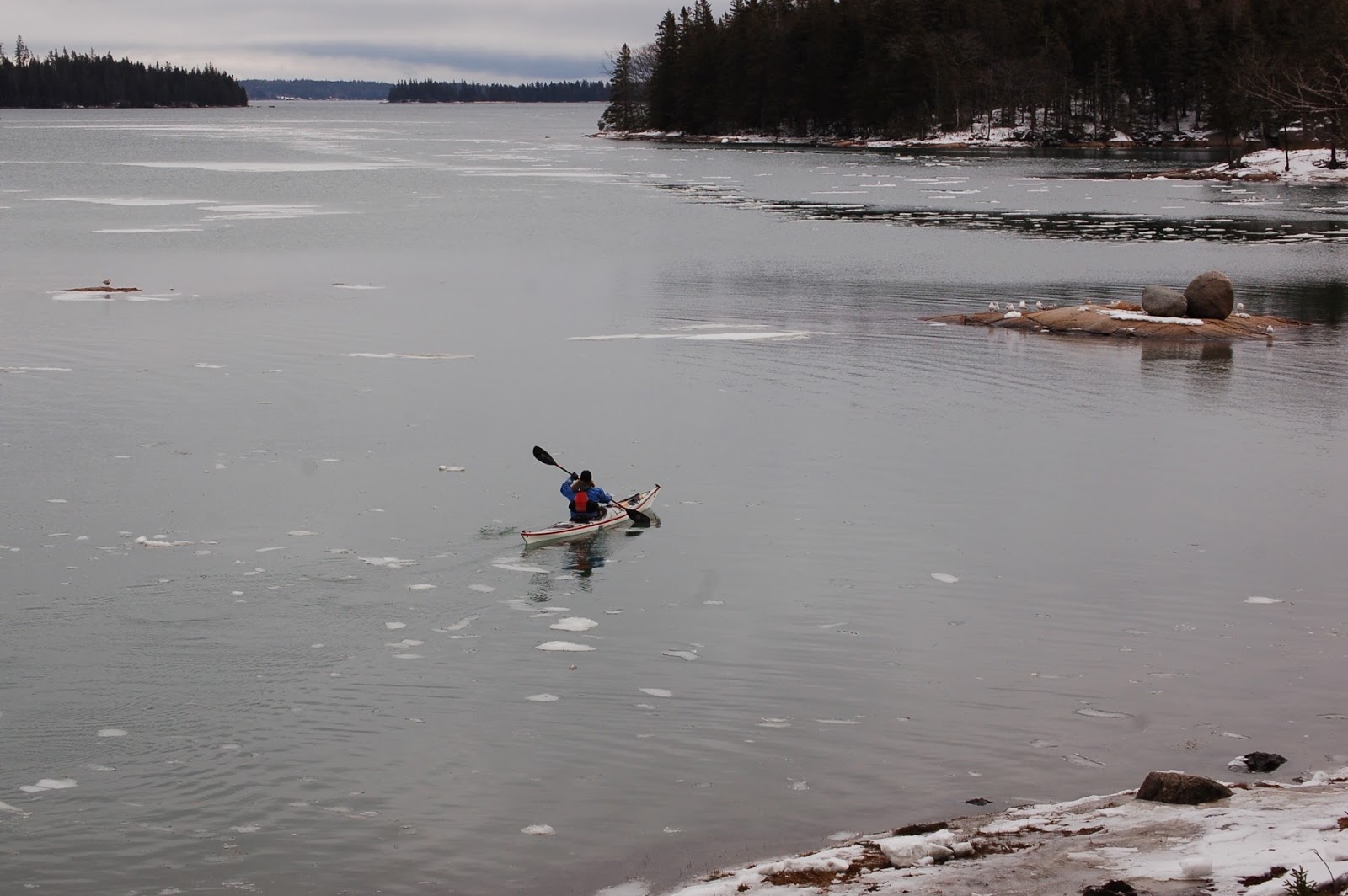
Rant over: back to ‘the experience of paddling’. Right. Well, it was a nice paddle, not much to say about it really. An hour and a half: along Shore Acres Preserve and around Campbell Island. Some ice floes, which are cool to paddle among. It makes you feel like Nanook or some Arctic explorer as you weave among the ice. A bit of wind in the face for the return stretch. It just felt good to get out. And then the real storm came.


But then again, you could just wait for the ocean to freeze, strap-on some snowshoes and walk over the ice at low tide.


--
It's worth pointing-out that some of these photos were taken from shore, on days when I wasn't even considering getting on the water (or the ice, as the case may be). And thanks to Rebecca for the shots she took of me from the porch, when she was recuperating. 

Thursday, March 24, 2016

Warm Fingers and Toes

-->

One reason that many of our cooler weather excursions are limited to a few hours, is the chill that often sets-in to the extremities: cold fingertips and toes. While our core stays toasty, thanks to multiple thin, warm layers and our exertion which seems to fire-up that inner furnace, that warm blood doesn’t always keep our extremities warm. This is one of those ongoing subjects to which you hear plenty of solutions and opinions, but aside from avoiding cold weather, there’s no “one size fits all solution,” which is especially important to remember if you’re guiding people. You could be wearing the same gear as your paddling companions, but having an entirely different experience.  Age and gender figure heavily into blood circulation, but there are enough other variables that it’s pretty tough to guess what someone else is feeling.

 
One way to deal with the cold is with gear. As the air and water turned cooler this winter, I noticed that my feet were getting chilled every time. (It doesn’t escape me that, since we paddled in warmer climes last winter, it had been almost two years since I’d paddled in freezing water, and, well, I – and my blood circulation system – have grown older during that time). The first thing I did was put a foam pad beneath my feet, something to insulate them from that 30-odd-degree water on the other side of a thin fiberglass shell. That helped. But then I ordered the thickest wetsuit boots I could find.


Most kayak-specific gear is not quite thick enough for ice water and clomping around in the snow, so I thought I’d try-out some diving-oriented gear that I ordered from a company in Maryland that specializes in all things wetsuit-related, called Wetsuit Wearhouse.


These XCEL Thermoflex Dive Boots are made with 6.5 mm neoprene with a poly fleece lining that really keeps the heat in. The zipped sides help when it comes to getting drysuit booties over heavy wool socks into the boot (although I’m guessing these boots would keep your feet toasty even without the extra layers). I usually wear a 10 to a 10.5 shoe, and even with the drysuit and socks, the 10 worked just fine, but if you sometimes opt for a larger size and you’re wearing those extra layers, you might want to ensure that your feet are not cramped (which decreases circulation) and order-up a size. Since I started wearing the XCELs, my feet haven’t been even vaguely cold, and they’re even comfortable for walking and cling well to wet rocks. They go for about $64 at Wetsuit Wearhouse.

Hands are another matter. I’ve gone back and forth between gloves or mitts of varying thickness and pogies or a combination of the two. Hands tend to get wetter and are more prone to wind; even a mild breeze will cool your hands if they are encased in damp neoprene. Obviously, the thicker the neoprene, the warmer it will be, but you need to balance that warmth potential with your need to actually use your hands. Mitts make a lot of sense, since the fingers stay warmer when they’re all together. But it’s tough to go through life with claws instead of fingers. Taking pictures is out of the question. You might be able to get a sprayskirt on. I’ve usually gone with a combination of mid-weight gloves and pogies. With the gloves alone, especially once they’re wet, my hands would be cold. But encase them in that extra layer and they tend to be toasty.


But I thought, along with the thick boots, I’d give thick diving gloves a try. The 5/4 mm XCEL Thermoflex Dive Gloves are by far the warmest neoprene gloves I’ve worn. Not only that, but they work pretty well at keeping your hands dry. The neoprene is lined on the inside with XCEL's exclusive Thermo Dry Celliant inner lining, which according to the website “recycles your body heat and converts it to usable infrared energy for greater warmth, increased endurance and drying time, faster recovery, and overall enhanced performance.” So far, the sealed seams have kept all the water out, aided by a hefty Velcro strap around the wrist. They’re thick enough that a little break-in time makes them a bit more pliant. The longer I’ve worn these gloves, the more I like them, especially on those sub-freezing days. These go for about $45 at Wetsuit Wearhouse.

There’s an old adage that says if your feet are cold, put on a hat. It’s easy logic- much of your heat goes out through the top. In past years in New England, as my bones get a little creakier and my circulation poorer, I’ve taken to wearing some sort of hat for warmth for more than half the year, and it does go a long way toward keeping my hands and feet warm. I usually have two or three warm hats in my day hatch, just in case (and they are often enough leant to guests, even in mid-summer). On the water though, the knit hat has always felt like a bit of a weakness, since I’d really rather not get it wet, even if it is wool or synthetic. Yes, there are the neoprene skullcaps, complete with chinstraps, but I don’t wear these casually, especially since I can’t hear once my ears are completely covered. Besides, when I started wearing one of those years ago, my overly fashion-conscious buddy Todd nicknamed me “Cannonball.” Oh, to have been called “Cannonball.”


The Stormr Typhoon Watch fishing beanie fits just like an ordinary wool beanie, but it’s made of 3mm neoprene with a thin, fleecy lining to wick-away moisture. When I wear it on the water, I can feel the heat building-up in my torso like a stoked woodstove. If I need to hear better, it’s easy to fold the edges up. It works well when wet, and stays on in the stiffest breeze. And unlike the hoods and scullcaps that might make you feel like a superhero or earn you a cool nickname, you can wear the beanie into the convenience store on the drive home and not get stared at, except by other covetous paddlers. I may need to get a thinner version for warmer weather paddling. These go for about $25 at Wetsuit Wearhouse.

Of course all of these items work best if you rinse out the salt water after each use and let them dry. You’re much more likely to stay warm if you start your excursion with dry gear. I like to have extras, especially if I’m guiding or paddling with friends, so there’s always an option or two. Wetsuit Wearhouse has far more options than I knew existed, and if these options allow me more time on the water and more confidence that I’ll be able to return home without numb appendages, they’re worthwhile investments.

Thursday, February 11, 2016

February


Some days the winter seems to drag-on slowly. Others, you realize it will be over before you know it- before you’ve had a chance to do all those winter things you’d hoped to do at the beginning, when the winter stretched-out ahead with so much promise. Maybe a bit like suddenly discovering that you’re in your fifties and you think holy crap, how did that happen? Winters, like lifetimes, go by in a flash. We plan on certain things to get us through it: sports, library visits, potluck dinners, holidays, and you imagine doing these things casually, like they’ll be bright spots in the middle of long stretches of slow-moving empty time, but instead we rush to and from them like anything else.


Aside from trips to the pool at the Bar Harbor YMCA, all my paddling lately has been short, close-to-home trips among the nearby islands, and I seem oddly content with this. Sometimes I go with company- Rebecca or –lately- Bill, who is getting in shape for a trip to Baja, but more often I’m alone, with which I am also oddly content.


There’s been enough snow that I can slide my kayak down to the high tide line like a toboggan, and carry it from there. I wade-in and plop into the cockpit. My hands are in thick gloves and pogies. My heels rest upon a piece of foam to help insulate them from the near-freezing water just below the hull. These precautions help, but after a couple hours, while my core will at times feel hot beneath two or three wool layers and a drysuit, my fingertips and toes tend to get a bit numb. Most of the time I hardly notice – one of the good things about keeping these winter trips fairly short.


Since I haven’t been writing lots of blog posts lately, I tend to have a narrative going in my head as I paddle, with observations and commentary. They could be the same, from one day to the next:

“Snow began to fall, slowly at first, hardly noticeable. Then the flakes grew dense, turning the sky a deep gray…”

“Eagles seem to be claiming Potato Island for another year…”

“Dull light today, dark and not much tonal range…”


I bring hot chocolate in a vacuum bottle as a back-up in case I (or someone) get cold and need warming. But half-way through the trip I usually just drink it. It feels like a luxury, to float on the water, sipping the chocolate. It would also be good leftover, when I get home, but as a rule, everything is better out on the water.


Inevitably, I’ve put-off paddling until the end of the day, after I’ve done enough work, and I end-up returning as it gets dark, pointing for the dark stretch of rocky beach, far below the house we’re staying in, where I’ve left-on a light.


Yesterday, since the weather looked colder and windier for the next few days, I brought my kayak inside, so I can do a few gelcoat repairs. I don’t mind a few non-paddling days, although today I realized that it would have been perfectly fine out there. Still, I have a lot of work to do, and only a few more months in this particular situation, and I know it will go quickly.

I’ve been going over what I hope will be final proofs of the guidebook. The publication date is less than two months away. I’ve also been preparing for a slideshow/talk that I’ll deliver in a couple of weeks… in a church basement in Deer Isle- part of IHT’s winter lecture series. I’ve known for awhile that I would need to do something like this to promote the book. I’m not much of a performer- probably part of the reason I like to write. So I’ve been working on text to accompany the slideshow. It’s evolving into an essay about the process of researching and writing the guidebook, but I’m exploring other threads that lead into this story- how I got into sea kayaking, my writing background, this blog. As usual, the text is growing into a monster that needs to be tamed.


If you're in Deer Isle on Wednesday, February 24th, I'll be giving my slideshow/talk at 5  at the Congregational Church.

If you can't make that, I'll be doing it at Jesup Library in Bar Harbor on June 10th.


Wednesday, December 30, 2015

Stinson Neck in the Snow


We had an amazing run of warm-for-December weather, and well, I guess it had to end sometime. We've been paddling in 40 and even 50-degree weather... not a lot of big trips- mostly afternoon jaunts out to the nearby islands. We work all morning, and most days I'm pretty restless by lunchtime, ready to get out for a paddle or a walk. We've also had Rebecca's parents visiting for the holiday, and her Mom has joined us for a couple of paddles. I haven't been looking forward to snow in any particular way, but not really dreading it either. Bad weather makes it easier to stay in and get work done, but I get a little stir-crazy after a bit. This afternoon I suddenly found myself done with work and alone. We'd just had our first real snowstorm, and though the temps were below freezing, there wasn't much wind. I got my gear together, left a note on the counter and headed-out.


Off to the east, Western Mountain on Mount Desert Island rose into the clouds, where it appeared to still be snowing. It was nearing high tide as I followed the shore of Stinson Neck: icicles dripping down from overhangs, fresh snow on spruce boughs. Most of the lobster boats still out have been fitted for scallop dragging. One of them motored in slow circles out beyond Crow Island as I crossed the mouth of Conary Cove and headed out to the Lazygut Islands.


 A few days ago out there (I guess it was Christmas) we were out at Lazygut at a lower tide and a very small swell. There's some really nice ledges out there where we find the occasional wave and some rocks to play around. Today the tide had covered the ledges, but I rode some waves through the narrow, shallow slots between the Thrumcaps. I took a break for a cup of hot chocolate.


I've enjoyed paddling with others, but there's something about getting out by myself that I don't get when my journey is shared. The experience becomes more intuitive, making choices without discussing them, just going. No conversations or observations, just the thoughts passing through my head, and with any luck those thoughts eventually get replaced by pure action: paddle paddle paddle, edge, turn, oh look an eagle, rock, turn, wave, etc, etc.

I do find myself thinking about what I'm working on, and that can be good too. Who knows where thoughts will go- as much a part of the trip as the physical route. I'd like to be able rationalize my paddling that way, that some of the best writing happens in my head when I'm not holed-up with a computer.


I headed around the west side of the neck, following the rocky shore below the Haystack School and into Billings Cove, where it was calm, getting close to sunset above that thick layer of clouds. A bit of snow had started spitting down again, and it felt good, invigorating, fresh. I paused in a still stretch of water and listened. Unfortunately, I can't quite experience silence anymore- just the ringing in my ears that descends when there's no other sound to distract my brain. But it felt quiet.

I carried over the Sunshine Causeway and made my way around Plumb Point. Lights had come on in the house, and I made my way toward them.

Sunday, February 2, 2014

Bartlett Island


On Saturday afternoons we’ve been going to the pool in Bar Harbor for practice. The tough part, often enough, is loading and unloading boats in the wind and cold and worrying about icy roads; we’re not usually tempted to go for a paddle outside. This time though, with temps in the thirties and not much wind, we decided to do both: ocean in the morning, pool in the afternoon. We launched at Bartlett Landing, on the northwest side of Mount Desert Island, and set-off around Bartlett Island at high tide.

 
-->
I’d brought along the little point-of-view video camera, and we experimented with different set-ups as we made our way toward the south end of Bartlett Island. Ice coated much of the steep, shore-side granite, and at high tide we could cruise alongside, our progress a bit slowed by the desire for video.


I don’t bring the little video camera on every trip. The great thing about such a camera is that you can turn it on and it does the work while you continue paddling. Of course, after you’ve downloaded copious amounts of footage-- which takes time as well as storage space on the computer, you reign-in the shotgun approach and try to get footage that counts.


-->
One of the reasons I paddle is that it puts me in the moment. Any kind of multi-tasking is a challenge to appreciating the moment: even thinking too much can be a form of multi-tasking, like wondering about how I might write about this, if I should blog about it. It takes you away, spreads your attention thin.  

Does shooting video make it more challenging to be present and attentive to the moment? You are essentially looking for little pieces of experience to save for later, an artifact to bring home, as if that is the object of your quest, rather than the quest being the reward in itself. But using the camera could actually make you focus more completely on the moment. Certainly, taking photos and video does slow me down sometimes when I might be apt to just go cruising-on. I slow down to consider how something looks and end up looking far more closely, thinking about it, appreciating it.

 
-->
I’m not sure that doing something without cameras makes it a more pure endeavor, and I probably won’t find out any time soon, since I’m fairly addicted to image-making. The trend of posting on Facebook adds a whole other level to the question that I think I’d better stay away from for the moment, since we’ve got an island to get around here.


-->
The real highlight of the trip was the ice: the tall icicles in Dogfish Cove, the long expanses of thin skim ice we plowed through along much of the western side. In the distance, seals climbed aboard an ice floe. Paddling through the ice was hard-going and a bit surreal: the constant crunching sound against our hulls, the paddles penetrating just enough to move forward, leaving alternating holes in our wake. I worried a little about breaking a paddle, and a little less about damaging hulls, but we made it through okay, finally taking a quick break on The Hub before hurrying, with the tide, back down Bartlett Narrows to the launch.


Wednesday, January 22, 2014

Knowing When To Fold

 
We had our boats packed, ready to go, but the precipitation had most certainly turned from snow into a messy mix of rain and cold wind-driven sleet that stung our cheeks. Rebecca wondered, “you think this is a good idea?”

            “But we’ve got our boats all packed,” I said. “All we have to do is launch.” Hearing myself, I realized she was right: it wasn’t a good idea.

 
We’d woken to see calm water stretching out to spruce-covered islands coated with snow like confectioner’s sugar. Though we had been out for a few paddles lately, we hadn’t had one that felt like paddling in a winter wonderland in quite awhile, and this appeared to be it. And it was warm- hovering right around freezing. The weather called for increasing winds in the afternoon, and more snow. If we were going to get out, it seemed prudent to get out early. 


We were a bit worn-out from our previous day’s pool session in Bar Harbor, but paddling seemed the best antidote to get all those muscles stretched out and working. So we ate a quick breakfast and got ready, which takes some time—an investment of time, you might say. So that by the time we had our gear together, drove over to the ramp and got the boats ready, it felt like we were ready to make the investment pay off. But then the precipitation began in earnest, and the wind picked-up, and suddenly it seemed not such a wise investment. Hearing myself say “but we’ve got our boats all packed,” was like hearing someone else in a safety article just before they put themselves in certain peril, and I knew the answer then, even if I wouldn’t admit it.


We talked it over for a minute or two. We could put on neoprene masks, we could just go to some of the nearby islands, or even just head down to Webb Cove and back. We had to remind ourselves that we were doing it for fun, not because we needed to, or to feel rugged (or to get pretty pictures for a blog post). We had thermal flasks full of hot cocoa and suddenly my mental picture changed, from taking a break on a snowy island, to sipping cocoa, warm and dry in the front room of our apartment, looking out at the storm, knowing we’d made the right choice. 


But it was still really hard to give up on the paddle and go home. And over the next hour as the weather changed three times, we went back and forth, deciding alternately that we’d made the right and wrong choice. I’m sure if we’d gone out, I would rationalize any discomfort and say it was well worth it. But you make your choices and stick with them. Sigh.

Monday, January 6, 2014

Scraggy Island Ledge


Sunday afternoon. We get our gear together and get down to the launch. The air is in the low 30s, sunny with not much wind. This time, we head west, along the shore of Crotch Island.


And on toward Mark and then Scraggy Islands. 


A few years ago, Todd and I paddled past Scraggy Island Ledge and came upon an amazing ice formation: a wave-like icy cornice that had frozen in place. Unfortunately, my camera battery had just run out. I've gravitated toward the ledge ever since, hoping to find something like it. It's always starkly gorgeous, but I've never seen ice like that again. Not a bad excuse to keep looking.


Rebecca tries to get me to play in some waves for the camera, but I remind her that it's mid-winter, and sunset is a half-hour away. The water feels... cold.


We head back, passing between Crotch and Sand Islands as the sun goes down. The lights of Stonington twinkle on as we slip between the Two Bush Islands, where only a thin scrap of the American Flag flaps from the pole.

Later, I remark that it's good to get out, but it's not enough to keep the paddling callouses on my hands, especially with the thick gloves. I'm looking forward to some longer trips, but for now, these excursions into the archipelago will do.