Showing posts with label Kennebec River. Show all posts
Friday, June 12, 2015
Always More to Learn
The learning never stops. A few years ago, when I worked toward earning my ACA Level 3 instructor certification, I claimed to have no interest in progressing to the highest level. The prospect of coaching people in the bigger, more potentially hazardous conditions just didn’t have its appeal. But as I progressed into those environments, it helped to have the occasional guidance from upper-level coaches. As I became more comfortable getting out in rougher spots and moved-on to L4 certification, I naturally started finding myself in those spots with less-experienced paddlers, attempting to pass-on the same kind of coaching that had helped me.
This week I went to an L5 instructor development workshop (IDW) to get pointed in the right direction. We met at AMC’s Knubble Bay cabin, which became our base, and spent the next three days paddling in the area: Five Islands, Reid State Park and the mouth of the Kennebec River. These locations translate to distinctly different environments: rocks & ledges, surf and tidal currents. Each day we had conditions at or beyond the level 5 remit: 3-5-foot seas, 15-25 knots of wind, 3-4-foot surf break and 4-5 knots of current. Beyond that, the water felt cold- still in the high 40s.
But it’s not all about conditions. A big part of L5 has more to do with being able to simultaneously accommodate students at different levels, with different needs. First you need to be able to assess a paddler- see what is working well for them and what isn’t. Then you need to be able to guide them through different activities to help them learn and discover. There’s no set way of doing things. The process will change according to the student and the environment, so the coach needs to be able to put things together on the fly.
Often, in instructor development sessions, we might need to pretend that we’re at a lower level to be students for our peers, but at L5, we just coach each other. It’s tougher, since we’re often looking at skills we’re trying to improve for ourselves, but for that reason it’s also very valuable. And you never get it all. You may focus on improving one aspect of your performance, but then you need to return to some other habit or skill that falls to the wayside.
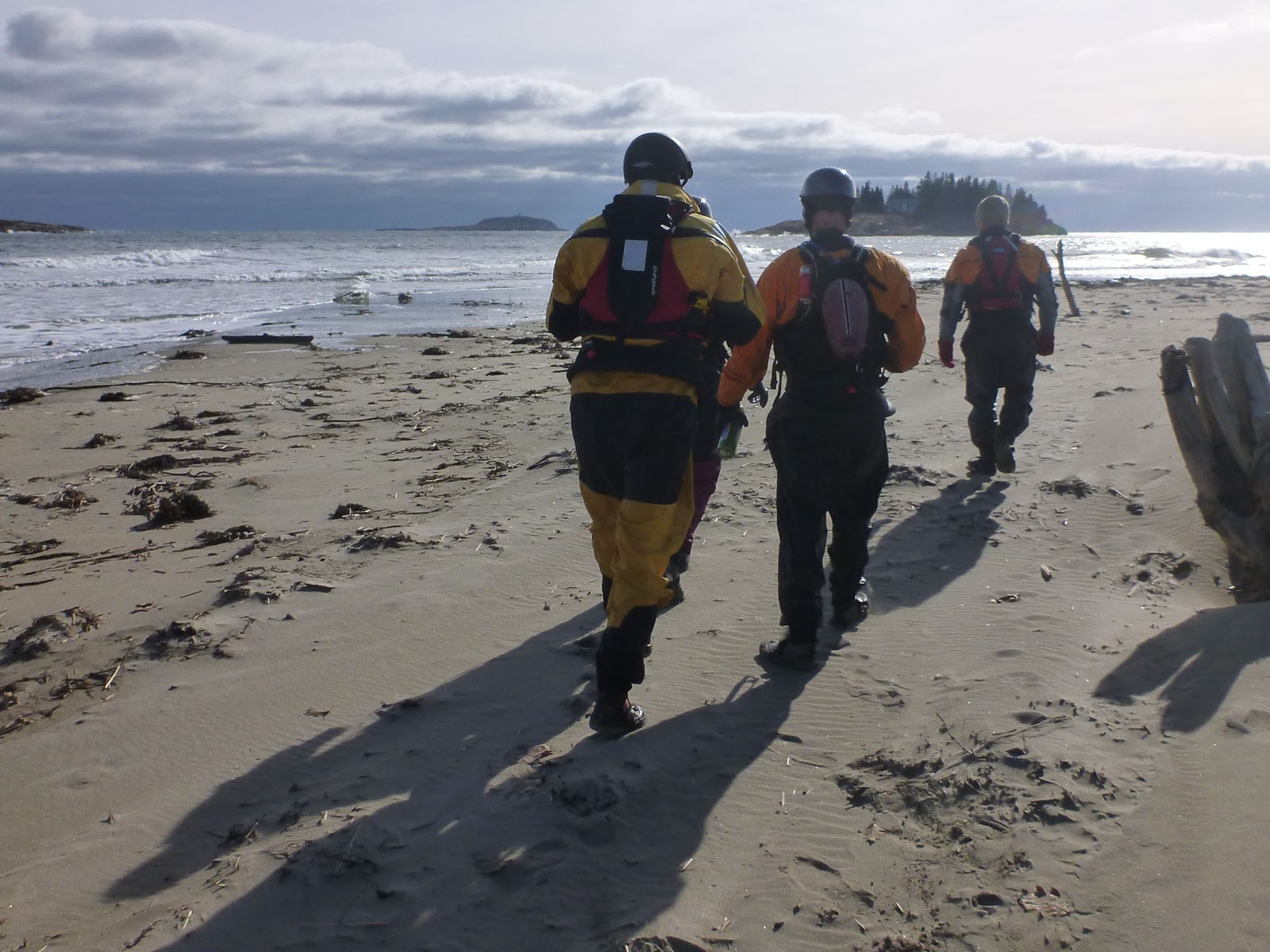
I don’t take action photos at these events anymore, especially when I’m an instructor candidate, so the photos I have are off-water snapshots, but I like the way these photos, over time, have the feel of a family album, bringing together people we run into at these events and paddle with from time to time. I left with an action plan, the crux of which involves spending more time in these L5 environments with students and peers, working on observational skills and translating that to activities.
Despite the bracingly chilly water, it felt great to be paddling in Maine again. I was glad I’d spent plenty of time in the Florida surf this spring, where the water is now about thirty degrees warmer, but aside from awesome paddling, the Maine coast provides us with far more challenging environments than we’ll find most other places, and you need to keep paddling in challenging places if you want to keep your skills sharp.
We’ll be transient for a couple more weeks before we settle-in at Old Quarry for the summer.
Sunday, November 18, 2012
Practice Students
Nate and I were headed south on Route One well before sunrise. A couple of hours later we pulled off at a gas station, puzzling over the map when a car with a familiar kayak on its roof passed by; "There goes Ed." We followed him to the AMC cabin on Knubble Bay, where we met the others- a dozen of us in all. We were there as practice students for several candidates assessing as ACA Level 5 instructors. For the next two days, we would be their guinea pigs.
Sometimes, practice students are referred to as teabags, since getting dipped repeatedly into the ocean is usually part of the drill, but I'm told that various other connotations have brought this term out of favor. Practice students are needed for ACA assessments, and if possible, you want to get real students- not someone just pretending that they've never heard of torso rotation. We've had practice students for Instructor Development Workshops, and I had them for my L3 Instructor assessment. Some were great; others were challenging in the way that any student can bring along their own hurdles. The challenges usually involve ego... not accepting that you might have something to learn from the instructor candidates.
Why be a practice student? The short answer is free instruction. The long answer...
At the AMC cabin, we separated into two groups. Our instructors, Mark and Danny introduced themselves and we got some sense of how the day would go. I'd paddled with both of the other students, Ed and Jenna. Todd Wright would be the assessor that day and would switch with Josh Hall (recipient of the ACA 2012 Excellence in Instruction Award) for Day 2. In a way, I think we all just wanted to get onto the water. Until then, we would be sussing each other out, wondering how skilled the others were, how we would fit in- or if we would be wet, cold and out of our element for the next two days. If I were an L5 candidate, I'd worry that the students are either too skilled and I'd have nothing to teach them, or that they're not proficient enough. Either way, you try to figure out what your students need to learn and how you'll make that happen.
We spent the first day in the mouth of the Kennebec River, practicing in the surf on Popham Beach and in the current out toward the middle. For Level 5 students, the day might involve more coaching than lessons, our instructors observing and getting us to understand how we might paddle better. If you count the assessor, the instructor to student ratio was 1 to 1: not bad.
The next day, we launched in Knubble Bay and used the current around Goose Rocks and Lower Hell Gate. I'd hoped for some rock gardening out at the Thread of Life or Damariscove Island, but conditions looked a bit small. So, while you can't always count on swell and wind, tidal current is fairly dependable, and it's tough to teach L5 skills in L2 conditions. We didn't have a lot of current, but in a way, the mild flow is almost better for coaching.
In addition to working on our personal skills, we watched the candidates to get ideas for our own styles of instruction. Whether it's a warm-up exercise or the subtly different ways we try get concepts across, getting exposure to other teachers is priceless- one of the best ways we can develop our own teaching skills.
And then there's the "just soaking it in" factor. After our first day, we all sat around a long table in the AMC cabin, trading stories, having a laugh or two. I mostly listened, impressed by the camaraderie among paddlers who have been at this for awhile, who, among a revolving cast of characters, show up at these paddling events, whether they're on the East Coast, West Coast, Scotland or Wales, and share their love of the sport. It's not something they're doing to get rich, and it isn't an easy lifestyle, but paddling has obviously pointed the way.
So I soaked it in. I had a good two days. Nate had a good two days. Pleasantly exhausted, we had a lot to talk about during the drive home. We felt fortunate and grateful for a lot of things: that we've had good teachers along the way, that we've found peers to share it with- including our wives who paddle their own boats and make it possible for us to go off on some of these trips.
Labels:
ACA,
instruction,
Kennebec River,
Knubble Bay,
L5,
Lower Hells Gate,
Muscongus to Casco Bay,
Popham Beach
Location:
199 Jewett Rd, Georgetown, ME 04548, USA
Sunday, August 5, 2012
Long-Term Students
![]() |
| Me, Nate, Brian. The Kennebec. Photo: Todd Johnstone-Wright |
![]() |
| Mike. The Thread of Life. Photo: Nate Hanson |
(An example: I look at the photo below and wonder what I'm doing with the paddle, and if maybe my wrist could be straighter- I'm probably just trying to not plow-into Todd).
![]() |
| Todd, Me. The Kennebec. Photo: Nate Hanson |
![]() |
| Sherry, us in the background, mouth of the Kennebec. Photo: Todd Johnstone-Wright |
We gathered Monday evening at a campground in Boothbay and on Tuesday morning drove over to Fort Popham. This was the first time we had paddled together as a group, although most of us had paddled together on different occasions. Before we launched, we all stated what we hoped to get out of our time there. I felt so burnt-out from work, all I could muster was "I wanna have some fun." After all, we were headed to Popham Beach.
![]() |
| Brian. The Thread of Life. Photo: Nate Hanson |
![]() |
| Me, Todd. The Thread of Life. Photo: Nate Hanson |
![]() |
| Me. The Thread of Life. Photo: Todd Johnstone-Wright |
On Wednesday we launched from East Boothbay and headed-out to the Thread of Life and played among the rocks. We found just enough swell to make it interesting.
![]() |
| Nate, The Thread of Life. Photo: Todd Johnstone-Wright |
![]() |
| Mike, The Thread of Life. Photo: Todd Johnstone-Wright |
![]() |
| Joe, The Thread of Life. Photo: Todd Johnstone-Wright |
Friday, June 1, 2012
IDW in Boothbay
I spent the last four days in the Boothbay area, taking part in another ACA Instructor Development Workshop. I did my first IDW a year ago, preparing me to instruct at level 3, and in the fall I assessed and became certified. I plan on teaching for awhile before assessing for level 4, but it was great to start the summer with four days of reinforcing personal paddling skills and teaching methods.
The course was taught by Todd Wright and Carl Ladd, who were joined on our last day by John Carmody.
(click on photos for bigger versions)
Boothbay is near a great variety of paddling environments, so, depending on the weather and conditions and what you hope to do, you could venture out to open ocean islands, rocky ledges or sandy beaches with good surf. We spent our time in tidal rivers, finding a bit more current each day until the last, when we played in the tidal race at the mouth of the Kennebec.
We also paddled on Knubble Bay, Lower Hell Gate and the Sheepscot River. We found calm stretches as well as places where the tide squeezes large volumes of ocean through narrow gaps between islands- good places to teach and be taught, but also just some really nice paddling.
I wasn't there to take pictures, and since we spent plenty of time in the water practicing rescues and such, I have a lot of blurry, water on the lens shots.
I also have pages and pages of notes that I wrote down each evening, trying to make sense of all we'd done. At the beginning of the class we talked about what kind of learners we are, and I half-jokingly said "slow." But I do seem to get things through layers of being taught, experience, and then reflecting upon it. Often enough I wonder why I keep this blog, and in a way I think it's become one layer of the process, forcing me to reflect upon things that might otherwise slip away.
I won't be offering much here in the way of reflection, but as with the trips we take, my kayaking learning process involves at least three stages. There's the anticipation beforehand, in which we prepare, try to get ourselves as ready as we can be. Maybe we brush-up on strokes, or study some of the more academic aspects like tidal or weather prediction or navigation. There's the class itself. It's a mix of fun and hard work. Some of it is instruction and feedback directed at us... and some of it is us directing instruction and feedback to others. Sometimes you get put on the spot and discover that your method needs a little work, or that you don't own the skill or subject as well as you could. Sometimes things go wrong, but it's the perfect time for that to happen. We probably learn the most when things don't go smoothly (like the husky tow in current, when one of the rescuers capsizes and we're all drifting in a tangle of ropes).
Then, after the class, you hope it comes together with the other layers of experience and instruction. We're given an action plan- an inventory of our strengths and weaknesses with suggestions for steps to improve. It can be overwhelming at times. A year ago I came home with a lot to improve, but ideally, every time you go paddling, you find yourself working on it. I can only wonder how, a year from now, I'll look back on what I'm doing now.

Labels:
Boothbay,
Carl Ladd,
instruction,
John Carmody,
Kennebec River,
Popham Beach,
Sheepscott River,
tidal currents,
Todd Wright
Location:
Boothbay, ME 04537, USA
Subscribe to:
Posts (Atom)