Showing posts with label Whitewater. Show all posts

Thursday, June 8, 2017

Whitewater For Sea Paddlers: Class in Vermont


Rebecca and I just spent three days taking a whitewater class in Vermont with Nate Hanson (Pinniped Kayak) and Todd Wright (St.Michaels College Adventure Sports Center) (both of them pictured above). I can still count the number of days I’ve spent whitewater boating on two hands, but I feel like I’m getting the hang of it and enjoying it more each time. 

  
Much of my attraction to taking the class was that I didn’t want to sit through a beginning whitewater class that assumed I would need to learn a lot of skills that I already had. While there may be more emphasis in whitewater on certain skills and strokes, they’re basically the same maneuvers we would do in sea kayaks. With my last blog entry about whitewater for seakayakers, I posted it on some Facebook groups with the question: “do sea kayaking skills transfer to whitewater kayaking?” and a number of people weighed-in with opinions in the Facebook comments. 
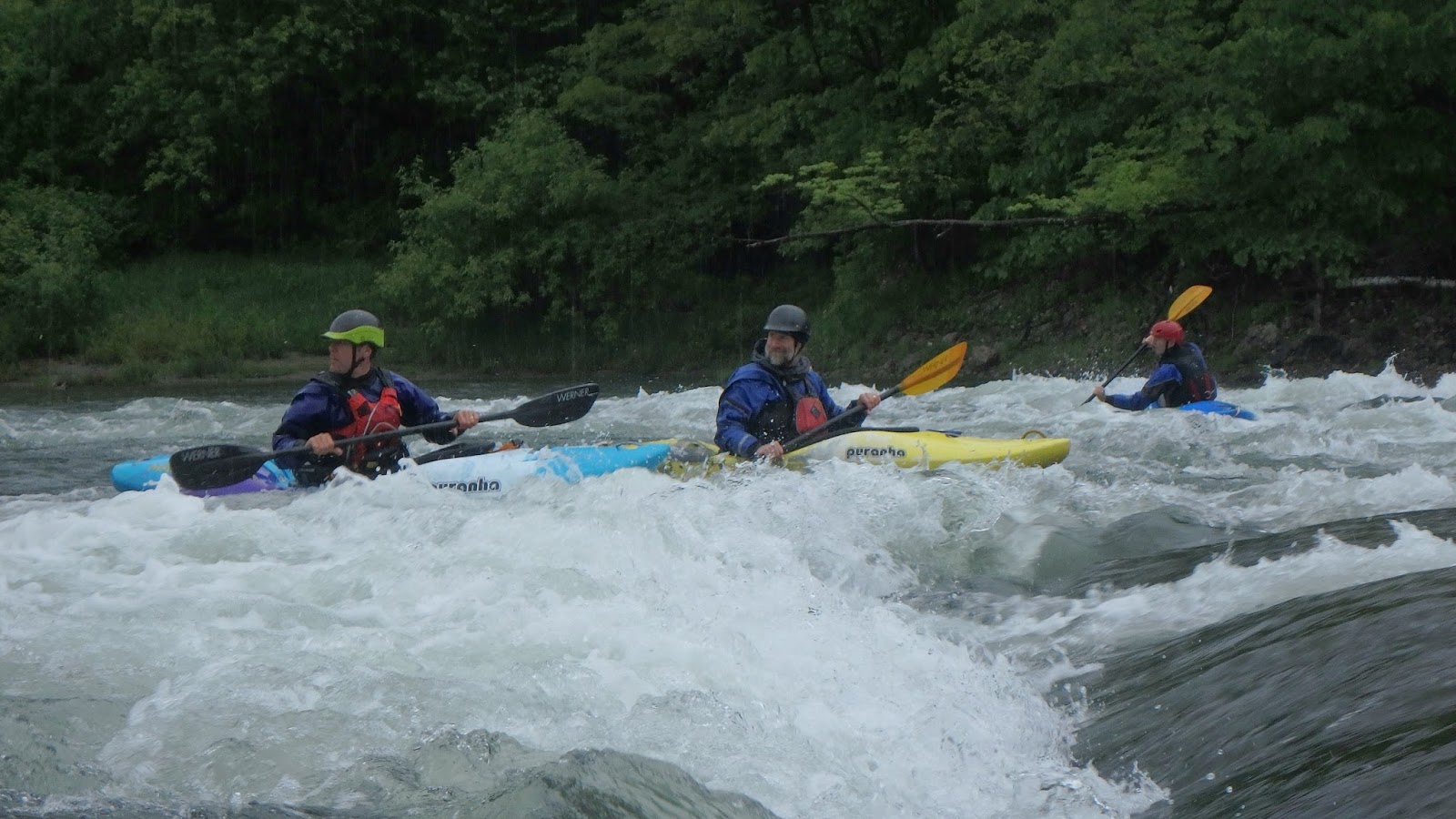

Some of those people had experience in both pursuits – which seems like a good basis for an educated opinion. In general, those with experience in both pursuits felt that skills definitely transferred, and those with a whitewater background tended to assume that sea kayakers might need to learn the basic sorts of skills that we teach sea kayakers during their first lesson. I suppose this says more about our notions about either pursuit than anything else, but after the last three days I can claim with more conviction that both forms of paddling are parts of the same thing: different boat, different environment, but most of what you learn in one boat or environment is going to help you in the other as well. I not only learned about whitewater paddling, but that experience will help refine my sea kayaking skills. 


Everyone in the class had been previously coached in sea kayaks by both Nate and Todd, and in addition had all spent some time paddling in tidal currents like Sullivan Falls, so on the first day- Monday on the Lamoille River, we were able to get out and start having fun right away. 


That day was a ‘park and play’ day, where we used the features in a short stretch to get a feel for the boats, play around on features and experiment with some of the maneuvers we would use in tidal currents, like reading the water, ferrying, surfing, attaining against current and getting efficiently into eddies. 


In the afternoon we worked on safety and group management: rescues, swimming with and without boats and tossing a throw rope to a swimmer. 


One big difference between the two boats is that sea kayaks maintain momentum pretty well. You can take a couple of good strong strokes that will propel you well across an eddy zone. But, while whitewater boats can turn on a dime (which will be super easy if you’re accustomed to turning a sea kayak) they have the momentum of a potato. And you’ll need to use strokes, edging and trim to minimize turning. This took some getting used to.


The next two days we did day-long runs on the White River and the Lamoille. It rained hard for much of Tuesday, so when we returned to the Lamoille for a longer run on Wednesday, the volume of flow had more than tripled. It was my first day paddling a whitewater boat in sunshine, and as far as I can tell it functioned pretty much the same as on a cloudy day. 


By then, we were given a longer leash, striking off on our own to find our own lines and features, and I think we were all beginning to have more of a sense of autonomy, like we might be able to get out and do this on our own and have a sense of what we should or shouldn’t get into. 


Aside from the whitewater-specific experience, as an instructor, it felt great to be a beginner in a class. It helped put me into the shoes of the people I teach and guide, reminding me how it feels to be frustrated when I’m not understanding something, as well as the little victories when I rise to a challenge and maybe have an ‘aha’ moment or two.


It’s also worth mentioning that the part about getting to go down a river amidst some gorgeous scenery is pretty awesome as well. Sometimes you get a stretch of flatwater where you float/paddle downstream and take a breather before the next set of rapids, and in those times I marveled at how sea kayaking had brought me to this beautiful place, via a whitewater kayak. And, as with paddling on the ocean, it brings us to some sublime spots to eat lunch.


I think a lot of sea kayakers who might otherwise enjoy and benefit from river paddling find the thought of it scary because it’s a little mysterious, and what we mostly see of it in media are the more sensational moments, which might involve drops from waterfalls or getting pinned inside a grabby hole. As with all paddling, there’s always risk, but you can still have challenges and minimize the risk, and a good way to do that is to start with a class like this one.

Monday, May 15, 2017

Whitewater for Sea Kayakers: The Union River


-->
When we’re teaching or guiding people in sea kayaks (or to people wanting to rent kayaks) and we inquire about their experience in such boats, we sometimes get a response along the lines of a shoulder shrug and the claim that ‘I’ve done whitewater,’ as if their having once spent some time in a short boat bobbing down a creek trumps anything one might do in a sea kayak. It seems a common attitude, and it would be understandable if the only thing one saw of sea kayakers were the more prevalent species (perhaps best that I don’t describe that at the moment – that could be a whole other post) (And my guess is that if you're reading this, you are not among that species).

 
-->
But the response could mean anything from ‘I pointed it downstream and somehow lived,’ or ‘I’ve learned rescues, refined skills, spent LOTS of time on the water and expect that some of that might apply to sea kayaking as well.’ Usually the former is probably closer to the truth, akin to a skier who manages to get to the bottom of a black diamond run and figures he (sorry- it’s usually a ‘he’) is now an expert. Kind of like hitting your first roll, once upon a time, in a sea kayak.

 
-->
Well, the shoe is on my other foot now; I’m a sea kayaker wondering how my abilities might transfer to whitewater kayaking. And I know that if I told that to most whitewater instructors I’d probably get a fairly obvious eye-roll. I’ve gone whitewater kayaking a few times now, under close supervision of more competent paddlers, and I’ve loved it. And I would say that having good boat handling skills does transfer, especially if you’ve spent some time in tidal currents or surfing, and you’ve rolled enough in those conditions that you tend to come-up rather than swim. (Maybe swimming isn’t a big deal, but it does seem like a bit of a bother, especially when the water is COOLD) (note the extra 'O' - I'm trying to learn the vowel-enhanced lingo).

-->
I did a little whitewater canoeing when I was in high school, mostly on what I would consider guided trips, and then Rebecca and I paddled on our own on some rivers out west (The Colorado, the Rio Grande) on excursions that could only be counted as mishaps in which we were lucky things didn’t get worse. Ah, but you really want to be able to get to those places, deep in the canyons, far into the wilderness, and the rivers are the way to get there. We’re lucky, actually, that those mishaps didn’t turn us off on paddlesports. Those experiences may have actually encouraged us to approach sea kayaking as we have: cautiously, seeking guidance and coaching, building confidence slowly. 


So our approach to whitewater is similar. We’ve wanted instruction, but you know that a beginner class might try our patience. We’ve waited for the opportunity to take a whitewater class aimed at sea kayakers, and in a few weeks we’ll do just that. Nate has been good about getting us out in those short, funny boats as pictured in these shots from a recent run on the Union River in Ellsworth. 


That run is perhaps a bit easier than the Sou, and it allowed us to spend a lot of time just trying to surf the waves, getting more of a feel for how these boats handle. And maybe we’re Nate’s guinea pigs a bit as well, since he’ll be assisting Todd Wright in the upcoming Whitewater for Sea Kayakers class. The class will be June 5-7, and is based in Burlington, Vermont. There may still be spaces left. I’ll admit, hearing the roar of that running water still gets my stomach a little fluttery, but maybe that’s not a bad thing. 


Friday, March 10, 2017

The Sou


Rebecca and I were playing pickleball in Stonington when we got a text from Nate. Did we want to go for a whitewater run on Wednesday with him and Chris? Of course we did. Never mind that I needed to pack to leave Thursday morning to go guide a trip in Georgia. These opportunities don't come every day; you say yes to them.


After a foggy drive, we met in Hampden at the take-out for a run on Souadabscook Stream. The parking area was a sheet of ice, so we parked along the roadside and shuttled up to the put-in in Nate's truck. Fortunately for us, Nate and Chris have an extra boat or two and were happy to outfit and coach us. Of course a lot of the gear - like everything we wore - is the same we would use for sea kayaking. And of course, a lot of the skills overlap as well, especially if you spend some time in tidal currents.


Despite the snowy banks and the sculptural ice formations atop rocks or hanging from flooded trees, the air temps crept up into the high forties, and we were plenty warm. This was my second time in a whitewater boat, and the second time on the Sou (rhymes with 'cow') but Rebecca's first such excursion.


Whitewater can offer a nice counterpoint to sea kayaking. It takes you inland to places we don't get to in sea kayaks, at times when boating on the ocean might be less practical. And although the emphasis seems to be more upon thrill-seeking than journeying, we enjoyed the less-bumpy stretches as well. You just drift downstream and enjoy the ride.


But then there's the bumps, and they're a lot of fun.


I'd like to think I'll be plunging into whitewater boating as I did sea kayaking, but it's not likely, at least anytime soon. I feel lucky when these opportunities come my way, and we would undoubtedly do it more if we invested in our own gear and began taking classes and getting coaching as we did for sea kayaking. But maybe it's knowing what it took to improve my sea kayaking skills that makes me hesitant to spread myself too thin. Maybe it's yet another reason to figure-out how to spend less time working and more time having fun.


As on last year's run down the same stream, I chose to not run Grand Falls at the end. Chris did though.


If you're a sea kayaker and you'd like to give whitewater a try, Nate will be teaming-up with Todd Wright in Vermont for a class meant just for you this June!

I've got a short article in the new issue of Adventure Kayak Magazine about paddling in some of my favorite neighborhoods. Chris (above) appeared in a profile as well. It isn't online yet, so if you don't already subscribe, you might just have to run out and buy it!

I also discovered that Paddling Magazine published a favorable review of AMC's Best Sea Kayaking in New England last summer:


Wednesday, March 16, 2016

Down A Small River In A Very Small Boat

-->

Souadabscook Stream – or simply The Soo, as it is known by some – flows down out of the hills and ponds west of Bangor and empties into the Penobscot River in Hampden, less than twenty miles from where the river widens into Penobscot Bay. In spring, snowmelt swells The Soo with enough water to make it navigable in a small boat, and enough current to turn it into a quick, bumpy ride that descends rapidly over a series of drops as the water rushes toward the Penobscot. I had wanted to try this sort of paddling for a long time, so when my friends invited me to join them on a run down the stream, I instructed my secretary to clear my schedule for the day.


The invitation had included a sunrise foray into Sullivan Falls, which is where Nate had met-up with Chris and Justin, but I figured my first whitewater run would be enough for one day, so I met them at the Irving Station in Hampden, where they were fueling-up on a convenience store breakfast. They said that Sullivan had been particularly big, and cold.


We caravanned up to the take-out, where we scouted Great Falls – the final and biggest drop on the run - from the road. It looked and sounded pretty big to me, what Chris said passes (in the Midcoast area) as a Class 4 drop… not that this information meant anything to me. We left two vehicles there and crammed into Nate’s truck to get to the put-in. 


Fortunately, there’s a lot about padding a whitewater boat that crosses-over with sea kayaking. We wear a lot of the same gear, and the boat handling skills are similar. Chris leant me one of his fleet of Jackson boats, as well as a short, wide-bladed paddle with a 45-degree feather. The sprayskirt was so tight I couldn’t get it on by myself, so my first impressions were of much less control and confidence than I normally have in a kayak (not a bad thing to experience, since I’m usually guiding and teaching others with a similar feeling). But I got onto the water and played around a small wave, getting a feel for it, planting the blade close to the boat to avoid bobbing back and forth too much, experimenting with basic maneuvers. And we headed downstream.


When you watch people in whitewater boats bobbing down a series of drops, going with the flow, it can be difficult to tell how much of it is their maneuvering the boat, and how much they are just drifting along, getting pulled by the current. My guess is that some paddlers – the best ones – do plenty of maneuvering, while others could almost be passively riding in an inner tube. Most paddlers are probably somewhere in between, but they could all be going down the same river with the same end result – getting from the put-in to the take-out, hopefully in one piece.


We descended a series of drops – small waterfalls – and I got a feel for the boat, sometimes going back to surf on a wave and just to get comfortable, going back and forth in the current. The skill might come into play above the drop, getting yourself into position so that you’ll hit it at the right angle and get pulled into the desired flow. Beyond that, for me anyway, it was then more a matter of hanging-on, getting ready to brace, and continuing to propel myself forward to avoid getting pulled back into the holes that reside beneath some of these drops. It felt good to hit it right, to get buoyed along and feel the boat drop beneath you and the slap of cold fresh water on the face, and then to turn sharply into the eddy where the others were waiting and cheering me on, often looking at me curiously, wondering how it felt to me, if I was hooked. Yes, I was hooked.

 
We came, finally, to Great Falls, which we’d scouted from the road. Great Falls is more of a proper waterfall, not quite vertical, but steep, descending down a stair-like series of drops, only the middle stair is maybe 6 or 8 feet tall with a curving rooster tail of a wave at the bottom. The roar of the falling water gives you a sense of its power, and you know that if you screw-up here, you might get stuck down there in that hole. The other guys talked about what line to take, but I knew right away that mine was to stand to the side and take pictures while they did it. I’d felt good about everything so far, but I knew I didn’t have the moves to do this properly. One could certainly float right over it and get lucky- in the way a novice skier might get to the bottom of a steep run, but I’d like to have a little confidence in my abilities rather than in my luck.

 
The others made it look easy. They approached, found the right spot with the right angle and bounced right down it. I dragged my boat through the woods and joined them at the bottom. The take out lay just around the next bend.