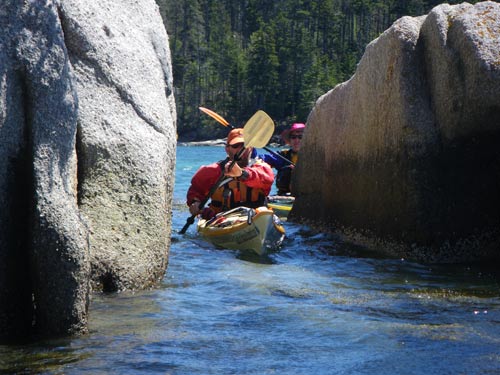
I’m paddling beside Todd and Nate along the steep, rocky east shore of Damariscove Island, heading south into the wind and waves. We’ve been staying uncharacteristically far from the rocks, trying to stick close together. The wind and surf hiss and grumble- a constant backdrop of chaotic noise.
Todd, in charge of the group for this leg of our journey, frequently motions for the others to pull in a bit closer, unsure if maybe one of our instructors has put them up to something. Then we notice the other Todd - Todd Wright, our instructor trainer, putting on his helmet. We give each other an enquiring look; what could this mean? At the very least, it seems like a good time for everyone else to pause and put their helmets on too. Sure enough, Wright soon paddles into a turbulent rocky cleft and capsizes. He ends up floating in the water beside his boat, with waves bearing down on him.

This is the last of four days of instruction, intended to put us on the path toward attaining American Canoe Association (ACA) instructor certification. We started the week by driving down to Popham Beach on Monday for some time on our own in the surf. I felt a little tense until that first capsize in the waves. Suddenly you’re upside down, getting pummeled with no idea which way is which... except your paddle finds its way to the surface and then you’re up, bracing into the next wave, paddling back out for more. Seawater drips from your nose and ears. A little trial by fire and confidence-building was a good way to start, since the next four days would be humbling.

On Tuesday, in the calm, tidal water at our campground near Boothbay Harbor, we spent hours going over strokes. The focus was not to be dogmatic- fitting into one way of doing things, but to consider core principals of efficient, effective and safe paddling and analyze how our strokes worked or didn’t work. It would be tough to say that a little dogma doesn’t creep into the process; after all, there is a right and a wrong way. Previously, we all thought we put plenty of torso rotation into our forward strokes. Not so. I switched to a high-angle paddle, and, after a little coaching, found my new forward stroke (that I will be indefinitely refining).

At the same time, we looked at ways of teaching, taking turns at various lessons. Each time, we gave feedback to the presenter and then our instructors showed us ways to better involve the students. In addition to instructors Todd Wright and Peter Casson, we were joined that day by John Carmody (check-out this photo of him in the current Canoe & Kayak Magazine) who we’ve all taken instruction from before. One other student, Brian, joined us from Vermont.

As the week went on, we gradually took on more challenging conditions. On Wednesday we launched from East Boothbay and paddled out around the ledges at The Thread of Life. For Thursday and Friday we were joined by Anna and Tully, students from St. Michael’s College, who could be our “guinea pigs”. Thursday we were at Popham, learning how to launch beginners into baby waves, then practicing rescues out in the tide rips on the Kennebec. We did plenty of rescues and towing. The lessons never stopped.
On Friday, against a strong breeze, we headed out to Damariscove Island. There’s plenty to say about the place- the history and its stark wildness, several miles out to sea, but for us, the island was another paddling exercise- a place to navigate to, to tow people pretending to be seasick to, and to get around as a group.

After he capsizes, Wright hangs onto his boat and waits for help. Todd D directs the rest of the group to point into the wind and wait, then from a safe distance, directs the rescue. Nate is right there, instructing Wright to flip his boat over and push it out. While Nate pulls the boat over his deck, draining the water, Wright is told to swim out, using his paddle to propel himself out of the impact zone to the bow of Brian’s boat. As Wright continues to kick, Brian backs away to Nate, who has Wright’s boat ready. Nate is drifting close to the rocks though, so Todd moves in, clips on and starts towing as they get the swimmer back into his boat.
The crowd goes wild!

On the drive home, we’re all feeling pretty exhausted- and maybe even a bit disheartened to discover, once again, that we have much work to do. We are undoubtedly more knowledgeable and prepared than we were on the drive down, but as always, we can use more refinement and practice.
Thanks to Nate Hanson for the photos.
On a sad note, a sea kayaker died yesterday off Hancock Point. From this article in the Bangor Daily News, it looks like a familiar story: an "open-cockpit" kayak (whatever that means) and strong offshore winds.
Follow-up on the Hancock Point accident here in the Bangor Daily News.